

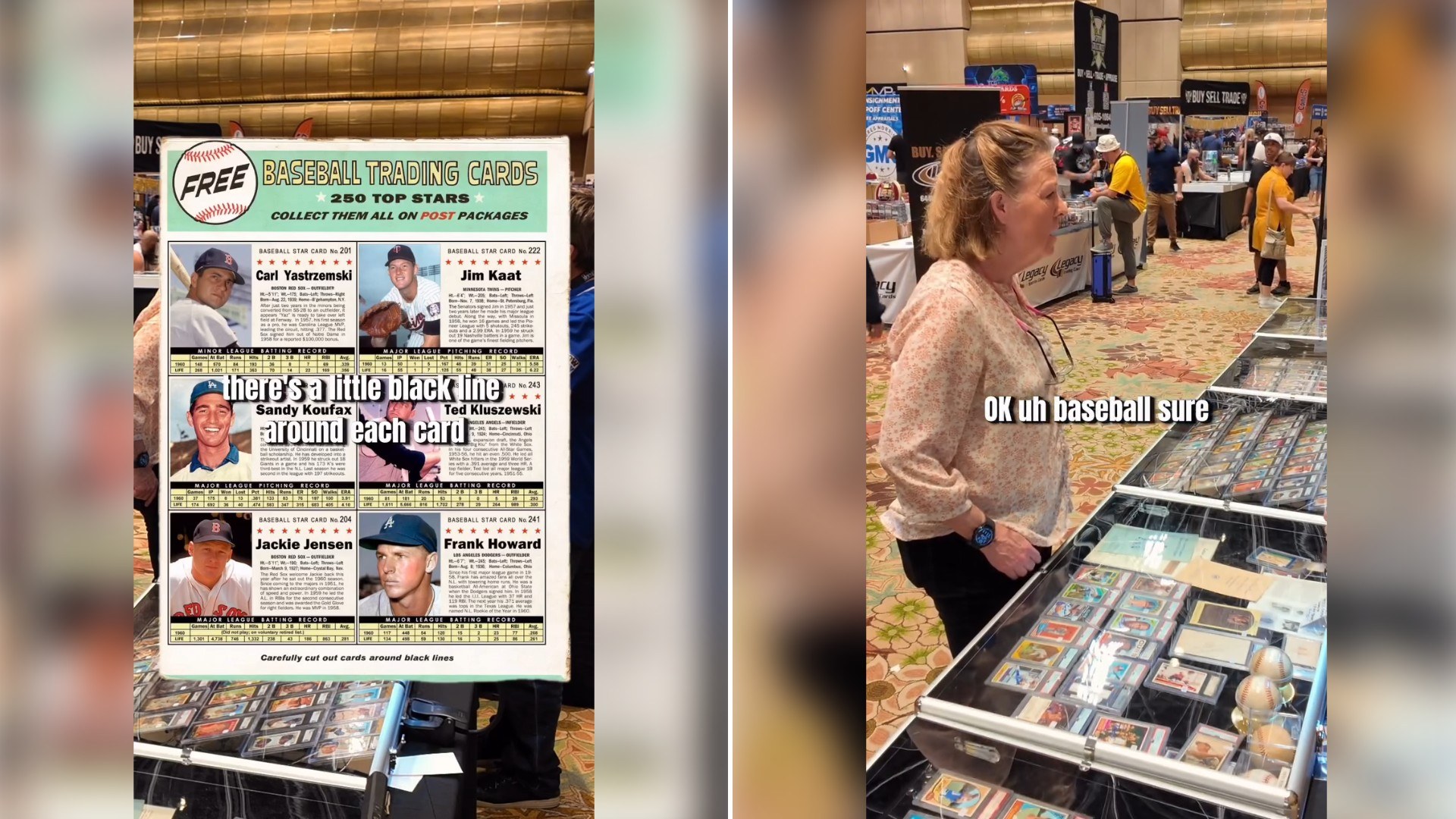
Card shows have always doubled as informal appraisal counters, and that is the role @frontrowdan steps into in a video filmed at one such event, sitting down with a stranger who is weighing whether to sell a set of vintage cereal-box promotional baseball cards passed down through the family. As a longtime sports card dealer, he walks through the collection item by item, explaining on camera exactly which factors determine what each piece is actually worth.
Cereal-box baseball cards, inserted into cereal packaging as a marketing tie-in throughout the twentieth century, occupy a specific, somewhat overlooked niche within sports card collecting. Because they were distributed as a promotional bonus rather than sold as a dedicated product, condition and completeness vary wildly, and a dealer’s trained eye can spot details, printing quirks, specific issue years, player significance, that an untrained owner would have no way of knowing to look for.
That gap between what a family assumes an old collection is worth and what it is actually worth is one of the most consistent storylines in the sports memorabilia world, and it is exactly why videos like this one resonate with such a wide audience beyond dedicated collectors. Everyone either has, or knows someone who has, a box of old cards sitting untouched in a closet with no real sense of whether it is worth a few dollars or a few thousand.
For the stranger in this video, the conversation is clearly personal as much as financial, a decision tied up in family history rather than a simple transaction, and the dealer’s patient, item by item approach treats it that way, walking through the reasoning rather than just naming a number.
Card shows themselves occupy an interesting space within the broader collectibles economy, functioning simultaneously as a marketplace, a social gathering, and, as this video demonstrates, a kind of informal clinic where strangers can get real answers about items they have wondered about for years without ever committing to a formal appraisal. That accessibility is part of what makes shows like this one valuable well beyond the booths actively buying and selling.
The specific category of cereal-box cards also highlights something true about promotional collectibles more broadly: items given away for free at the time of release often end up, decades later, rarer and more sought-after than cards that were originally sold as a dedicated product, precisely because fewer people thought to preserve something that arrived, almost incidentally, inside a box of cereal rather than a purpose-built pack. Survivorship becomes the whole story, since most of what was printed simply did not make it this far in good condition.
There is also something worth noting about the emotional weight a dealer has to navigate in a conversation like this one. Appraising an item is one thing, but appraising an item that clearly carries family history, something inherited rather than purchased, requires a different kind of sensitivity than a straightforward transaction at a booth. The dealer’s calm, methodical walk-through in this video reflects an awareness that he is not just naming numbers, he is helping someone make sense of an inheritance.
That tension between sentimental and financial value shows up constantly across every category of collecting, not just sports cards. A thrifted quilt, a box of old vinyl, a drawer of inherited jewelry, all carry the same basic dilemma: how do you weigh what something is worth to a stranger against what it means, or meant, to the person who kept it in the first place. A good dealer, appraiser, or collector learns to hold both truths at once rather than dismissing either.
For the broader audience watching a video like this rather than sitting across the table themselves, there is also a practical education happening in real time, since the specific details a dealer points out, printing era, condition markers, player relevance, are exactly the kind of knowledge that takes years to build up through experience alone. Watching someone else’s collection get broken down item by item is, in a sense, a free crash course for anyone hoping to evaluate their own boxes more confidently in the future.
It is also worth pointing out how much this kind of video does for the reputation of card shows generally, which can sometimes get unfairly stereotyped as insular spaces meant only for serious buyers and sellers. A dealer willing to sit down with a total stranger, walk through an inherited collection with patience, and treat the conversation as worth having regardless of whether a sale ever happens is exactly the kind of interaction that keeps these events feeling approachable to people who might otherwise never bother attending one.
For anyone sitting on an old family card collection of their own, the lesson from a breakdown like this one is straightforward: a proper appraisal from someone who actually knows the category can surface value that would otherwise stay invisible, and that knowledge is worth seeking out before a box like this ever gets sold, donated, or thrown away.
There is a broader lesson here too for anyone who has ever hesitated to get an old collection looked at simply because they assumed it was probably worthless. The cost of finding out is usually low, a quick conversation at a show or with a reputable dealer, while the cost of never finding out can mean selling, donating, or discarding something with real value attached, without ever knowing what was actually lost in the process.
Whatever the stranger ultimately decides to do with the collection, the conversation itself has already done something valuable, turning a box that sat untouched for years into a set of cards whose story, and worth, is finally understood.

Leave a Reply