

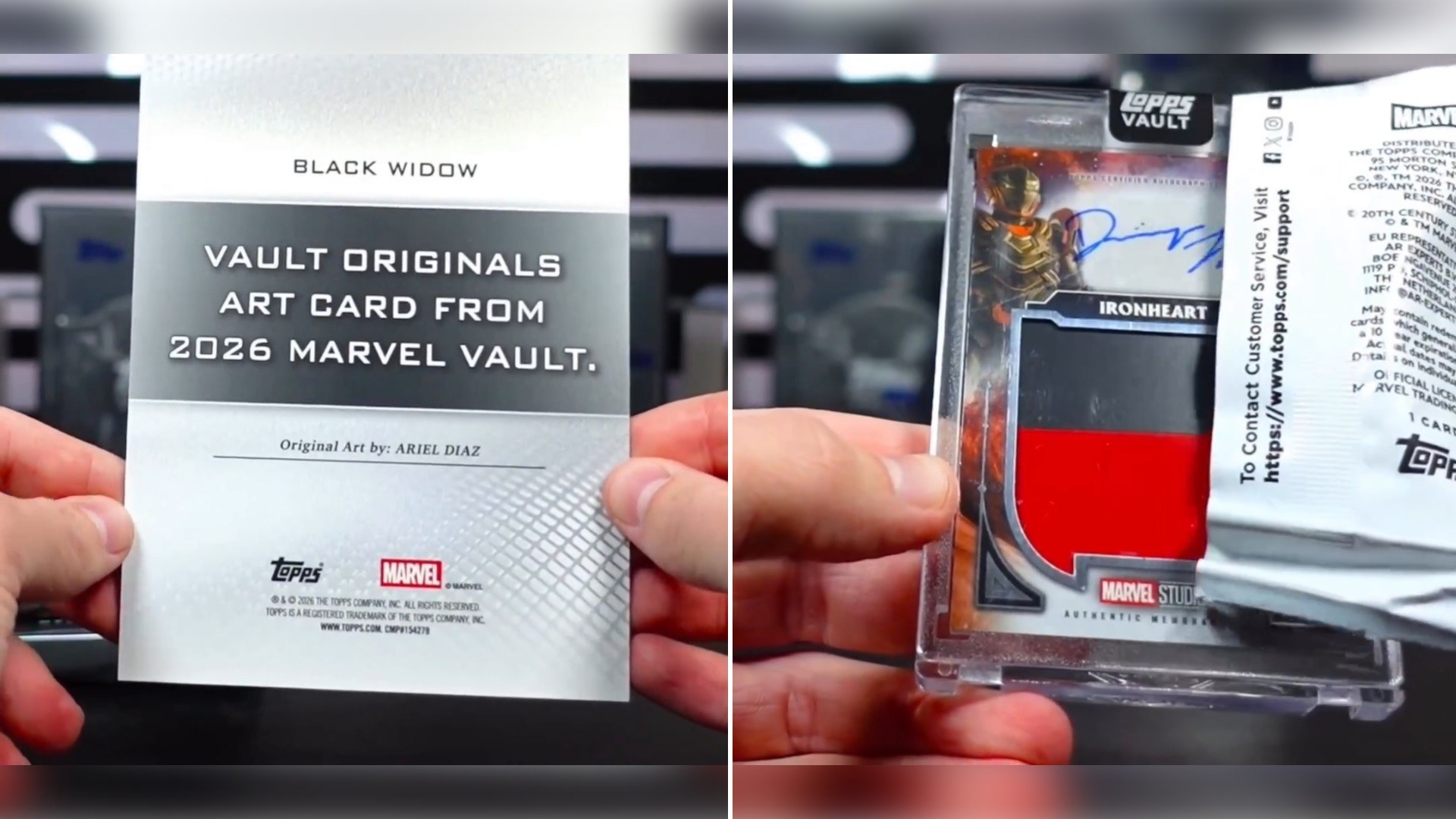
A sealed box hitting a desk always carries a certain weight in trading card content, and that is exactly the moment @synthcitycollectibles builds around in a video showing a high-end box of Topps Marvel Vault cards being purchased in store, then opened live at a desk setup back home. Worth noting upfront, though: synthcitycollectibles is not simply an individual treating themselves to a one-off collector’s splurge. The account’s own caption describes a semi-commercial card-breaking operation, complete with a community of regular collectors and nightly live-breaking streams hosted on Whatnot, which makes this box opening less a personal indulgence and more a glimpse into how that kind of breaking business actually operates behind the scenes.
Card breaking, where a seller opens sealed product on camera for an audience, often live, has grown into a genuine corner of the collectibles economy over the past several years, and Topps Marvel Vault sits squarely in the kind of premium product that breaking communities are built around. Each pack in the box carries real odds at a rare hit, and the tension of watching those odds play out card by card is exactly what keeps a breaking community coming back night after night.
Seen through that lens, the video works as a kind of preview or highlight reel for the business itself, a condensed version of the live-breaking format designed to pull new viewers toward the regular streams rather than a single, isolated moment of personal excitement. That is not a criticism of the content so much as useful context, since breaking operations rely heavily on exactly this kind of short-form teaser to build an audience for their longer live sessions.
The breaking model itself is worth explaining for anyone unfamiliar with how it works: rather than one person keeping everything pulled from a box, a break typically sells individual spots to a group of participants ahead of time, tied to specific teams, characters, or card slots within the product, and then opens the box live so everyone can see in real time whether their spot paid off. It is part group-buy, part lottery, part entertainment, and the format has thrived specifically because it turns what would otherwise be a solitary hobby into a shared, social event with real stakes for everyone watching.
That social structure is a big part of why nightly streaming has become such a sustainable model for accounts built around breaking. A single unboxing video captures a viewer’s attention once, but a recurring schedule builds the kind of habitual audience that a business actually needs to survive, turning casual viewers into regulars who show up specifically because they know a new break is coming and want a shot at a spot in it.
Topps Marvel Vault specifically occupies a premium tier within Marvel-licensed cards, the kind of product priced and packaged for collectors who already understand the odds and are buying in anyway for the thrill of the chase, the social experience of a live break, or both at once. A breaking operation built around that kind of product is, in effect, selling access to the exact feeling this video captures: the anticipation before a box is opened, magnified by the knowledge that real value is on the line.
For collectors newer to the hobby, understanding the difference between a hobbyist’s personal unboxing and a breaking business’s promotional clip matters, since the incentives behind each are genuinely different even when the on-camera excitement looks similar. Both can be entertaining, but only one is functioning as an actual storefront.
It is worth noting, too, that the rise of breaking communities has changed how a lot of casual fans first encounter the trading card hobby at all. Rather than walking into a hobby shop and buying a single pack on a whim, a growing number of newer collectors get their start by buying into a break, watching a stream, and only later graduating to sourcing and opening sealed product entirely on their own. Short clips like this one function as an on-ramp for exactly that pipeline, turning a casual scroll into a potential new regular for a nightly stream.
There is also an interesting parallel here to how other secondhand and collecting markets have professionalized over time. The same evolution that turned casual vintage reselling into full-blown curated storefronts, or turned garage-sale flipping into an organized picking-and-reselling trade, is playing out in trading cards through the rise of breaking. What used to be a purely private hobby, one person quietly opening packs at home, has become an entire small-business category with its own recurring customers, its own scheduling rhythm, and its own promotional content strategy, of which a clip like this one is a small but telling example.
That professionalization does not necessarily take anything away from the pure enjoyment of the moment, though. Even inside a business model, the box still has to actually be opened, the cards still have to actually turn up, and the reaction still has to be real, or a breaking community stops trusting the person running it almost immediately. In that sense, authenticity is not just a nice quality to have in this corner of the hobby; it is the entire foundation the business depends on to keep collectors coming back night after night.
What does carry over regardless of the business model is the underlying appeal of the format itself: sealed product, real odds, and the unscripted reaction of someone finding out, card by card, exactly what they got.
Whether viewed as a personal splurge or a piece of business promotion, the moment still lands the way it was built to, proof that the basic emotional mechanics of pack opening do not change just because there is a storefront attached to them.

Leave a Reply