

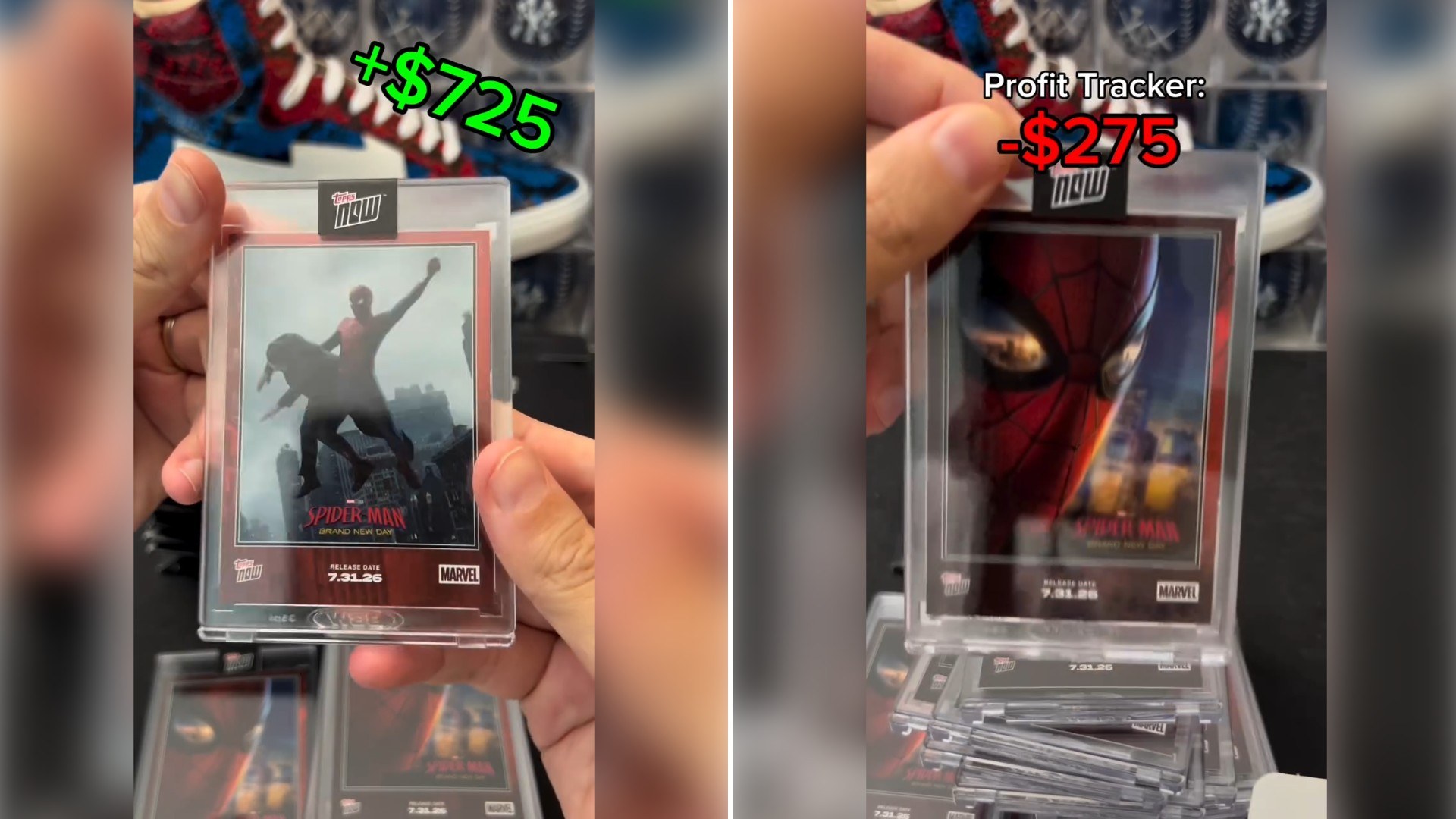
Trading card collecting has always had a documentary streak to it, people tracking their own progress the way athletes log training, and @mommasbasementcards has turned that instinct into an ongoing, self-imposed challenge. In the latest entry, marked Day 23 of an attempt to build toward one hundred thousand dollars through trading cards, she tears through an entire run of Marvel-themed packs back to back, tracking an on-screen tally as she goes, all in pursuit of a valuable Spider-Man pull.
The video leans into the grind as much as the payoff. Pack after pack gets ripped open in quick succession, most yielding nothing especially notable, which is exactly the rhythm that makes the hobby feel real rather than staged. When a pull finally does land close to the Spider-Man card she is chasing, the suspense that has been building across the entire run snaps into a genuine reaction.
Framing a hobby as a long-running numbered challenge, rather than a single video’s worth of content, is an increasingly common approach among card collectors online, and it mirrors how the hobby actually works day to day. Building real value through trading cards rarely comes from one lucky pack; it comes from repetition, budget discipline, and a willingness to sit through plenty of ordinary pulls while waiting for the one that matters.
Marvel-branded trading cards in particular have seen renewed collector interest as the franchise’s characters remain dominant across film and television, keeping demand steady for key rookie-era and rare parallel cards featuring characters like Spider-Man. That sustained demand is part of what makes a public, numbered challenge like this one resonate with an audience beyond just card collectors, since viewers can track the running math alongside her and understand exactly what a good pull would be worth.
What makes the Day 23 framing so effective is that it turns an inherently repetitive activity into something with narrative momentum. A single unboxing video lives or dies on the strength of one pull, but a numbered series invites viewers to follow along the way they would a season of a show, checking in to see how the running total has moved since the last installment. That structure rewards consistency over flash, which is a subtle but important shift in how trading card content gets made and watched.
There is also a transparency to this kind of content that sets it apart from a lot of collecting media. By tracking a visible dollar goal on screen, she is inviting viewers to do the math themselves, to see exactly how many packs it took to get meaningfully closer to six figures, and to judge for themselves whether the math is working in her favor. That openness is rare in a hobby where actual profit and loss numbers are often kept private, either out of superstition or simple reluctance to admit when a run of packs did not pay off.
The grind itself, dozens of ordinary pulls stacked between the rare hits, is also doing real work here, even if it looks like filler at first glance. Anyone who has spent real money on packs knows that the ordinary pulls vastly outnumber the valuable ones, and a video willing to actually show that ratio rather than editing straight to the good part earns a different kind of trust from an audience that has learned to be skeptical of unboxings that seem to hit big every single time.
Spider-Man cards specifically have held a particular gravity within Marvel collecting for decades, buoyed by a character whose mainstream visibility rarely dips, unlike heroes who cycle in and out of the cultural spotlight depending on the latest film slate. That consistency makes Spider-Man pulls a dependable target for a challenge built around measurable value, since the character’s demand curve tends to hold steady in a way that more niche characters simply cannot match.
It is also worth noting how much patience a challenge like this actually requires off camera, far more than the finished video ever fully conveys. Sourcing enough product to justify a Day 23 milestone, keeping a running tally accurate, and staying motivated through the inevitable stretches where nothing valuable turns up are all quieter forms of discipline that rarely get credit compared to the excitement of a big reveal, but they are exactly what separates a serious long-term collector from someone chasing a single viral moment.
The rise of this kind of goal-tracking content also says something about how the trading card hobby has matured as an online community. A decade ago, most card content online amounted to isolated unboxing clips with little connective thread between them. Now, series like this one function almost like a running ledger, giving longtime followers a sense of investment in someone else’s collecting journey the same way they might follow a stock picker’s trades or a renovator’s house flip, checking back in specifically to see how the numbers have moved.
There is a financial literacy angle buried in here too, whether or not that is the intent. Watching someone methodically track pack cost against pull value, pack after pack, day after day, gives casual viewers a far more honest picture of the economics of the hobby than a single highlight reel of nothing but hits ever could. It is, in its own way, a useful corrective to the more curated corners of collecting content that only ever show the wins.
That honesty is also what makes the occasional big pull land so much harder. When a viewer has just watched a dozen unremarkable packs get opened in a row, the moment a genuinely valuable card finally turns up carries real weight, precisely because the video did not rush to get there. Patience, on both sides of the camera, ends up being the quiet engine that makes this whole format work.
For collectors considering a similar approach, documenting a long-term goal publicly carries its own kind of accountability, turning what could be an expensive private habit into something more structured, more visible, and ultimately more motivating to see through pack by pack.
Whether Day 23 ends up marking real progress toward that hundred-thousand-dollar target or just another entry in a much longer run, the format itself has already proven its staying power, turning what could be a one-off unboxing into an ongoing story that viewers have a reason to keep following.

Leave a Reply