

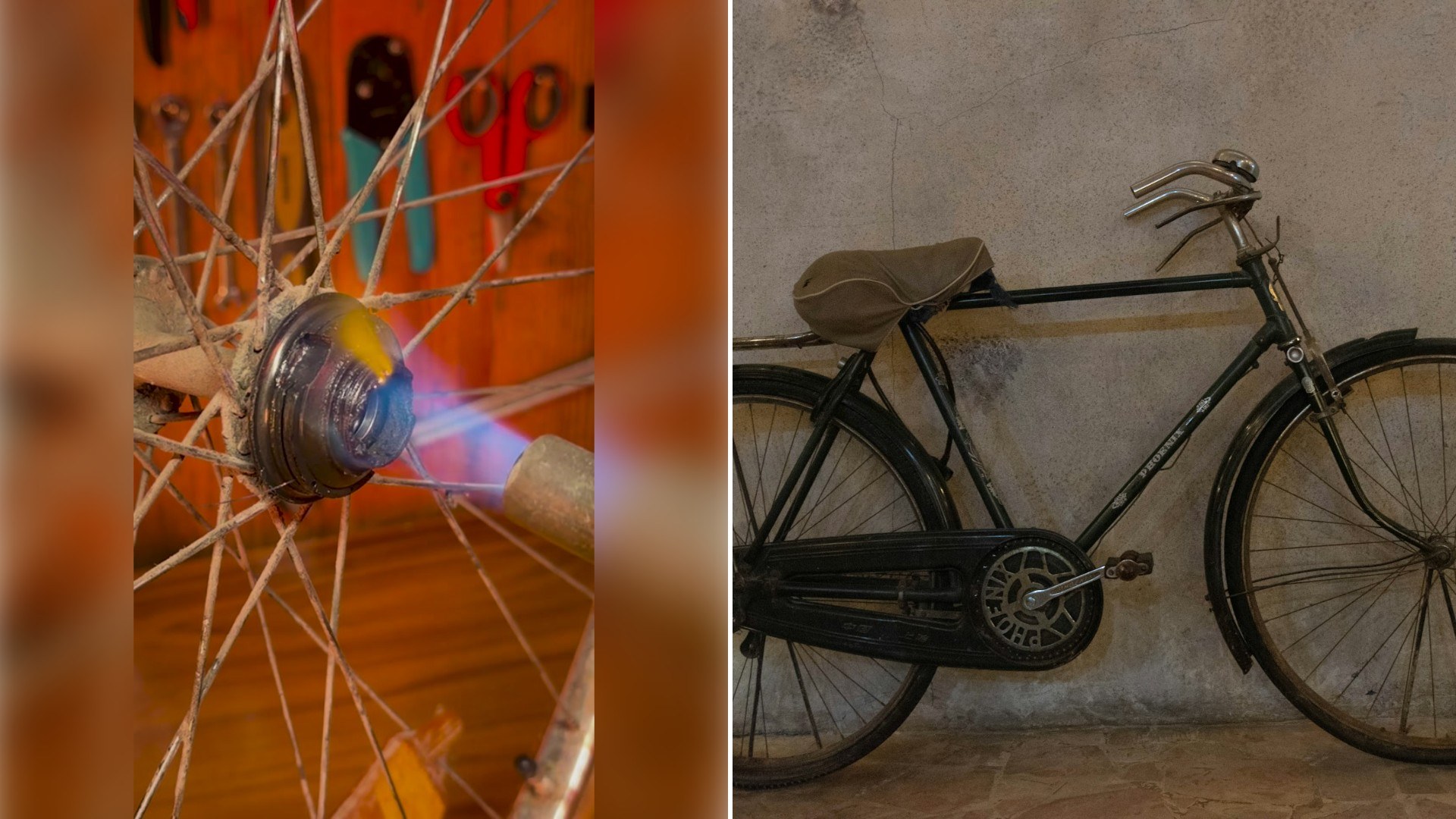
Some restorations are about fixing what is broken, and others are about uncovering what was there all along, and the latest project from @bike_muenchen falls firmly into the second category. Working through a fast paced cleaning montage, the creator sets out to strip decades of built up grime from a 1950 Cinelli bicycle frame and its components, a vintage Italian bike whose original craftsmanship had been buried under years of accumulated dirt and neglect.
Using brushes and degreaser, the process moves quickly on screen, each pass removing another layer of grime and slowly revealing the frame and components underneath, until the true condition of the bike begins to show through for the first time in who knows how many years. That reveal is the entire emotional core of the video, the moment where a dull, dirty object suddenly starts to look like the finely crafted piece of Italian cycling history it actually is underneath everything covering it up.

@bike_muenchen
Cinelli, founded in Milan in the years after the Second World War, quickly became one of the most respected names in Italian cycling, known for frames that combined careful engineering with genuine aesthetic craftsmanship at a time when bicycles were as much a statement of national manufacturing pride as they were practical transportation. A 1950 example represents some of the earliest output from a brand that would go on to define an entire era of competitive and enthusiast cycling, which makes uncovering its original details underneath decades of grime feel like uncovering a small piece of design history.
Vintage bicycle restoration has grown into a genuinely dedicated hobbyist community over the past decade, driven partly by renewed interest in classic Italian and European frame builders and partly by a broader appreciation for the kind of hand-finished manufacturing that largely disappeared from mass-market bicycle production once mass manufacturing techniques took over the industry. Restorers in this space often treat their work less like simple cleaning and more like a form of historical preservation, carefully avoiding methods that might damage original paint or decals in pursuit of a quicker shine.
That care is part of what makes fast paced cleaning montages like this one deceptively complex despite how effortless they can look on screen. Choosing the wrong degreaser or scrubbing too aggressively on original paint or decals can permanently damage details that took decades to develop the specific patina collectors actually value, meaning restorers have to balance the satisfying visual progress of a cleaning montage against the very real risk of erasing the history they are trying to reveal in the first place.
For anyone drawn to vintage bicycle restoration after watching a transformation like this one, experienced restorers generally recommend starting with gentle, non-abrasive cleaning methods and only escalating to stronger degreasers or tools if a milder approach fails to make progress, since original finishes on frames this old are often more fragile than they appear. Researching the specific manufacturer and era of a frame before starting any cleaning is also considered essential, since a builder like Cinelli used particular paint processes and materials that respond differently to cleaning agents than a more generic mid-century bicycle might.
Beyond the technical process, restorations like this one tap into a growing cultural appreciation for objects built to be repaired and revived rather than replaced. A bicycle frame built in 1950 by a manufacturer as respected as Cinelli was made to be ridden and maintained for decades, and the fact that one can still be brought back to a presentable, functional state seventy-five years later says as much about the quality of the original craftsmanship as it does about the patience of the person willing to put in the work to uncover it again.
It is also a reminder of how much value can hide underneath simple neglect rather than genuine damage. A frame that looks beyond saving under a decade of grime can turn out to be almost pristine once properly cleaned, which is exactly why patient restorers are often rewarded for giving an unpromising-looking bike a real chance before assuming it belongs in a scrap pile instead of back on the road.
There is also something meaningful about how visible the restoration process itself becomes once shared this way, giving viewers who will never personally own a vintage Cinelli a genuine appreciation for the labor behind preserving pieces like it, rather than only ever encountering the finished, polished result without any sense of what it took to get there.
For anyone who owns an old bike languishing in a garage under a similar layer of grime, this kind of transformation is a good argument for giving it a proper, patient cleaning before assuming it is only fit for the scrap pile, since the frame’s true condition often cannot be judged accurately until the surface dirt is finally gone.
That same principle holds true across nearly every category of vintage restoration, where the biggest transformations often come not from replacing anything at all but simply from removing the years of buildup that were hiding the original object the entire time.
In the end, the frame’s true colors were there the entire time, simply waiting for someone patient enough to actually go looking for them underneath the grime.

Leave a Reply