

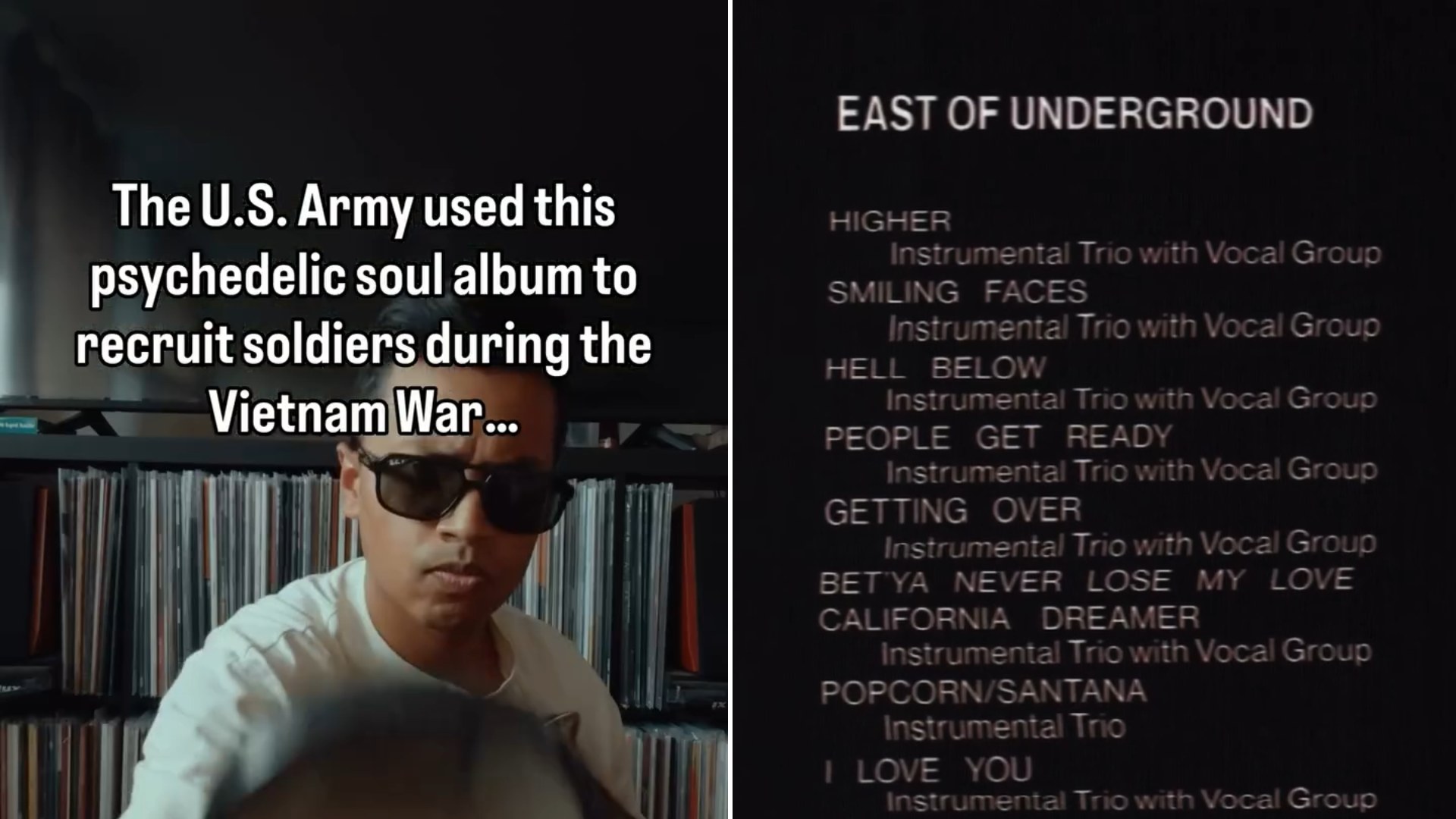
Fewer than a dozen copies of the original vinyl are known to still exist, and record collector @thebengalpetshop found one anyway. His video shows a handheld scanner sweeping across the album cover for “East of Underground” while the actual recording plays underneath, and his voiceover lays out the backstory in a single striking line: “The U.S. Army used this psychedelic soul album to recruit soldiers during the Vietnam War.” The clip drew 168,800 views, nearly 16 times his account’s usual reach, from an audience that clearly had never heard of the record before.
Soldiers, not session musicians
A scanner sweeping over an album cover is a small gesture. What it reveals here is anything but.
The story behind the album is stranger than most vinyl origin stories, mostly because the band members were not professional musicians moonlighting for the military. They were active-duty American soldiers stationed in West Germany, competing in a U.S. Army talent competition that band leadership actually used as a recruitment and morale tool, according to The Arts Desk. That outlet reports the group recorded its self-titled album in 1971, emerging from the winningly titled Original Magnificent Special Services Entertainment Showband Contest, and that for at least some of the musicians involved, joining a showband was also a documented way of avoiding deployment to Vietnam itself. The music leans into raw, unpolished funk and psychedelic soul, described by The Arts Desk as channeling Sly and the Family Stone and Santana with what the outlet calls “ragged glory.”
None of that backstory is printed anywhere on the sleeve. It lives entirely in the record’s context, in who made it, why they made it, and what the military got out of letting them. A talent contest built to entertain troops abroad ended up doubling as a recruitment showcase, and the fact that it also produced music worth preserving fifty years later was, by most accounts, closer to a happy accident than the point of the exercise.
Why so few copies survive
Rarity on its own rarely makes a record worth chasing. Rarity paired with a story this specific is a different matter entirely.
The same source that documented the album’s origin also confirms just how scarce original pressings have become, noting that surviving copies of the original vinyl exist only in the low double digits worldwide. That kind of rarity usually belongs to records nobody wanted in the first place, small pressings that flopped and got tossed. This one is different. It survived in tiny numbers not because it was forgettable, but because it was made under military circumstances that never anticipated wide public distribution or long-term preservation. A reissue eventually made the music available more broadly, but an original 1971 pressing, the kind @thebengalpetshop is holding in his hands, remains a genuine grail for collectors of both soul music and military history alike.
That dual appeal, Vietnam-era history collectors on one side and rare psychedelic soul collectors on the other, is likely part of why the video traveled so far outside the usual record-collecting corner of the internet. A find like this rarely stays confined to one niche audience for long, because it hands both crowds something they were separately already hunting for.
The pattern worth noticing
Some of the rarest vinyl in existence has nothing to do with chart performance and everything to do with the strange, specific circumstances that produced it in the first place. A record made by soldiers, for the Army, during a war, was never going to sell like a studio release. It was always going to end up exactly like this: nearly lost, endlessly interesting, and worth a scanner sweep the moment someone finally tracks a copy down.
Records like this survive on the edges of official history, made by people who were following orders rather than chasing a hit, and that is precisely what gives them their weight decades later. The soldiers who recorded it in 1971 almost certainly had no idea their showband tape would end up being scanned on camera in front of hundreds of thousands of strangers, or that a collector would one day treat finding a copy the way other collectors treat finding a mint first pressing of a chart-topping album.

Leave a Reply