

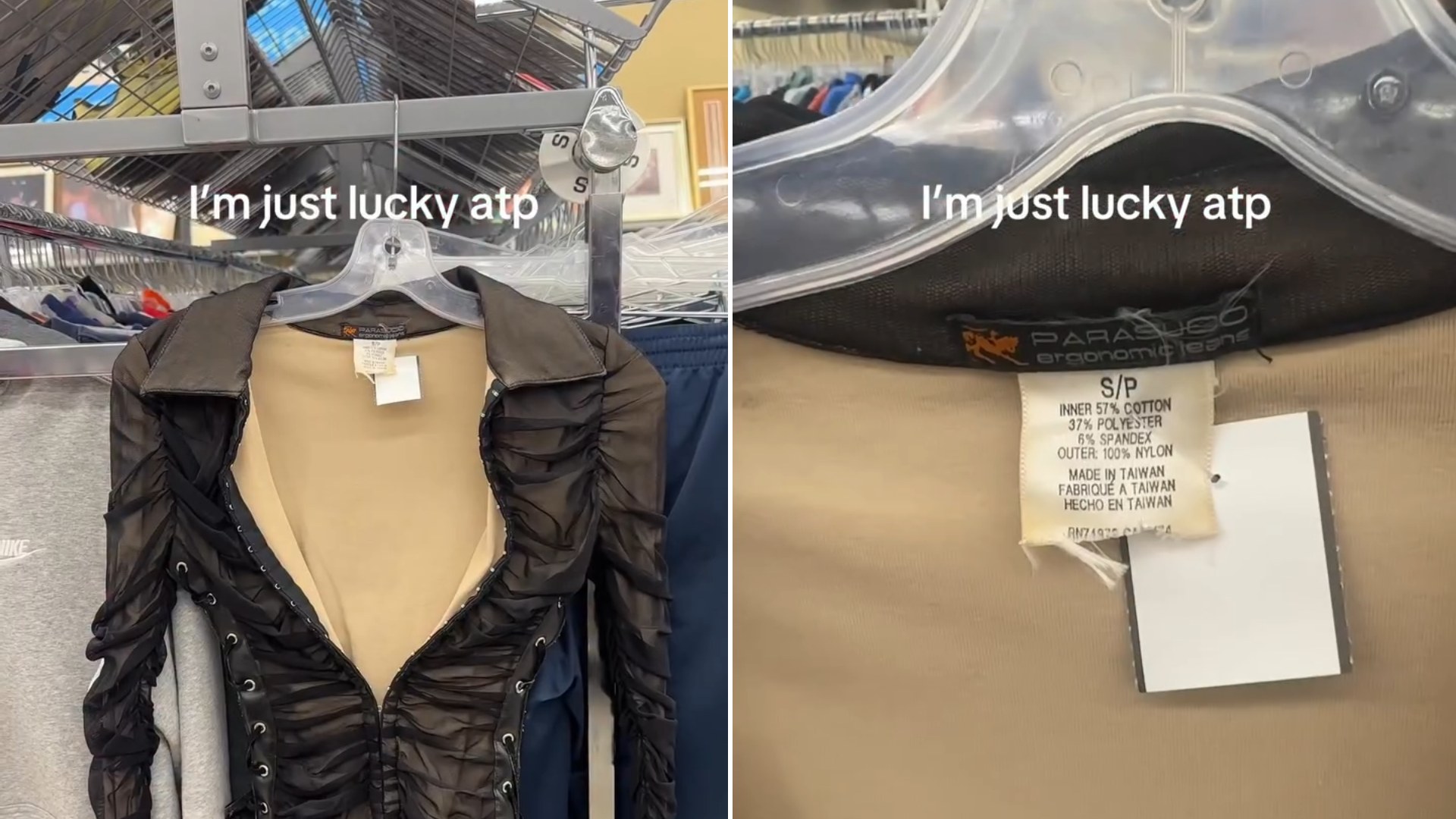
A black, laced-up top pulled off a crowded thrift rack does not usually spark a brand revival campaign, but that is more or less what happened after thrifter @ctrl_kiss posted her find. The label read Parasuco, an early-2000s denim brand most people under thirty have never heard of and most people over thirty instantly recognize. Her point-of-view video shows her spotting the top mid-rack and pulling it out with the kind of confidence that comes from knowing exactly what she has found. She captioned it simply, “I’m just lucky atp,” and it pulled in 132,000 views, over 40 times her usual reach.
The brand behind the label
Most thrift-store finds do not come with that kind of backstory attached, which is exactly why a shopper spotting a defunct-feeling label and knowing instantly what it once meant makes for such compelling viewing.
Parasuco has a longer history than most Y2K devotees probably realize. Founder Salvatore Parasuco, an Italian immigrant who settled in Montreal, launched the line in 1975 under the name Santana Jeans before it became the brand shoppers know today, according to FashionNetwork. The company built its reputation on genuine technical firsts rather than just trend-chasing, introducing stretch denim for women as early as 1976 and later pioneering acid-wash and sandblasted finishes that became denim staples across the industry. By the late 1990s and early 2000s, Parasuco had become a red-carpet and backstage regular, dressing acts including NSYNC, the Backstreet Boys and Celine Dion, which is exactly the era @ctrl_kiss’s top comes from.
That combination, real innovation paired with real celebrity cachet, is part of why the brand’s resale value has started climbing again. It was never a mass-market label the way some Y2K denim brands were, which makes an authentic piece from that window genuinely harder to find at a thrift store today. Salvatore has described the company’s approach as producing something new nearly every month rather than chasing a single seasonal trend, a philosophy that kept its catalog varied and, decades later, kept individual pieces from all looking identical on a resale rack.
Why Y2K denim is having a moment
Early-2000s fashion has cycled back into relevance largely through platforms like TikTok, where a generation too young to have worn it the first time is now actively hunting it down. Low-rise cuts, laced and corset-style detailing, and heavily embellished denim, the exact silhouette in @ctrl_kiss’s find, define that period’s aesthetic. Brands like Parasuco sit right at the center of it, distinct enough from mainstream 2000s denim that a real piece stands out from reproductions instantly.
What makes finds like this one land with an audience is the rack itself. Nobody curated this at a vintage boutique with a designer price tag attached. One top got correctly identified in a matter of seconds, sitting in the middle of an ordinary local thrift store’s inventory. That kind of eye, recognizing a defunct-feeling label at a glance, is exactly the skill set that keeps thrifters glued to accounts like hers, and it is a skill that only comes from genuinely knowing fashion history rather than just following whatever a resale app happens to be pushing that week.
It is also worth noting how quickly the top likely moved once the video posted. @ctrl_kiss’s own caption, mentioning she was sending the piece to a new home the very next day, suggests the demand for a correctly identified Parasuco item was immediate rather than theoretical. Niche brand recognition like this translates directly into a faster sale, on top of making for a genuinely good video.
The pattern worth noticing
Every viral thrift find like this one nudges a half-forgotten label back into circulation, and Parasuco’s own history of genuine technical firsts gives this particular revival more substance than most nostalgia trends manage. The rack does not know which labels used to matter. The shoppers scanning it apparently still do.
There is a longer arc here too. A brand that survived fifty years in an industry known for burning through labels within a single decade has already proven it can adapt, and its recent return to the American market suggests the company itself is banking on exactly the kind of nostalgia @ctrl_kiss’s video captured almost by accident. A single lucky rack find and a company’s formal comeback strategy end up pointing in the same direction, even though neither one planned it that way.

Leave a Reply