

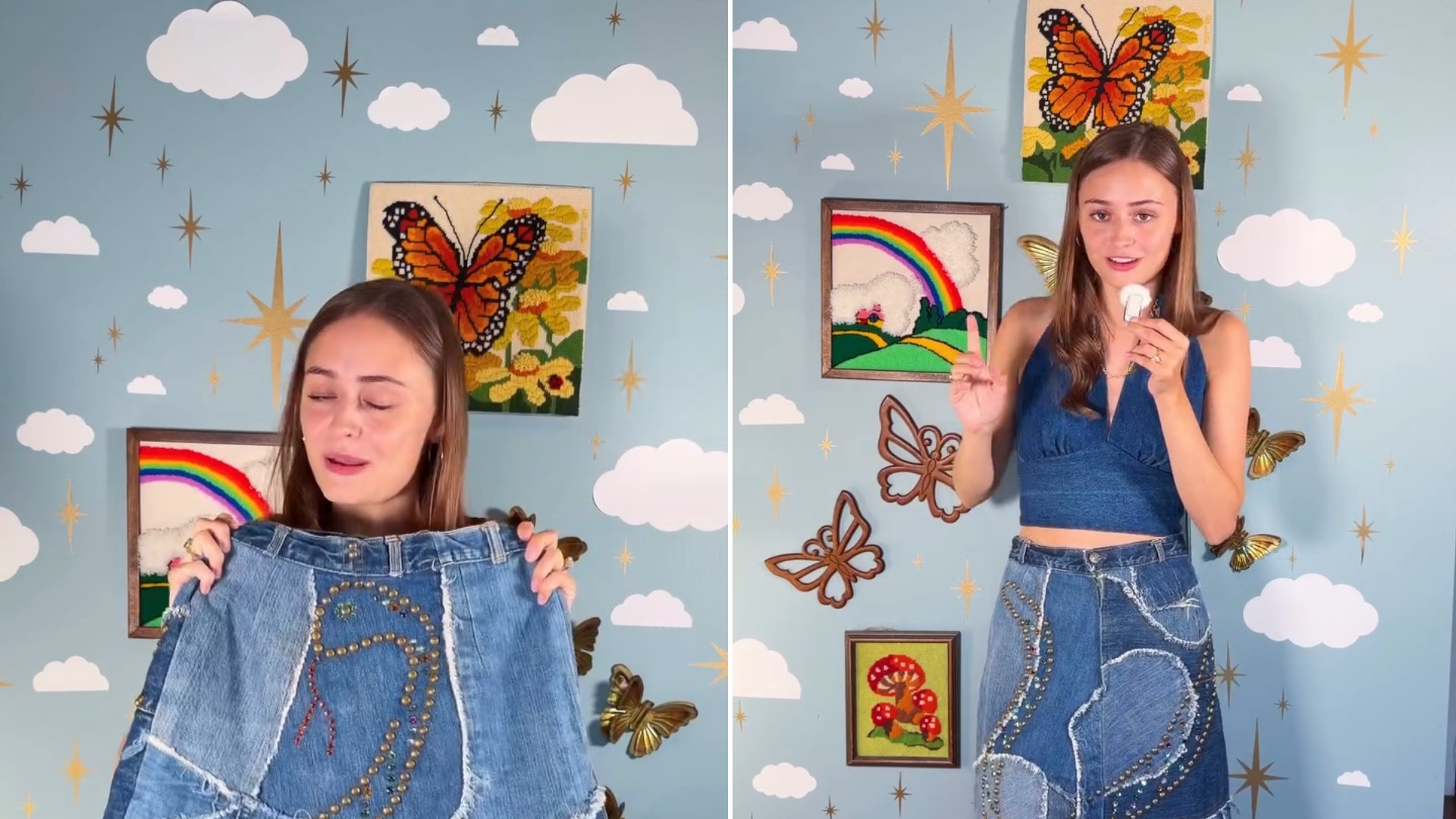
Most purchases on Depop, the peer-to-peer marketplace built around secondhand and vintage fashion since its 2011 founding, end with a shipping confirmation. This one ended with an actual phone call to the designer. Vintage buyer @heytheremissblue bought an unusual denim skirt through the resale app, then did something most shoppers never bother to attempt: she tracked down the person who originally made it and asked whether the piece she was holding was real. Her video walks through that entire process on camera, ending with a question she poses directly to viewers, whether she had actually stumbled onto a piece of real fashion history. The clip pulled in 537,000 views, 66 times what her account usually sees.
Why verification matters in vintage denim
Denim is one of the trickiest categories in vintage resale to authenticate. Unlike a designer handbag with a serial number stamped inside, a skirt or pair of jeans from decades back often carries nothing more than a faded woven label and a construction style that only someone deeply familiar with a brand’s history would recognize. That is exactly the gap @heytheremissblue found herself in. The skirt read as unusual enough, in its cut, hardware and stitching, that a guess was not going to be good enough for her. So instead of relying on a forum thread or a guess from other collectors, she went straight to the source.
Reaching an original designer directly is rare in resale culture, mostly because it rarely occurs to buyers that the person is even findable. Independent and mid-tier designers from past decades are not always household names, but many are still working, still reachable, and often thrilled to hear that a piece of their early work has resurfaced decades later in someone’s closet. Getting confirmation straight from that source turns a secondhand purchase into something closer to provenance research, the kind of legwork museums and auction houses do for far more expensive objects.
There is also a human element to it that a database search could never replicate. A designer confirming their own early work often hands over far more than a simple fact, sharing context nobody else could provide: why a particular cut was chosen, what era or collection it belonged to, how many were even produced in the first place. That kind of detail turns a simple yes-or-no authentication into a genuine origin story, exactly the sort of thing that makes a video like this one spread.
What this means for other thrifters
Her approach offers a genuinely useful blueprint for anyone who has ever wondered whether an odd vintage find is actually significant. Reverse image searches only go so far when a piece predates the internet’s habit of cataloging everything. Reaching out to a brand’s official account, a listed designer, or even a small archive can turn up answers that no amount of scrolling through resale listings ever will. It requires patience, and often more than one attempt before getting a response, but the payoff, an actual confirmation from the person who cut the pattern, is worth far more than a guess.
It also reframes what a Depop purchase can be. Most secondhand app listings get treated as disposable, worn a season and flipped again. A skirt that turns out to carry real documented history behind it changes that calculus entirely, transforming a cheap impulse buy into something a buyer might actually keep, insure, or eventually pass down. That shift in how a single piece gets valued, from disposable to archival, rarely happens without exactly the kind of digging @heytheremissblue did on camera.
The pattern behind the story
Vintage fashion has always rewarded people willing to dig past the label and into the story attached to it, and this particular hunt shows how much easier that digging has become now that designers themselves are often just a message away. The mystery used to end at the hanger. Now it can end with the person who threaded the very first needle.
It is worth remembering how recently this kind of direct access simply did not exist for most shoppers. A decade or two ago, tracking down a smaller or independent designer meant phone calls, mailed letters, or hoping a fashion archivist happened to know the right person. Social media collapsed that distance almost entirely, and @heytheremissblue’s video is a small but genuinely useful demonstration of what that collapse actually looks like in practice, one thrifter, one message, one confirmed piece of history.

Leave a Reply