

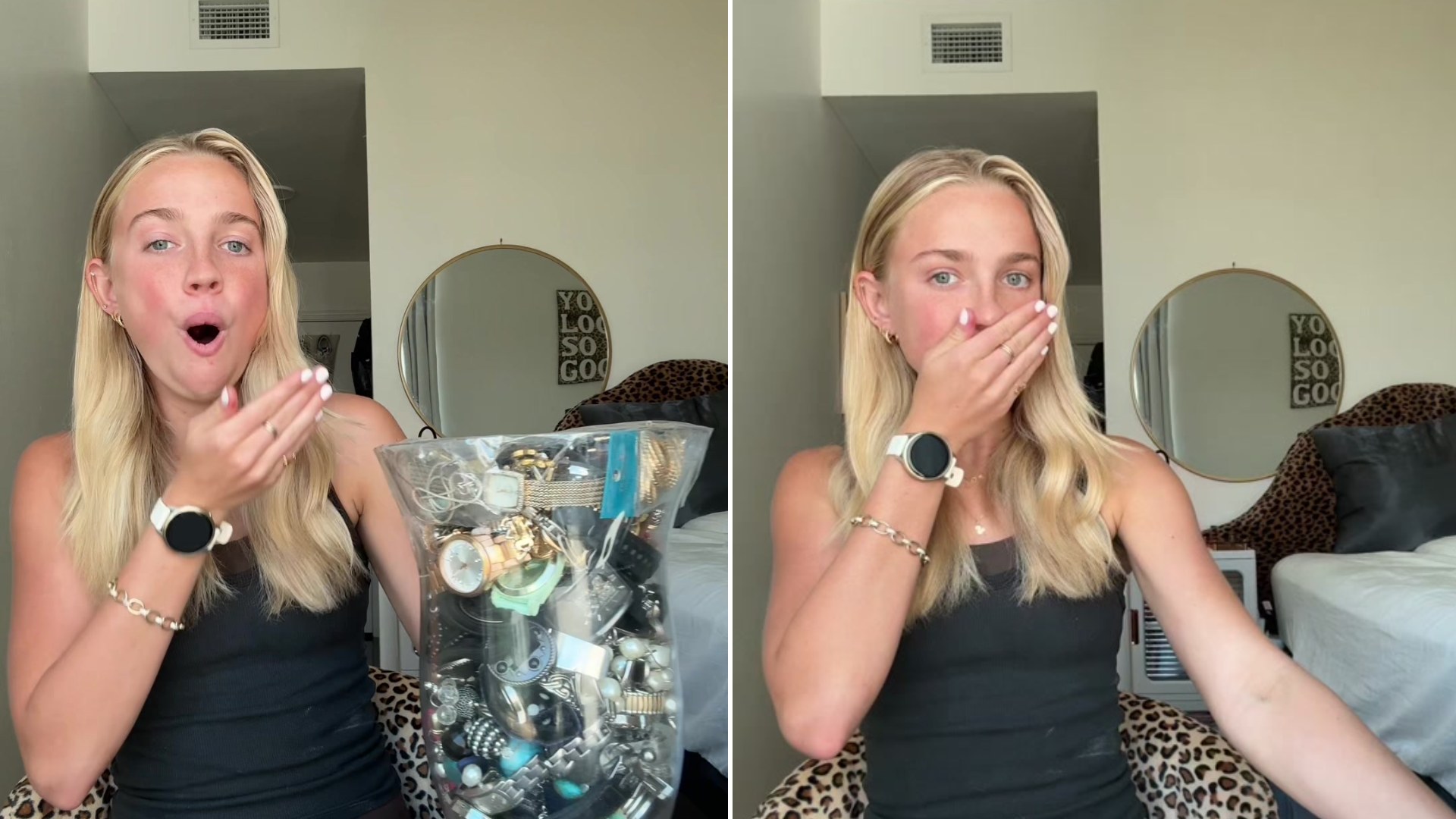
Twenty-five pounds of jewelry sounds like an exaggeration until you watch reseller @rkmichelle8 actually lift the jar. Her video shows a massive glass container, stuffed edge to edge with rings, chains and tangled costume pieces, sitting on a table in front of her like a puzzle she has to solve one item at a time. She calls it her “25lbs mystery vase,” and over the course of the clip she works through it piece by piece, holding each item up to decide whether it gets worn, sold or tossed back in. The video pulled in 1.4 million views for an account that usually sees a fraction of that, and it is easy to see why once you start watching her sort.
The appeal of the mystery lot
Buying jewelry by the pound instead of by the piece is its own strange little corner of the secondhand world. Estate liquidators, thrift stores and flea market vendors often unload costume jewelry this way because sorting through hundreds of individual pieces one at a time simply is not worth the labor for them. The buyer inherits that job instead, and the payoff can range from genuinely valuable finds to a jar full of tangled nothing. @rkmichelle8’s video captures that uncertainty in real time. She is not pretending to know what is in there before she starts, and that honesty is a big part of why viewers stuck around for the whole sort.
The economics behind it are straightforward once you see them laid out. A liquidator handling an entire estate does not have the staff hours to research, photograph and individually list five hundred small trinkets, so a bulk buyer effectively pays a discounted rate for taking on that labor themselves. A good chunk of what ends up in a jar like this is genuinely worthless costume material, bought at a dime a dozen decades ago. Mixed in almost by accident, though, a piece here or there can turn out to be sterling silver, gold-filled, or stamped with a maker’s mark worth real money to the right buyer. Nobody knows the ratio until the sorting actually happens.
Her decision-making process is where the video gets its rhythm. Some pieces she recognizes immediately and sets aside to wear. Others she inspects more closely, checking clasps and stamps before deciding whether they are worth reselling. A few get tossed without much ceremony at all. That variation, quick calls mixed with longer deliberation, keeps the pacing from feeling repetitive even across a jar that large.
Why bulk lots keep surfacing online
Resellers gravitate toward this kind of content because it mirrors what actually happens in the secondhand jewelry trade behind the scenes. Estate sales generate enormous volumes of costume jewelry that nobody has time to catalog individually, so it gets bagged, boxed or, in this case, jarred and sold as one unit. Buying in bulk is a bet, and creators like @rkmichelle8 have built entire audiences around letting viewers watch that bet play out live instead of just seeing a polished after-photo of the keepers.
There is also a satisfying, almost meditative quality to watching someone sort a physical pile of small objects on camera, the same instinct that fuels unboxing and organizing videos far outside the jewelry world. Add in the scale of a 25-pound jar and the genuine uncertainty of what’s tangled up inside it, and you get a video that works as both a resale tutorial and pure viewing pleasure. Viewers get to play along too, guessing at each piece right alongside her before she reveals her own verdict, which turns a solo sorting session into something closer to a shared game.
What it says about the secondhand market right now
Bulk mystery lots have existed for as long as estate sales have, but social platforms have turned the private sorting process into public entertainment, and that shift has changed how buyers approach the hunt in the first place. Shoppers no longer need to guess what a lot might contain before bidding on one themselves. They can watch someone else’s jar get emptied first, learn what to look for, and then go looking for their own.
It has also raised the bar for what counts as an interesting bulk lot in the first place. A modest baggie of tangled costume jewelry barely registers anymore next to a video like this one, sheer scale now doing part of the marketing work that a clever caption used to have to do alone. Sellers have noticed, and bulk lots advertised by weight rather than piece count have become a more visible category of listing than they were even a few years back, precisely because creators like @rkmichelle8 have shown audiences what that kind of volume can actually contain.

Leave a Reply