

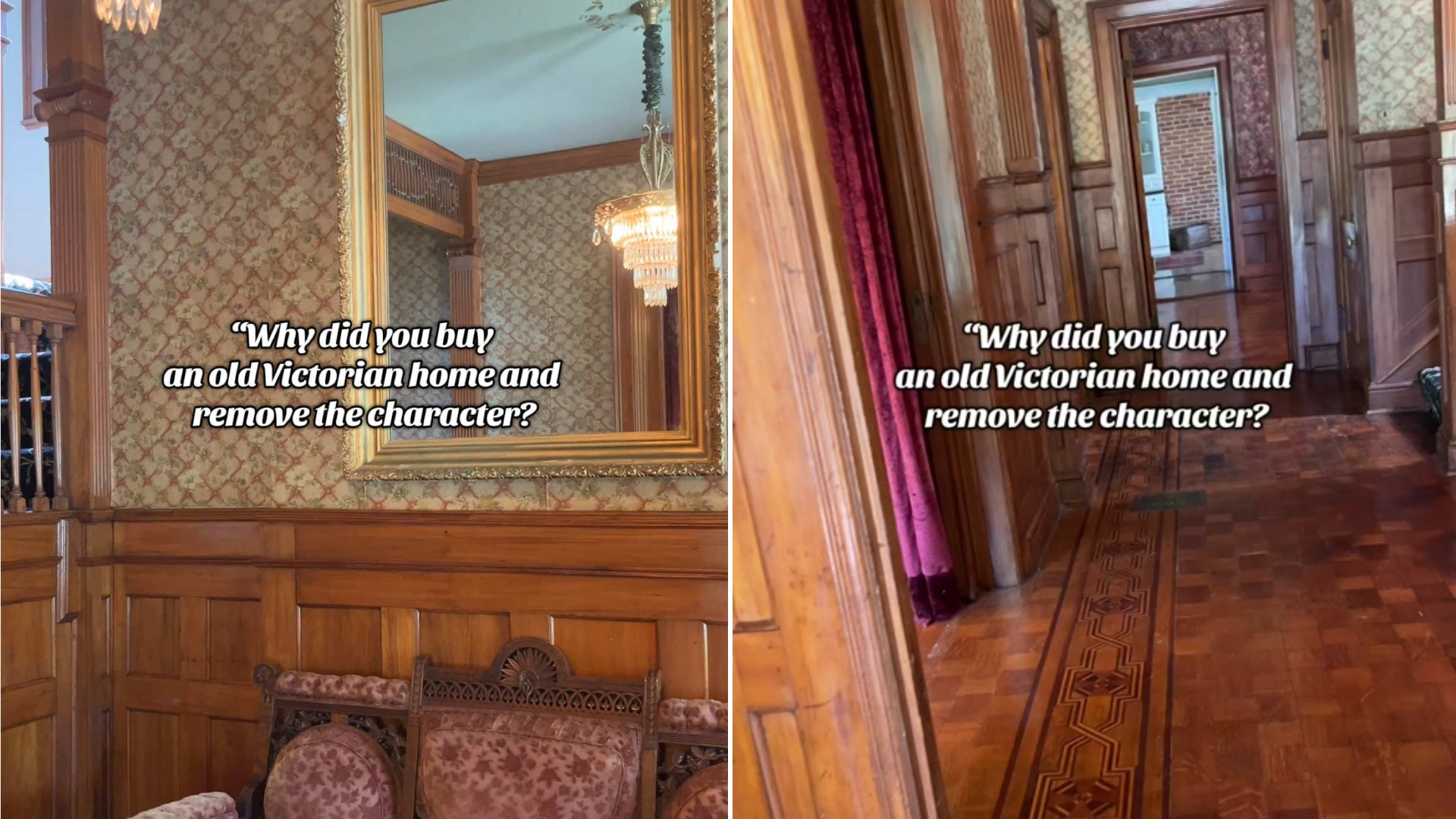
A TikTok showing the slow, careful rewallpapering of a brick Victorian home built in 1890 has racked up 3.8 million views, more than 38 times what creator @amy_easley usually sees on a post. Her caption sums up the project bluntly: “Our 1890 brick Victorian home has new wallpaper now. Let me tell you this was a challenging diy.” A text overlay early in the video pushes back on a comment she says she gets constantly, asking why anyone would buy a century-old Victorian house and then strip out its character. Her answer, shown rather than spoken, is the time-lapse itself: hours of careful hanging meant to add period-correct pattern back into a room, not erase it.
Why an 1890s House Would Have Had Wallpaper Everywhere
By the time @amy_easley’s house was built, wallpaper wasn’t a luxury reserved for the wealthy anymore. It had been mass-produced and widely affordable for decades. British wallpaper production exploded from roughly one million rolls a year in 1834 to nearly nine million rolls by 1860, once machine printing took over from slow, expensive hand block-printing, and prices fell as low as a farthing per yard, according to the Victoria and Albert Museum. That shift meant a house like this one would almost certainly have shipped with patterned walls from the start, not bare plaster waiting for a later owner’s taste. Stripping it back to nothing would have actually been the historically inaccurate move.
Design tastes had also gotten more elaborate by the 1890s, not less. A layered decorating scheme combining a patterned frieze near the ceiling, a busy fill pattern in the middle of the wall, and a separate dado pattern below the chair rail had been standard practice since roughly 1880, per the V&A. William Morris, whose more than 50 wallpaper designs reshaped what middle-class households considered tasteful, pushed patterns drawn from real, observed plants rather than the exotic florals that dominated earlier decades. A home from this exact period was built to be dense with pattern, layered and a little busy by modern standards, which is precisely the look @amy_easley appears to be chasing back.
The Part That Made It “Challenging”
Modern rewallpapering on a house this old comes with headaches a newer build simply doesn’t have. Plaster walls settle unevenly over more than a century, corners stop being true right angles, and trim work original to the 1890s rarely lines up cleanly with rolls cut for a contemporary, perfectly square room. Getting a repeating pattern to match seamlessly around all of that takes exactly the kind of patient, frame-by-frame process her time-lapse compresses into seconds. It’s also easy to underestimate how much of the labor is invisible on camera: smoothing plaster, priming old surfaces so new paste actually adheres, and dry-fitting paper before a single strip gets committed to the wall.
The comments section leaned heavily into that framing too. Plenty of viewers said the finished room reminded them of a grandparent’s house, or of the specific pattern that lined a childhood hallway decades before anyone in their family owned the place. A few historic-home owners chimed in with their own horror stories about matching seams around uneven plaster, trading tips on primers and paste in a thread that quickly turned into a small community of people who’d all made the same stubborn choice to keep, rather than gut, an old house.
Restoring, Not Renovating
The distinction @amy_easley seems to be drawing, gently but firmly, in that text overlay matters more than it might first appear. Renovating an old house usually means updating it toward something modern, sanding away whatever feels dated until the rooms could belong to any decade. What she’s doing here is closer to restoration, pulling the home back toward what it likely looked like the year it was finished, pattern by pattern, plaster crack by plaster crack. Millions of viewers clearly found that distinction worth sticking around for, watching one strip of wallpaper at a time meet a wall that’s been waiting more than 130 years for it. There’s a reason a slow, unglamorous home improvement task like this one outperformed her regular posts by nearly 40 times over: people are hungry for proof that old houses can stay old on purpose.

Leave a Reply