

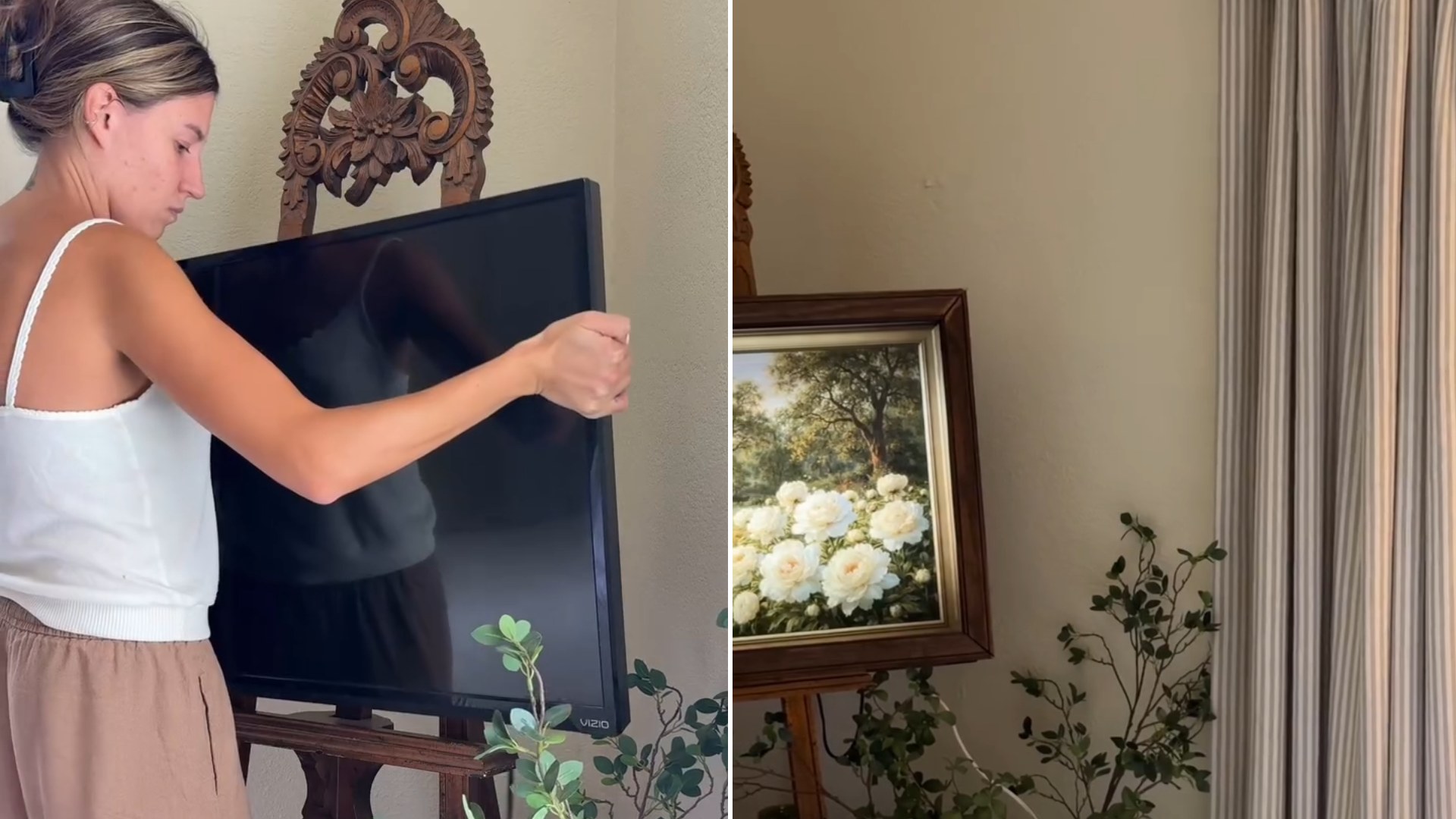
Propping a television on a wooden easel is enough to make guests stop and ask where you bought the painting. That’s the exact reaction creator @casa_della_mimosa says she gets in her own home, and the tutorial video walking through her build has now reached 322,300 views, more than 42 times what her account typically pulls. Her caption calls it “one of my best kept secrets,” and the overlay text she added captures the moment perfectly: “Where did you get that painting?!” No paint, no drywall cuts, no electrician required. Just an easel, a frame and a screen most visitors never clock as a screen at all.
An Old Trick Designers Are Still Catching Onto
@casa_della_mimosa isn’t the only one leaning on an easel to make a screen disappear into the room. Brooklyn-based designer Crystal Sinclair used the identical move on a client’s television, choosing “an antique easel instead of a traditional media console” specifically so the set would read as art rather than furniture, according to Domino. Stylist Scott Horne went a step further in a Los Angeles living room, folding a screen straight into a gallery wall and painting the surrounding panel a soft off-white so the frame’s edges melted into the background instead of announcing themselves. The through line in every version is the same: treat the screen like exactly one more object in the room, not the object the room is arranged around.
That’s a genuine shift from how televisions used to get handled in most homes. For decades the goal was disguise through furniture, a bulky armoire with doors that swung shut, a cabinet built specifically to swallow the set whole. The easel approach flips that logic entirely. Instead of hiding the television inside something, it dresses the television up as something else, in full view of the room and the guests wandering through it.
What Actually Makes It Work
The build itself is deceptively simple, which is likely why the video performed the way it did. @casa_della_mimosa’s step-by-step montage shows the screen slotted into a frame sized generously enough to leave a visible mat border, then rested on a sturdy wooden easel positioned at a natural eye-level angle, the same way an actual painting would sit in a studio. There’s no wall-mounting bracket, no hardwired cable box hidden behind it. When the television is off, the frame and easel simply look like a piece someone picked up on a trip, propped casually in a guest room corner because there wasn’t a free wall for it yet.
That casualness is doing a lot of the disguise’s heavy lifting. A perfectly centered, perfectly mounted screen reads as a television even with a frame around it, because mounted televisions are what people expect to see on walls. An easel breaks that expectation immediately. Nobody mounts a television on a painter’s stand, so when they see one, their brain files it under “art” before it has a chance to reconsider, and by the time anyone looks closely enough to notice a bezel, the moment for suspicion has already passed.
It also sidesteps a cost most disguise methods carry. A built-in cabinet or a gallery wall renovation usually means carpentry, paint matching and a weekend cleared out for the project. An easel needs none of that. It can be repositioned in seconds if the room gets rearranged, swapped to a different wall entirely, or moved out completely if a guest room turns back into an office. The commenters under @casa_della_mimosa’s video picked up on exactly that flexibility, several asking whether she’d done the same trick anywhere else in the house and where she’d sourced an easel sturdy enough to hold a screen without wobbling.
Function Dressed as Furniture
What ties @casa_della_mimosa’s guest-room trick to Sinclair’s Brooklyn loft and Horne’s gallery wall is a small but real design philosophy: a television doesn’t have to look like a television just because it is one. Give it an old-fashioned frame, prop it the way a real canvas would sit, and most rooms will happily let it pass as decor rather than technology. It’s a low-effort swap with an outsized payoff, the kind of detail that gets a guest to ask about a painting that was never really there.

Leave a Reply