

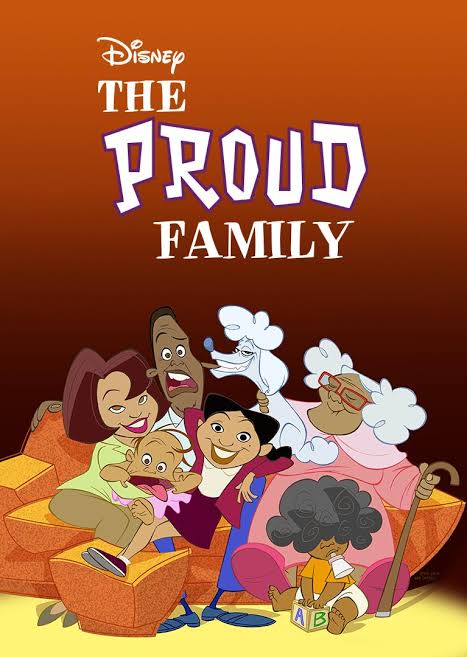
The Proud Family premiered on Disney Channel 25 years ago this week, and it did something no animated series on the network had done before: it existed there at all. Before September 2001, Disney Channel’s original programming was entirely live-action. Creator Bruce W. Smith built the show around a middle-class Black family in a fictional suburb, drawing directly from his own upbringing at a time when he says animation simply wasn’t reflecting families like his. Executives weren’t fully sold on every piece of the show, but it went on to become one of the network’s defining hits of the decade.
The First Cartoon Disney Channel Ever Called Its Own
The Proud Family debuted Sept. 15, 2001, as part of the network’s Zoog Disney block, and it holds a specific distinction: it was the first original animated series to air exclusively on Disney Channel. Smith co-founded Jambalaya Studios in 1999 and spent roughly two years developing the show before it reached air, pulling from his own experience with middle-class Black families in Los Angeles to shape the Proud household.
Executives Didn’t Love Everything About It
Not every creative instinct got an easy yes. Co-creator Ralph Farquhar has said Disney executives pushed back specifically on the show’s now-iconic theme song, performed by Destiny’s Child, telling the team at the time, “This is not a TV theme song,” according to a retrospective interview carried by 92Q. Smith has said that kind of resistance became almost a signal in itself. “Anytime we get a note that is against our instinct, we know, ‘Oh, this is going to work really well,’” he told the outlet.
The Voice That Had to Stay the Same
Continuity mattered just as much behind the scenes. Keeping Kyla Pratt as the voice of lead character Penny Proud across every iteration of the franchise, from the original series through the 2005 film to the 2022 revival, was treated by the creators as essential rather than negotiable, per 92Q. That kind of consistency is rare in animation, where recasting a young voice actor as they age out of a role is often standard practice, and it is part of why longtime fans describe the franchise as feeling like one continuous family rather than a rebooted product.
Two Seasons Was Enough to Leave a Mark
The show ran just two seasons and 52 episodes before wrapping with a feature film on Aug. 19, 2005, a short run by modern streaming standards but a long one by early-2000s ratings math. It averaged a 4.0 Nielsen rating among kids 6 to 11 during the 2003-2004 season, a strong number for the network at the time, and it has aged into genuine institutional standing since. AOL’s own ranking of the best Disney Channel Original Series placed it at No. 7, specifically citing its status as the network’s first animated original and its portrayal of “a warm tale of a family sticking together despite all their frustrations.”
A Show That Made Room for What Came After
It is hard to measure influence precisely, but The Proud Family’s early success made an argument Disney Channel clearly absorbed: an animated sitcom built around a specific, culturally grounded household could pull real ratings, not just a niche following. The network kept commissioning original animation through the rest of the decade, and executives who greenlit later projects were the same ones who had watched Smith and Farquhar’s theme-song fight turn into a top-rated show. That kind of internal memory tends to shape what gets a yes the next time around, long before critics start writing anniversary retrospectives about it.
The show’s second life backs up that theme song fight in a way no pitch meeting could have predicted. Disney brought it back in 2022 as The Proud Family: Louder and Prouder, and both Smith and Farquhar are still working on it a quarter century after the original pitch. A note that sounded like resistance in 2001 reads, in hindsight, like the moment the show found its own voice. Twenty-five years is a long time for any single note in a production meeting to still matter, but this one clearly does, since both creators keep bringing it up whenever anyone asks them to explain how the show almost wasn’t what it became.

Leave a Reply