

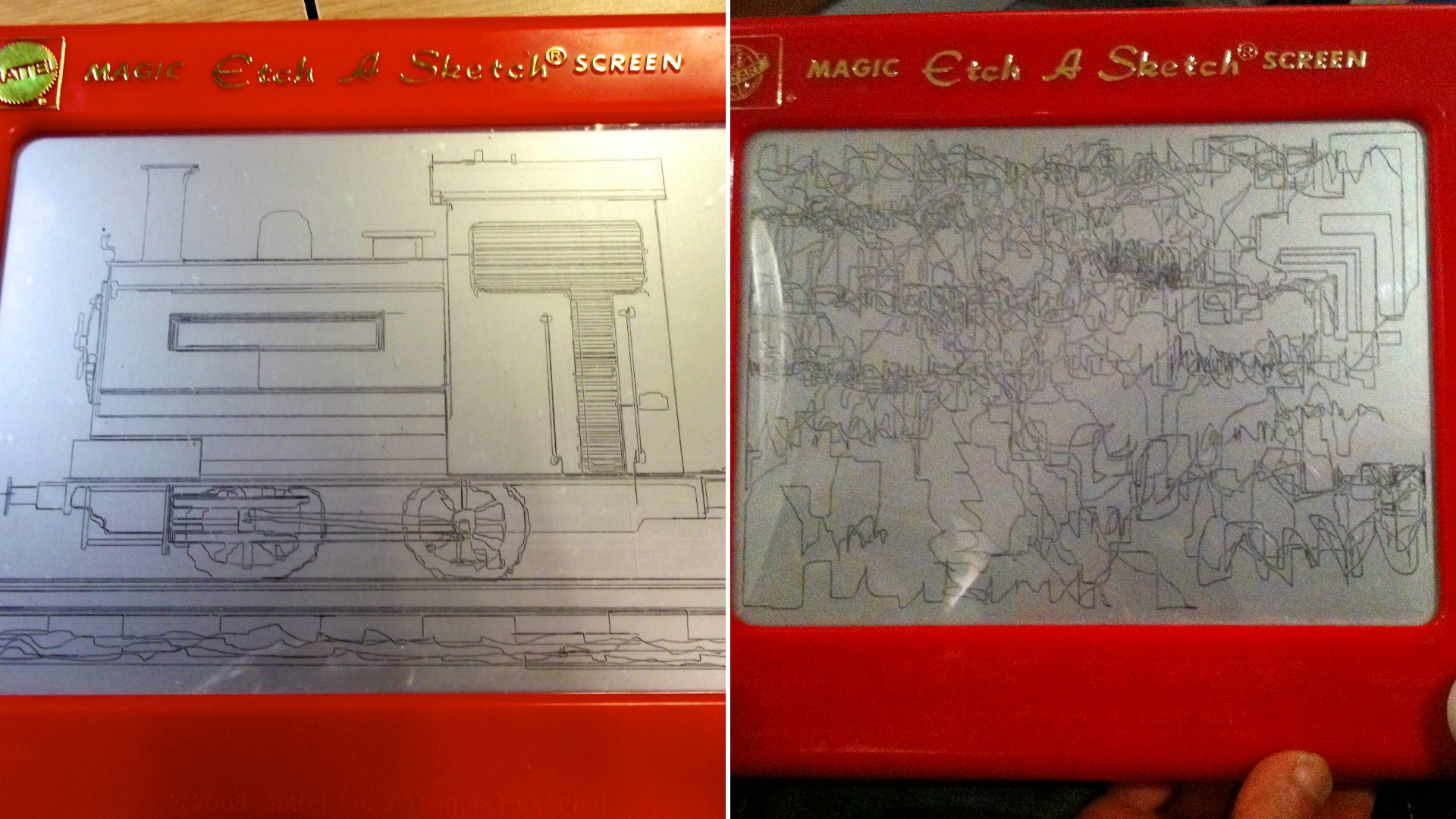
No toy company sat down and designed the Etch A Sketch on purpose. A French electrician with zero formal training in toy design stumbled into the mechanism almost by accident while tinkering in his own garage, and decades later, engineers who study the internal workings still find the solution genuinely clever.
An Accidental Discovery
Andre Cassagnes worked as an electrical technician in France during the 1950s, not as a toy designer, when he noticed something odd while applying a decal to a light switch plate. A layer of aluminum powder stuck to the underside of a piece of transparent plastic, and when Cassagnes traced a design on the front of the plastic with a sharp tool, the powder cleared away wherever the tool passed, leaving a visible line. According to HISTORY’s account of the toy’s origins, that unplanned observation became the entire foundation for what he would eventually build into a drawing toy.
Turning a Fluke Into a Mechanism
Cassagnes spent time refining the effect into something controllable rather than accidental. He built a system using two knobs connected by an internal pulley and string setup, engineered so that turning one knob moved a stylus horizontally and turning the other moved it vertically across the powder-coated glass screen. That X-Y mechanism is the real engineering achievement behind the toy, a deceptively simple setup of strings and pulleys that lets a user draw continuous lines in any direction using only two independent dials, with no motors, batteries, or electronics involved anywhere in the design.
From Prototype to Patent
The mechanism Cassagnes developed was eventually formalized and protected as U.S. Patent 3,055,113, filed under the description of a tracing device rather than anything resembling a toy. The patent record, viewable through Google’s hosted copy of the original filing, lays out the internal pulley-and-stylus system in full technical detail, the kind of document that reads more like an industrial design filing than the origin paper for one of the most recognizable toys of the twentieth century.
Ohio Art Takes a Chance
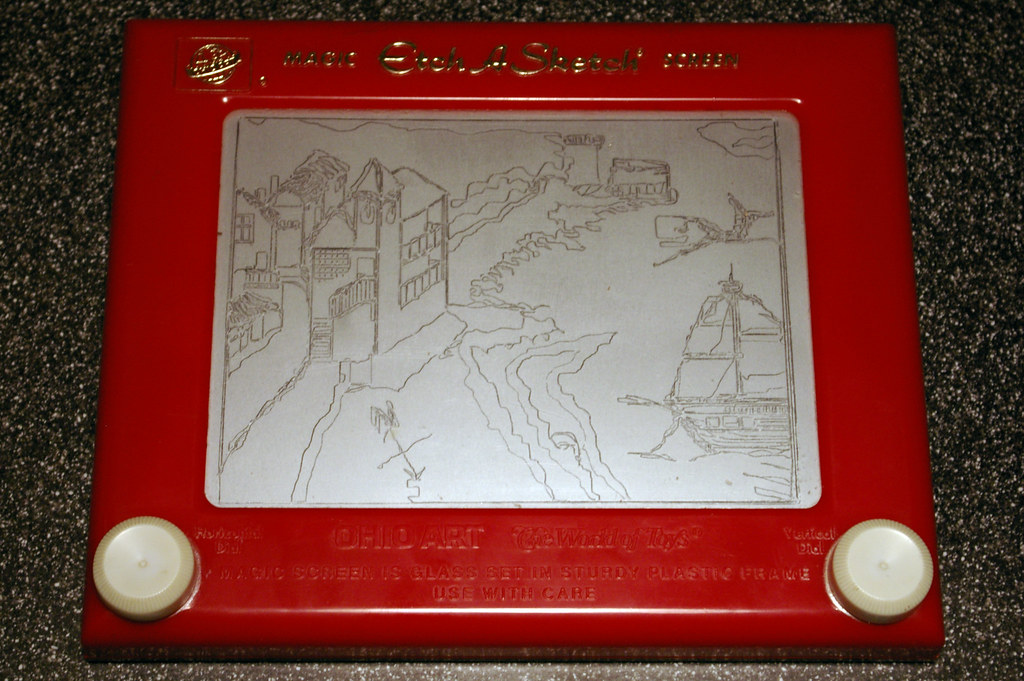
Cassagnes did not have the manufacturing capability or the toy industry connections to bring his invention to American shelves on his own, so the design eventually made its way to the Ohio Art Company, a manufacturer better known at the time for producing metal lithographed items and simple mechanical toys. Ohio Art licensed the mechanism, refined the housing into the red plastic frame that became instantly recognizable, and launched it in 1960 under the name Etch A Sketch. The toy became one of the company’s defining products for the rest of its history.
Why the Design Still Impresses
What keeps the Etch A Sketch interesting to engineers decades later is how much functionality Cassagnes squeezed out of purely mechanical parts. There is no computer chip translating knob movement into stylus position, only a physical string-and-pulley relationship doing all of the work. That simplicity is also why the toy has such a distinctive limitation collectors and casual users both know well, drawing a perfect diagonal line requires turning both knobs in careful coordination, a skill that takes real practice and separates casual doodlers from people who have genuinely mastered the toy.
Spotting an Original at a Flea Market
Original early-1960s Ohio Art units, produced close to the toy’s 1960 launch, are the pieces most serious vintage toy collectors specifically look for when browsing flea markets and estate sales. Early production runs used slightly different housing materials and label designs than later decades, small details that let an experienced eye date a unit within a few years just from the packaging and screen bezel alone. A working screen with a smooth, unscratched surface matters just as much as the housing itself, since decades of use can leave the internal aluminum powder clumped or unevenly distributed, which noticeably changes how cleanly the toy draws.
Ohio Art also produced smaller pocket-sized versions of the toy starting in the 1970s, and those compact units have become their own collecting niche entirely. Because they were manufactured in different sizes across different eras and occasionally under regional licensing arrangements outside the United States, a shelf of Etch A Sketch variants can end up looking like a small survey of industrial design trends spanning several decades, all built around the exact same pulley mechanism Cassagnes worked out in his garage.
A Garage Tinkerer’s Lasting Legacy
Cassagnes never set out to invent a children’s toy, he was simply curious about an odd bit of static electricity and aluminum powder behaving in a way he did not expect. That curiosity, paired with real mechanical persistence, produced a design elegant enough to remain in continuous production for more than six decades with barely any change to the core mechanism. For a toy invented by someone with no formal design background whatsoever, that kind of staying power is a genuinely rare achievement, and it is exactly the sort of quiet engineering story vintage toy collectors tend to appreciate once they hear the full version.

Leave a Reply