

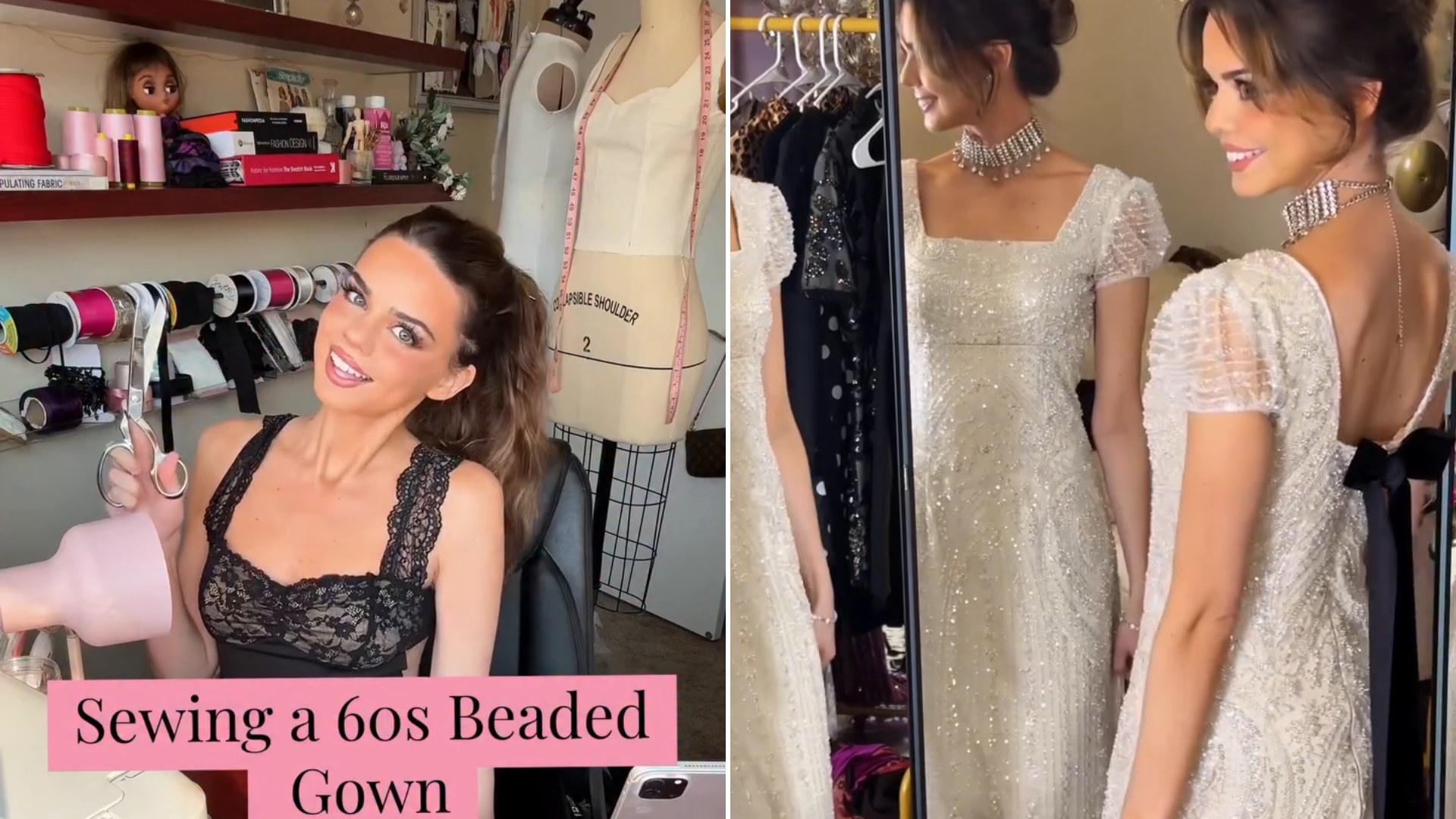
A sewing pattern envelope usually stays folded in a drawer, admired for its illustration and never touched again. One seamstress pulled hers out, cut into the tissue paper, and turned a decades-old design into a finished gown that’s now been watched 2.6 million times.
Starting From an Original Envelope, Not a Reprint
The project, documented on @libi.lou_’s own Instagram, begins with an original 1960s sewing pattern envelope rather than a modern reissue. The creator’s caption lays out the build in plain terms: “Sewing a 1960s Beaded Aline Empire Waist Gown with a nude satin lining. Beaded fabric is coming from…” What follows is a full transformation from tissue pattern to finished garment, an A-line empire waist gown covered in beadwork over a nude satin lining.
The reel has pulled in 2.6 million views on an account with 32,200 followers, a jump of roughly 72 times the creator’s typical numbers. That kind of reach is notable for sewing content specifically, a corner of social media that usually rewards speed and simplicity over the slow, exacting work this project actually required.
Why an Empire Waist Silhouette Still Reads as Sixties
The empire waist, with its seam sitting just under the bust and a skirt that skims loosely from there, is one of the most recognizable silhouettes to come out of 1960s formalwear. It offered a softer, more youthful alternative to the fitted, structured waistlines that dominated the previous decade, and it paired naturally with the era’s growing appetite for beading, metallic thread, and heavily embellished evening fabric. A pattern envelope built around that shape isn’t just a sewing template. It’s a blueprint for exactly how eveningwear was constructed at the time, down to the seam placement and the ease built into the bodice.
That’s part of what separates working from an original envelope from working off a reprint or a modern pattern inspired by the era. Vintage envelopes carry the actual measurements, seam allowances, and construction notes used by home sewists decades ago, with all the quirks that come from a pre-digital pattern industry. Following one faithfully means engaging with genuine period technique rather than a contemporary approximation of it.
The Skill Behind a Beaded Build
Beading a full gown is not a quick weekend project under any circumstances. Hand-applied or hand-finished beadwork requires the fabric to be handled carefully at every stage, since the added weight and stiffness of beaded panels change how the material drapes and how seams need to be reinforced. Add a nude satin lining meant to sit invisibly beneath the beaded layer, smoothing the silhouette without showing through, and the technical demands stack up fast. None of that is visible in a finished photo. It shows up only in the process, which is exactly why documenting the build rather than just posting the final gown is what made this project resonate the way it did.
Viewers drawn to vintage sewing content tend to respond most to exactly this kind of transparency. A polished final gown photographed on a dress form is impressive, but watching the raw pattern pieces, the beaded fabric sourcing, and the construction stages in sequence gives the finished piece real weight. It turns a beautiful dress into a documented process, closer to a restoration project than a simple sewing tutorial.
What the Reaction Says About Vintage Sewing
The scale of the response, millions of views on a niche sewing account, suggests an appetite that goes beyond people who sew themselves. Plenty of viewers likely have no plans to attempt beadwork of their own, but the appeal of watching an authentic period pattern become a wearable piece of history clearly reaches further than the sewing community alone. It taps into the same fascination that drives interest in restored vintage furniture or fully authenticated period clothing: the pleasure of watching something old and slightly obscure get treated with real craft and care rather than dismissed as outdated.
For anyone holding onto an old pattern envelope of their own, tucked away and never used, this kind of project is a reminder that those tissue pieces were meant to become something. Whether or not most people ever attempt the beading themselves, the gown stands as proof that a decades-old pattern can still produce something that looks, as much as any modern viewer could reasonably judge, museum-ready.

Leave a Reply