

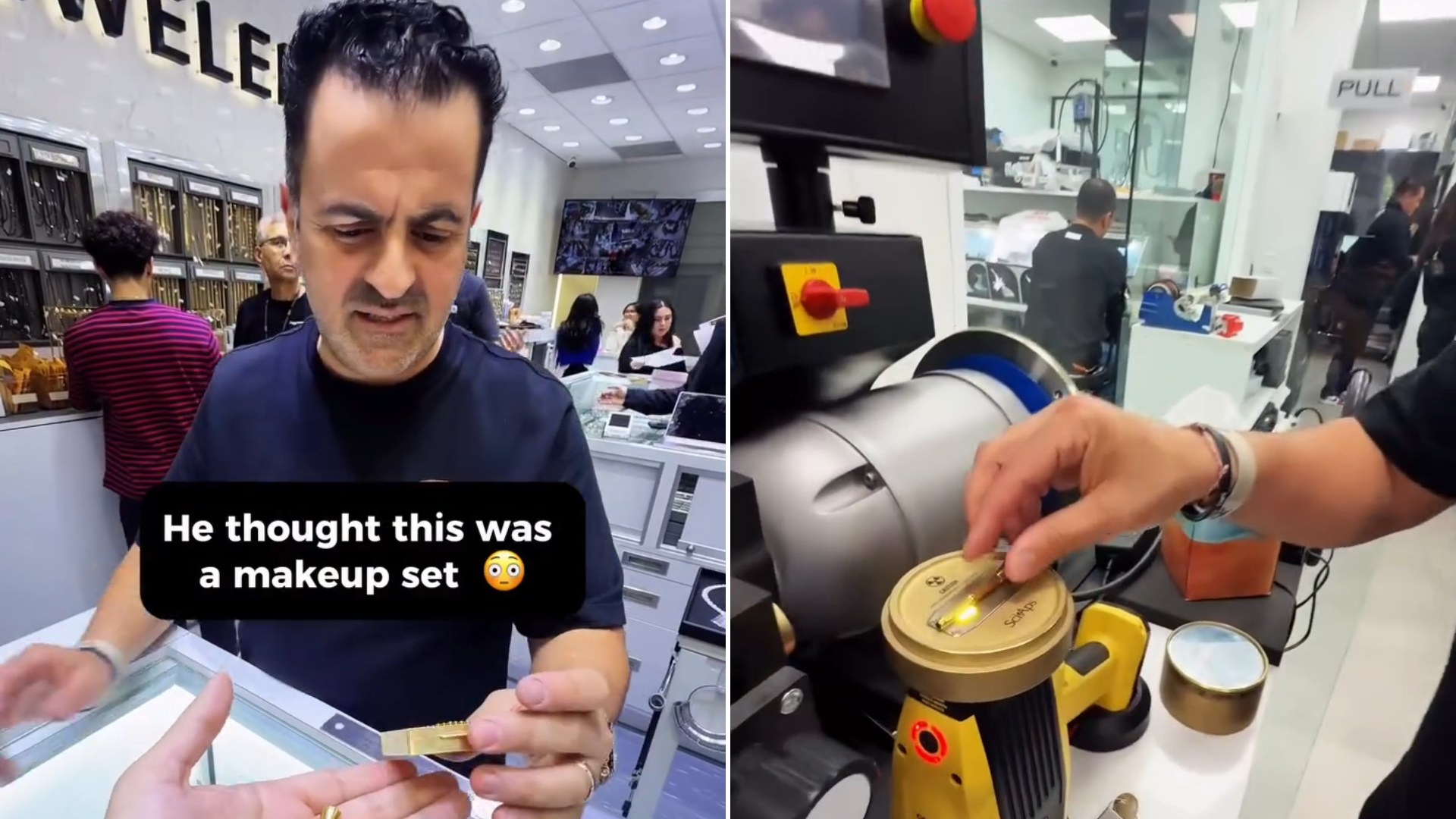
A dented old case picked up at a flea market for almost nothing looked, at first glance, like exactly what most people assumed it was: an outdated makeup set nobody wanted. Then a jeweler ran a real gold test on it, on camera, and the room went quiet at the result.
Mistaken for a Makeup Set
The on-screen text in @happyjewelers’s own Instagram Reel lays out the misunderstanding plainly: “He thought this was a makeup set.” The item itself, a vintage gold compact case found at a flea market, had the worn, dented look of costume-grade vanity clutter, the kind of piece easy to dismiss without a second thought. That is precisely the setup that makes a gold-testing reveal land so hard.
A Live Test, Not a Guess
Rather than eyeballing the case or relying on a hallmark alone, the jeweler runs an actual gold-testing tool over it on camera, walking through the authentication process in real time. There is no cut away to a “results” card and no edited jump to a conclusion. Viewers watch the same test a customer would watch in a real store, and the tool confirms what the case’s owner apparently never suspected: the makeup case is genuine gold.
The Caption Says It Best
The creator’s own caption frames the moment with a simple, almost disbelieving question: “I sold my make up set?” That single line does a lot of work. It suggests a piece that had been treated, priced, and probably handled for years as nothing more than a decorative case, only for a professional test to reveal it was worth dramatically more than anyone selling or buying it at a flea market table likely realized.
Why the Confirmation Moment Hit 4.5 Million Views
According to @happyjewelers’s own Reel, the video reached 4.5 million views, 471.4 times the creator’s typical median of 9,500, across a following of 484,000. Gold-testing content works because it turns a subjective guess into an objective, on-camera answer, and flea market sourcing raises the stakes further: anyone watching can imagine walking past a nearly identical case without ever suspecting what was actually inside their hands. That exact tension, between what an object looks like and what a real test proves it to be, is what carried this clip so far past the jeweler’s usual reach.
What Flea Market Shoppers Can Take From It
Vintage compacts and makeup cases from earlier decades were sometimes made with real gold plating or solid gold components, a detail modern reproductions almost never bother replicating since the material cost alone would price them out of the gift shop market. That gap between eras is exactly why a battered old case can still test genuine while looking every bit as rough as a two-dollar thrift shelf item. A dent or a scuffed hinge says nothing about what is underneath, and this video is a rare instance of a viewer actually getting to watch that gap close in real time, with a professional tool doing the confirming instead of a caption simply asserting it.

Leave a Reply