

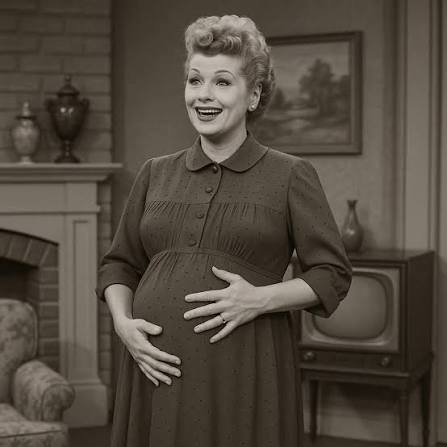
By the fall of 1952, Lucille Ball was expecting her second child, and the writers of I Love Lucy faced a problem no sitcom had solved before: a leading lady who could not simply disappear from the screen for two trimesters. Rather than hide her changing shape behind desks and laundry baskets, the show’s creative team decided to write the pregnancy directly into the story, making Lucy Ricardo pregnant right alongside the real Lucille Ball. It was a bold choice for 1952, and CBS made sure everyone involved knew exactly how far that boldness could go.
The trouble started with a single word. Network standards at the time treated the word “pregnant” as too suggestive for living rooms, and sponsor Philip Morris was just as nervous about the topic reaching prime time. So the scripts leaned on softer substitutes instead, mostly “expecting” and “with child,” while one episode title got creative in a different language altogether. According to the official Lucy-Desi archive, the storyline made Ball the first woman to visibly appear pregnant on a major American television network, a milestone that came wrapped in a long list of restrictions.
A French Word for an American Taboo
The episode announcing the news to Ricky carried the title “Lucy Is Enceinte,” borrowing the French word for pregnant because it sounded refined enough to slip past network standards while still telling viewers exactly what was going on. Nobody said the word “pregnant” out loud in the episode itself. As Time has reported, CBS’s own Code of Practices for Television Broadcasters treated any direct discussion of pregnancy as sexually suggestive material, so the entire arc had to be built around euphemism. Writers Bob Carroll Jr., Madelyn Pugh, and Jess Oppenheimer worked the word “expecting” into nearly every scene where the subject came up, and the show’s more delicate viewers were left to read between lines that were already fairly easy to read.
CBS did not stop at vocabulary. Every single script touching on the pregnancy was sent out for moral review before it reached the soundstage, a step almost unheard of for a comedy about a Cuban bandleader and his scatterbrained wife. A priest, a minister, and a rabbi each read the material to make sure nothing crossed a line the network could not defend to advertisers or affiliates. Writer Madelyn Pugh later recalled that the trio barely touched the scripts at all, noting the clergy “didn’t change a word,” a detail reported by Parade. The review board existed mostly to give CBS cover, not because the writers had actually pushed the material anywhere scandalous.
Timed to the Real Delivery Room
The production team went a step further and scheduled the on-screen birth to land on the same day Lucille Ball was due for her scheduled cesarean delivery. “Lucy Goes to the Hospital” aired on January 19, 1953, the very day Ball gave birth to her son, Desiderio Alberto Arnaz IV, known to most of America simply as Desi Arnaz Jr. The coincidence was not luck. It was engineered months in advance, with the episode filmed weeks earlier and held back for broadcast so fiction and reality would land on the same date.
That timing paid off in numbers that still sound implausible today. Roughly 44 million people tuned in, close to 72 percent of American households with a television set, according to figures cited by both Time and the Lucy-Desi archive. The episode reportedly out-drew the next morning’s broadcast of President Eisenhower’s inauguration by a wide margin, a fact that made newspaper columnists across the country take notice of what a sitcom pregnancy could do to the ratings books. Ball received tens of thousands of congratulatory letters and telegrams from viewers who felt like they had lived through the pregnancy right alongside her.
A Quiet Revolution in Prime Time
What made the whole arc remarkable was how little it actually showed. There was no delivery room drama, no explicit acknowledgment of how babies arrive, and certainly no use of the forbidden word itself. Audiences understood every beat anyway, and the ratings proved that a pregnant woman on screen was not the disaster network executives feared. CBS’s own restrictions, oddly enough, gave the storyline a kind of comic tension, since a good number of the jokes in the back half of the season came from Ricky’s inability to talk about the situation directly.
The word “pregnant” stayed largely off the air for years afterward, not fully accepted in prime-time dialogue until television standards loosened up in later decades. I Love Lucy did not break that taboo outright, but it showed advertisers and network executives that a family audience could handle the subject as long as the vocabulary stayed polite. For a show already famous for its physical comedy and Cuban conga numbers, the pregnancy season quietly became one of the most consequential runs in early television, proving that America’s living rooms were ready for real life, provided nobody actually said the word.

Leave a Reply