

Richard James was not trying to invent a toy in 1943. He was a mechanical engineer trying to solve a genuinely practical problem for the Navy, and the coil of tension spring that slipped off his shelf and tumbled across the floor was, by every account, a complete accident. Eight decades later that accident has sold more than a quarter of a billion units under the name Slinky.
A Spring Meant for Battleships
James was working on torsion springs designed to keep sensitive shipboard instruments steady against the rocking of naval vessels at sea, a wartime engineering problem with nothing to do with entertainment. According to a detailed account from Smithsonian magazine, one of his test springs fell from a shelf, and instead of simply clattering to the floor, it flipped end over end across a stack of books, onto a tabletop, and down again, walking itself along in a way that immediately caught James’s attention as something more than a failed prototype.
He spent the next couple of years refining the coil’s wire gauge and tension until it walked reliably and safely, working alongside his wife Betty, who handled the parts of the business Richard had no interest in. It was Betty who found the toy’s name, flipping through a dictionary for a word meaning sleek and sinuous in movement, and landing on “slinky.” The couple founded James Industries with a five hundred dollar loan to get the first batch made.
Four Hundred Units, Ninety Minutes
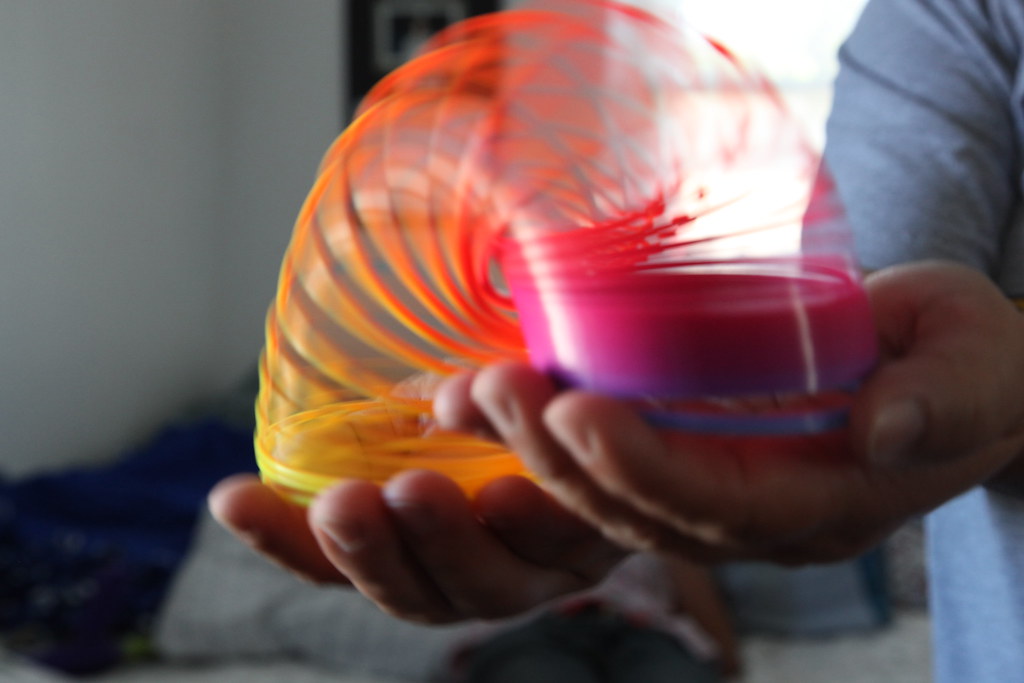
The Slinky made its public debut at a Gimbels department store in Philadelphia during the 1945 holiday shopping season. James set up a display and demonstrated the toy walking down an inclined plank, and the initial batch of 400 units reportedly sold out in about ninety minutes at a dollar apiece, a price that would run around fourteen dollars today. It was an unusually fast validation for a product built entirely around a manufacturing accident nobody had set out to commercialize.
The early success did not guarantee a smooth road ahead. Richard James left the family and the company in 1960, reportedly joining a religious group in Bolivia and taking much of the business’s cash reserves with him. Betty James was left to run James Industries largely on her own, and according to coverage from The Vintage News, she took the significant risk of mortgaging the family home to fund a booth at the 1963 International Toy Fair in New York, a gamble that paid off and helped relaunch the toy’s popularity for a new generation of children.
Still Just a Coil of Wire
Betty James kept the company running for decades afterward, and by the time the Slinky was inducted into the National Toy Hall of Fame in 2000, more than 250 million units had been sold worldwide. What makes the toy’s staying power notable is how little the product itself has changed since that first batch left the factory floor. It remains, at its core, a length of coiled steel wire with no batteries, no electronics, and no moving parts beyond the ones physics supplies for free once gravity gets involved.
That simplicity is part of what keeps the origin story so appealing decades later. A Navy engineer trying to stabilize equipment on a warship had no interest in toys, yet a single dropped spring turned into one of the most recognizable and enduring products in American toy history, built on an accident nobody could have planned for and a name a mostly self-taught businesswoman found by flipping through a dictionary.
A Jingle Almost Everyone Can Still Hum
Part of the Slinky’s staying power came from marketing that leaned into exactly how simple the product was rather than trying to disguise it. The company’s television jingle, built around the line promising the toy would walk down stairs alone or with a friend, became one of the most recognizable advertising melodies of its era, running with only minor updates for decades. Generations of children who never watched the original commercials still somehow know the tune, passed down the same informal way playground games and jump rope rhymes travel between kids who were never taught them formally.
The toy’s manufacturing also stayed remarkably close to home. James Industries kept production centered in Pennsylvania for decades, resisting the wholesale overseas manufacturing shift that reshaped so much of the American toy industry through the late twentieth century. That decision became a selling point in its own right, letting the Slinky market itself as one of the last mass-market toys still largely made using the same domestic process Richard James stumbled into by accident back when the company’s biggest customer concern was still winning a world war rather than winning shelf space at a big box retailer.

Leave a Reply