

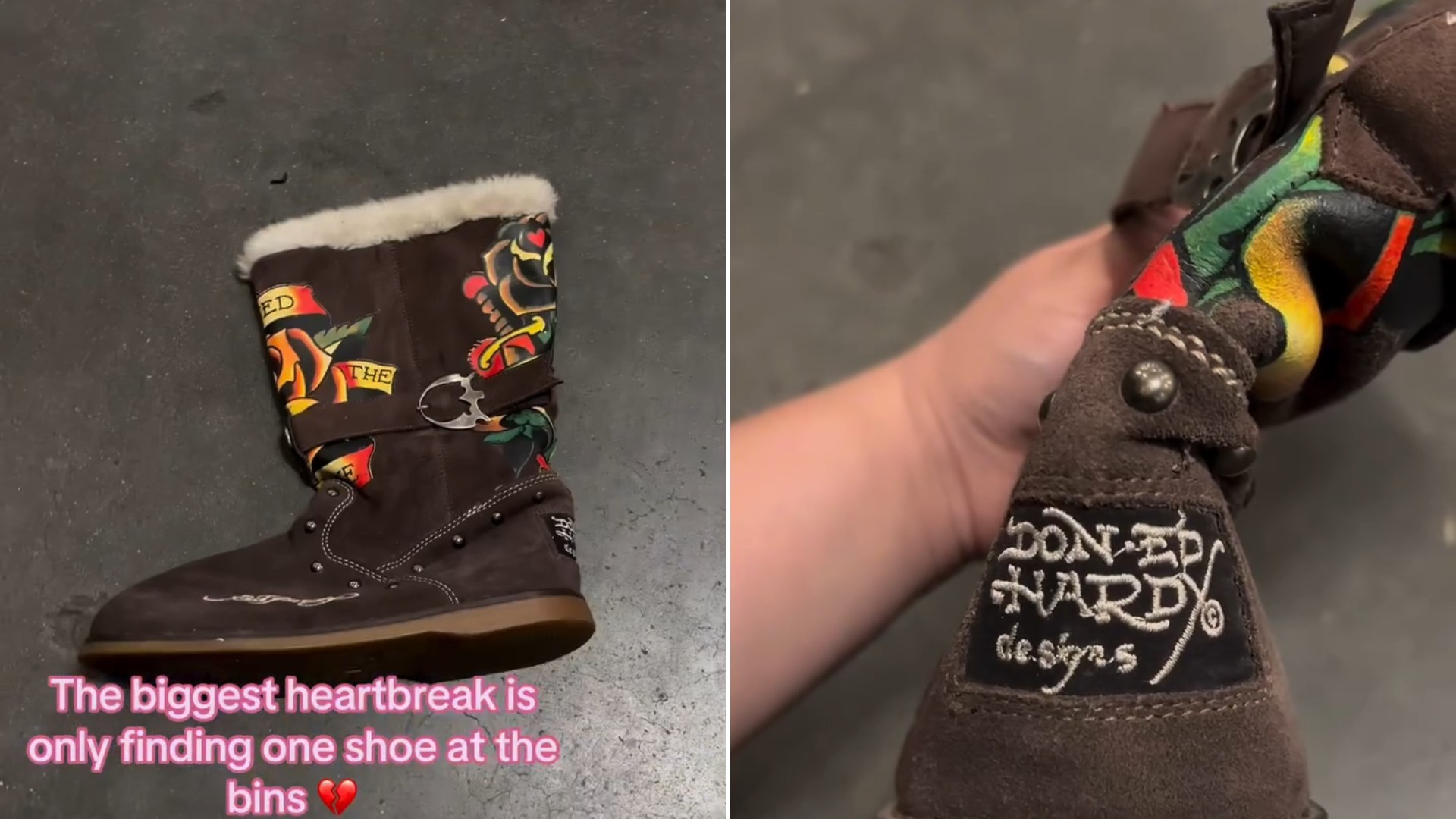
Every thrifter has a story about the one that got away, the item so good it becomes the thing you bring up months later out of nowhere. Reseller and closet curator prettyprincesscloset just added a new chapter to that genre when she found a single vintage Ed Hardy boot sitting in a bin, only to realize there was no matching pair anywhere else in the store.
The boot itself is the kind of piece that stops you mid aisle. Ed Hardy built its entire visual identity on bold tattoo flash art, the swallows, roses, tigers, and script lettering that came straight out of tattoo artist Don Ed Hardy’s own work before Christian Audigier licensed it into a full fashion line in the mid 2000s. Boots leaned especially hard into rhinestone embellishment and loud graphics in a way that made them impossible to mistake for anything else on a shelf.
Why Ed Hardy Still Hits a Nerve
The brand had a genuinely massive moment in pop culture, showing up on everyone from reality television stars to pro athletes during a stretch when maximalist, logo forward fashion ruled. It faded almost as fast as it rose, which is exactly the kind of arc that turns a brand into thrift gold two decades later. Gen Z rediscovered the aesthetic through Y2K revival trends, and millennials who wore it the first time around get an instant hit of nostalgia the moment they spot that tattoo lettering across a shoe or jacket.
A Brand Built From Tattoo Art
Ed Hardy the brand was built directly on the artwork of Don Ed Hardy, a tattoo artist widely credited as one of the pioneers of American tattoo culture. When Christian Audigier licensed that artwork for a clothing line in 2004, he took traditional tattoo flash, the swallows, koi fish, roses, and skulls that had lived on tattoo parlor walls for decades, and put it on hoodies, jeans, and boots aimed at a mainstream audience that had never set foot in a tattoo shop. It was a strange and wildly successful bet for a few years, turning underground tattoo imagery into something you could buy at a mall.
How to Spot the Real Thing
Because the brand got so big so fast, knockoffs flooded the market almost immediately, and that makes authentication part of the fun for anyone hunting Ed Hardy pieces today. Genuine boots and jackets tend to have dense, saturated embroidery and rhinestone work that feels solid rather than glued on, along with tags and hardware that match the era the piece is actually from. A thrifter who knows what real construction looks like has a much easier time telling a true 2000s piece apart from a later imitation riding on the trend’s nostalgia wave.
The Specific Tragedy of a Single Shoe
There is a particular flavor of thrift store heartbreak reserved for shoes, because unlike a jacket or a mug, a single boot is functionally useless on its own. Donation bins get separated, boxes get dumped out and picked through, and pairs get split up between different bags long before they ever reach the sales floor. Finding one boot that is clearly special, in a size that might even fit, only to search every shelf and bin in the building and come up empty, is close to a rite of passage for serious thrift hunters.
What Happens to a Shoe Like This
Some resellers hang onto orphaned shoes like this hoping the match eventually surfaces somewhere down the line, since donation centers do sometimes reshelve stock in waves. Others repurpose a standout single shoe as a display piece or a planter, treating it more like a collectible object than actual footwear. Either way, a boot this recognizable rarely gets left behind entirely, even without its partner, because the design alone carries enough nostalgia to be worth grabbing.
A Familiar Kind of Heartbreak
It is the kind of near miss that makes thrifting so addictive in the first place. A perfect match would have been the better outcome, obviously, but a single loud, rhinestone covered Ed Hardy boot sitting alone in a bin is still a small time capsule of an entire fashion era, and the disappointment of not finding its pair is proof of just how good the find actually was.

Leave a Reply