

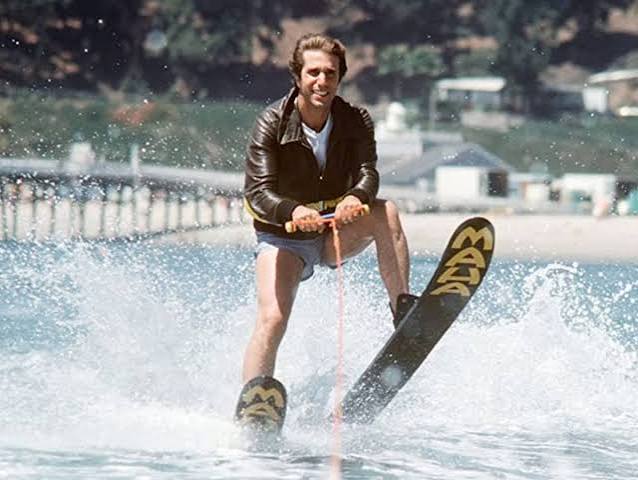
On September 20, 1977, roughly 30 million people tuned in to watch Arthur Fonzarelli strap on a pair of water skis, zip across a lagoon in his leather jacket, and sail clean over a caged shark. It was meant to be a crowning stunt for the coolest character on television. Instead, it eventually gave English a permanent new idiom for the moment a good thing goes flat.
The Stunt Itself
The episode, titled “Hollywood: Part 3,” was the third installment in a three-parter that sent the Cunningham gang out to Los Angeles. Richie and Fonzie, played by Ron Howard and Henry Winkler, end up at a Hollywood water-ski show where a producer dares Fonzie to prove his nerve. He agrees, dons his trademark jacket over swim trunks, and jumps a live shark penned off in the water. The episode was written by Fred Fox Jr., and according to a retrospective from Smithsonian magazine, the whole sequence unfolds under an almost cartoonishly bright blue sky and sea, with Winkler performing much of it himself.
At the time, none of this read as desperate. Happy Days was one of the highest-rated shows on network television, and the California arc was a ratings event in its own right, not a Hail Mary from a dying series. The show kept airing for seven more seasons after that jump, running eleven seasons in total before wrapping in 1984. Whatever the shark jump was, it was not the moment Happy Days actually declined.
A Dorm Room Coins a Phrase
The phrase itself did not exist until years later. In 1985, University of Michigan student Sean Connolly and his roommate Jon Hein were kicking around ideas about television shows that had passed their prime during a late-night conversation. Connolly landed on the Fonzie water-ski scene as the perfect symbol, and “jump the shark” was born as inside-joke shorthand between friends long before anyone outside their dorm had heard it.
Hein carried the joke with him for more than a decade before turning it into something bigger. In 1997 he launched JumpTheShark.com, a site that catalogued the exact episode, moment, or casting change where roughly 200 different television series supposedly tipped over into decline. Fans piled on with their own nominations for hundreds more shows, and the site turned an inside joke into a full-blown reference point for pop culture criticism. Hein eventually sold the company for more than a million dollars in 2006, according to the Wikipedia entry documenting the phrase’s history, which also notes it has since been applied well outside television, to everything from bands to political campaigns.
The Irony Fonzie Never Escaped
There is something almost unfair about how this played out for a show that was, by the numbers, still thriving in the fall of 1977. Happy Days had already spun off Laverne & Shirley into its own hit, and the extended Cunningham universe was arguably at its commercial peak. Yet a single stunt sequence, largely forgotten by casual viewers for eight years, became the permanent shorthand for a franchise supposedly running out of ideas. Henry Winkler himself has pushed back on the label over the years, pointing out that the episode tested well with audiences and that the show’s cultural footprint, drive-in diners, thumbs-up catchphrases, and all, only grew afterward.
What actually happened is a case study in how criticism calcifies into myth. A stunt episode gets a nickname from a couple of college kids, the nickname gets a catalog website a dozen years later, and the catalog website turns a single scene into the default vocabulary anyone reaches for when a sitcom introduces a new baby, a talking dog, or a long-lost cousin to keep the ratings up. Coverage from Mental Floss traces the same arc, noting how thoroughly the phrase outgrew its source material.
Happy Days ultimately aired its final episode in the summer of 1984, closing out a run that most measures would call successful rather than declining. But mention the show today and the shark jump usually comes up before the diner, the jukebox, or Mr. Cunningham’s hardware store ever does. Few single television moments have detached so completely from their own plot and floated off to describe something else entirely, a phrase so useful it barely needs the show that spawned it anymore.

Leave a Reply