

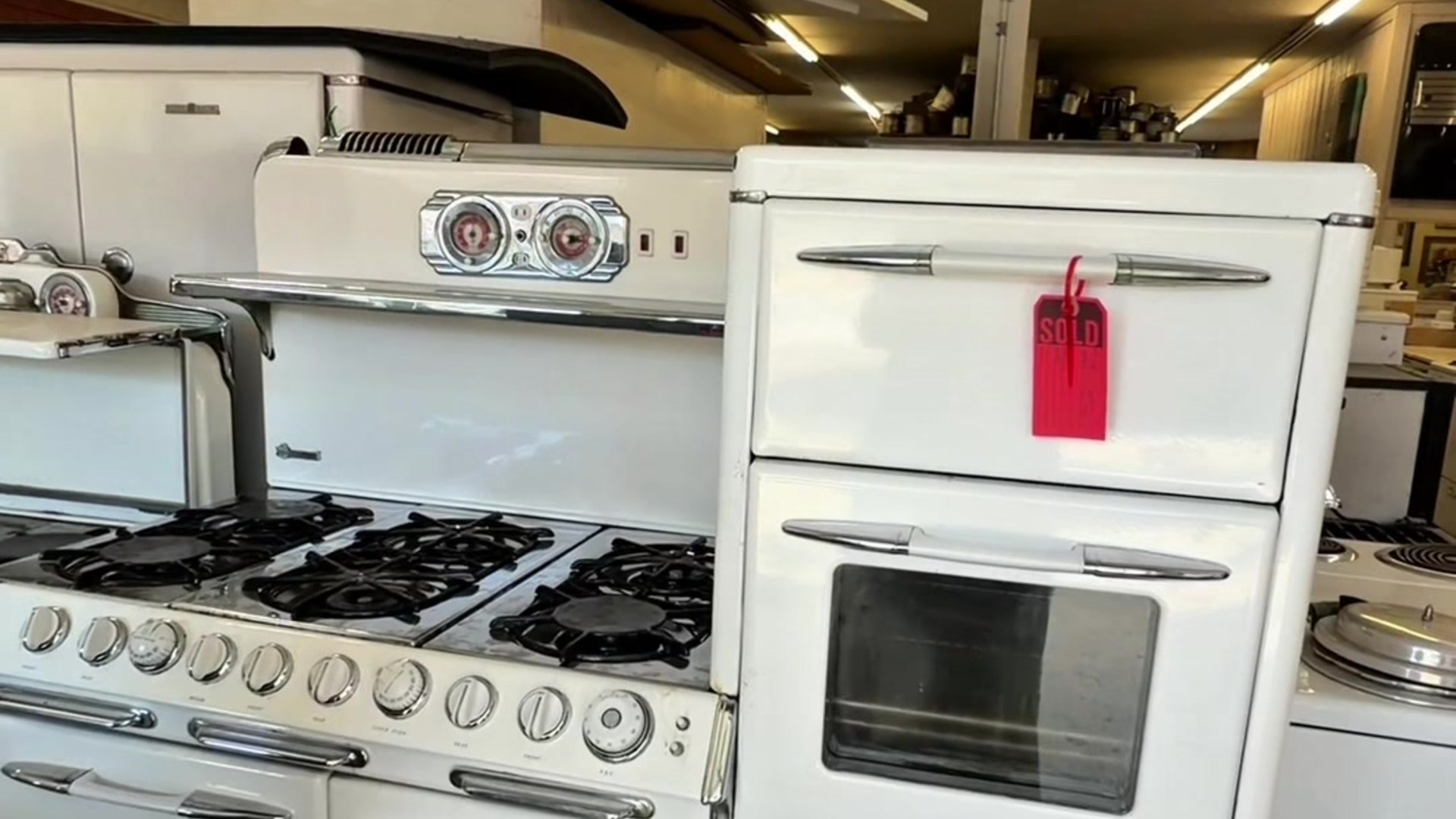
Some vintage kitchen appliances are content to sit quietly in a corner looking nice. A restored O’Keefe and Merritt stove is not one of them. Creator @mrshappyhomemaker recently stopped by a specialty antique-appliance store to tour one of these fully restored ranges in a showstopping red finish, and retro kitchen fans have not stopped talking about it since.
The Brand Behind the Obsession
O’Keefe and Merritt built its reputation in the mid-twentieth century making some of the most beloved gas ranges ever produced for American kitchens, the kind with heavy cast-iron grates, chrome trim, built-in griddles, and porcelain enamel finishes in colors that modern appliance lines rarely attempt anymore. These were not budget stoves. They were built to last, with a heft and mechanical simplicity that has made them wildly appealing to collectors decades after the company stopped producing them, and a reputation among vintage appliance fans that has only grown as reproduction ranges try, and mostly fail, to recreate the same look at a fraction of the price.
Part of the brand’s staying power comes from how differently these ranges were engineered compared to what most kitchens get today. A vintage O’Keefe and Merritt was built with the assumption that it would be repaired, not replaced, which means even a stove that sat unused for decades usually has more salvageable, working parts underneath the surface than anyone would expect from an appliance that old. That built-to-be-fixed mentality is exactly what makes a specialty restoration shop possible in the first place.
Why Restoration Is Its Own Specialty
Bringing one of these stoves back to functioning, kitchen-ready condition is not a weekend project. Specialty shops that focus on antique appliances typically strip a range down to bare metal, rebuild or replace the internal gas components to meet modern safety standards, recondition the porcelain enamel exterior, and polish the chrome trim back to a shine that decades of grease and use had long since dulled. The end result looks like something pulled straight out of a 1950s catalog, but functions like a modern range, which is exactly the combination that makes a fully restored piece worth far more than one still sitting untouched in a barn or basement.
That combination of authentic looks and modern function is also why a specialty store dedicated entirely to these appliances exists in the first place. Vintage stoves are heavy, mechanically complex, and often need parts sourced from other retired units just to get running again, which puts a real restoration well outside the scope of most home renovators working solo. A shop that stocks, restores, and sells these ranges essentially does the hardest part of the work before a stove ever reaches a customer’s kitchen.
Why Retro Kitchen Fans Cannot Look Away
Part of what makes a tour like this one so satisfying to watch is the sheer specificity of the details. A stove like this comes loaded with features that modern ranges have largely abandoned: multiple broiler drawers, built-in warming compartments, oversized control knobs, and enamel in colors bold enough that a manufacturer today would probably consider them a risk. Every one of those details reads as a small design decision from an era when kitchen appliances were built to be looked at as much as used, not hidden behind cabinet panels or kept deliberately neutral.
That red finish in particular does a lot of the visual work. A red vintage range is not a subtle kitchen choice, and it was never meant to be. In an era of stainless steel and matte black appliances designed to disappear into a kitchen’s background, a stove built to be the loudest thing in the room feels almost rebellious, which is exactly the appeal for anyone chasing a genuinely retro kitchen rather than a modern kitchen with a few vintage-inspired accents scattered around.
Tours like this one are a reminder that the retro kitchen revival is not just about paint colors and open shelving, it is about tracking down the real thing whenever possible. A specialty shop with a fully restored O’Keefe and Merritt on the floor is basically a museum you are allowed to actually cook on, and it is easy to see why a video showing off exactly that stopped so many people mid-scroll. For anyone chasing a genuinely retro kitchen rather than a modern approximation of one, a shop like this is proof that the real, original appliances are still out there, still fixable, and still worth the search.

Leave a Reply