

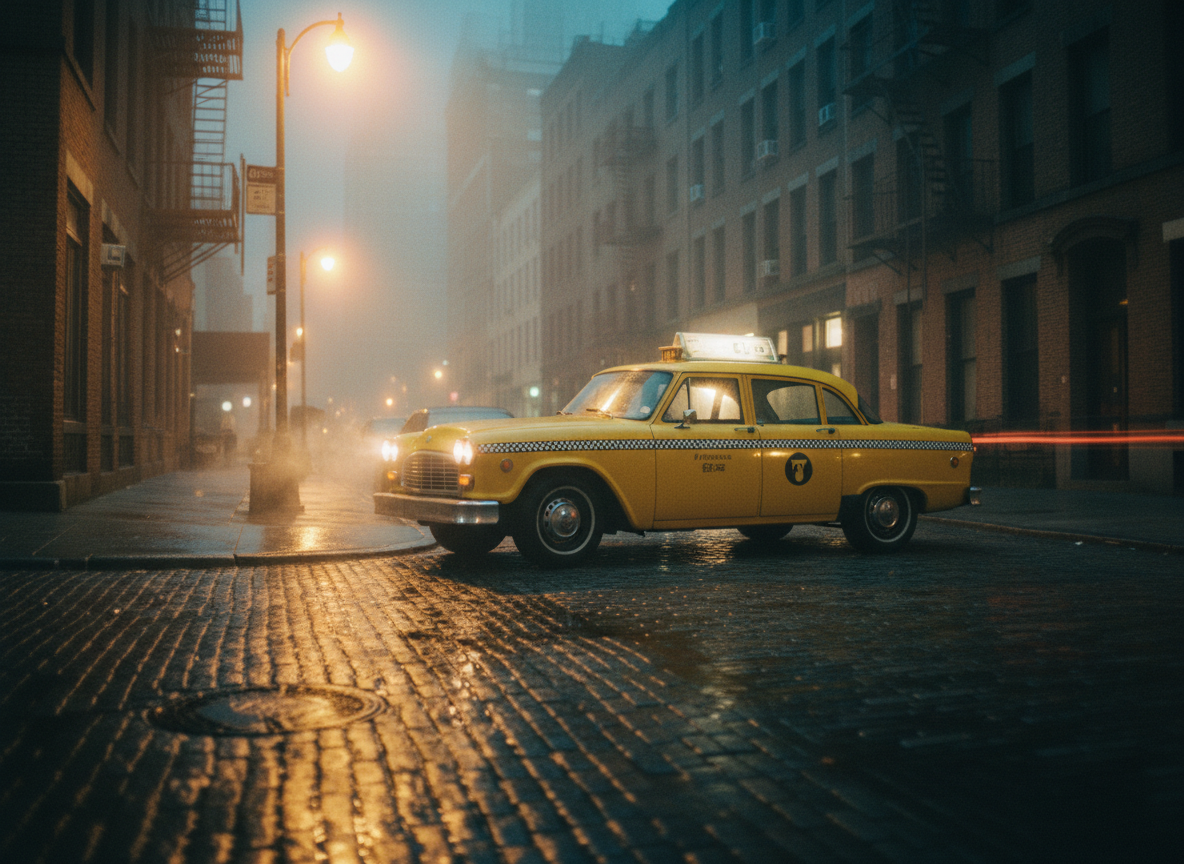
Robert De Niro got an actual New York City hack license in 1976, and according to a production account preserved in the AFI Catalog, he spent real weekends driving a real cab through Manhattan months before a single scene of Taxi Driver was filmed. One passenger who climbed into that cab, a writer named Mark Carducci, didn’t recognize his driver at all and later wrote about the ride without realizing an Oscar nominee had been behind the wheel.
A license that ended up in a museum
That hack license wasn’t a prop. It was the real municipal document New York City issued to actual working cabbies, and De Niro carried it as part of building Travis Bickle from the ground up rather than performing him from the outside. The license eventually left his possession entirely: it’s now part of the permanent collection at the Harry Ransom Center in Austin, Texas, filed alongside other archival material documenting how the film actually got made.
The numbers behind the film that almost didn’t get made
Taxi Driver premiered in New York on February 7, 1976, and opened in Los Angeles on February 25, per the AFI Catalog’s release records. It was built on a production budget of just $1.8 million, and it went on to gross roughly $29 million worldwide, with $28.3 million of that coming from U.S. theaters alone, according to its box office record. That’s a return north of fifteen times the money it cost to make, on a film about a lonely, alienated Vietnam veteran driving graveyard shifts through 1970s Times Square.
The film also won the Palme d’Or at the 1976 Cannes Film Festival and picked up four Academy Award nominations at the following year’s ceremony, including Best Picture, Best Actor for De Niro and Best Supporting Actress for a 13-year-old Jodie Foster. Its score, one of the most recognizable in film history, was composer Bernard Herrmann’s last: he finished recording it and died hours later, on December 24, 1975, before the film had even reached theaters.
The line nobody wrote down
Screenwriter Paul Schrader built the entire script around Travis Bickle’s isolation, but the film’s most quoted moment, “You talkin’ to me?”, doesn’t actually appear in Schrader’s original screenplay. It’s widely documented in film histories that De Niro improvised the mirror monologue on set, building an extended riff out of a single scripted stage direction that simply called for Travis to talk to himself. Scorsese kept the cameras rolling and kept the take.
That single unscripted moment has outlived nearly everything else about the film’s marketing. It’s been referenced, parodied and quoted in movies, sitcoms and stand-up sets for five decades, almost always stripped of the context that Travis is talking to an empty mirror in a rundown apartment, rehearsing a threat he has no one to deliver it to. The line survived because De Niro found something true inside an improvisation, the same instinct that sent him looking for a real cab to drive in the first place.
A city that didn’t need set dressing
Scorsese shot on the actual streets of 1970s Manhattan rather than building a version of it on a backlot, and the city he found needed almost no embellishment. Times Square in 1975 was genuinely full of the peep shows, porn theaters and street-level grime the film shows Travis driving past every night, which meant the production’s biggest design decision was mostly just showing up with a camera. That choice is part of why the film still reads as documentary-adjacent rather than stylized period piece, even fifty years and a fully renovated Times Square later.
De Niro’s cab research fit into a broader approach Scorsese and Schrader took with the character: nothing about Travis Bickle was meant to look performed. Travis’s diary entries, narrated in voiceover throughout the film, carry that same grounded, first-person logic rather than reading like exposition written for an audience. The hack license was simply the most literal version of a method that ran through every part of the production, on camera and off.
Fifty years later, the research still shows on screen
What holds Taxi Driver together half a century on isn’t just Schrader’s script or Scorsese’s camera work through a grimy, pre-Giuliani New York. It’s that De Niro’s preparation wasn’t a publicity story invented after the fact. The license is a physical object sitting in an archive, the fare records are part of the film’s own production history, and the choice to actually drive a cab rather than research one secondhand is exactly the kind of detail that separates a performance people remember from one they simply watched.

Leave a Reply