

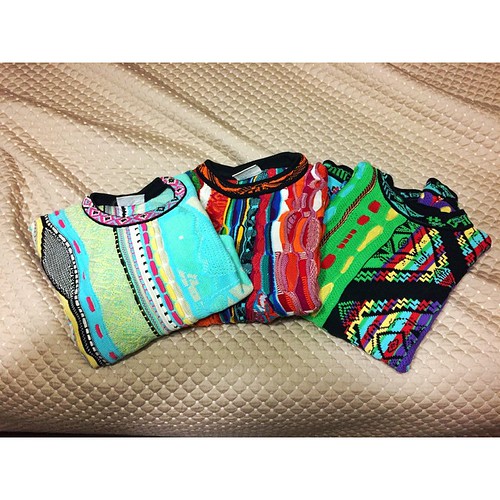
Coogi started in 1969 in Toorak, a well-heeled suburb of Melbourne, under the name “Cuggi,” selling colorful knit sweaters to tourists as souvenirs of Australia. The label didn’t even adopt the name most people recognize today until 1987, nearly two decades later. By the mid-1990s, that same small knitwear brand had become one of the most name-checked labels in American hip-hop, worn by a rapper who never set foot in Australia and referenced in lyrics that turned an obscure export into a coast-to-coast status symbol.
Souvenir Sweaters With an Unusual Design Language
What set the brand apart from ordinary knitwear was never subtle. Coogi’s sweaters were built around asymmetrical patterns and varied textures within a single garment, with color combinations drawn from Australian landscapes and Aboriginal art influences, according to the Smithsonian’s Cooper Hewitt design museum. No two panels of a given sweater necessarily matched, which made every piece read as more of a hand-built object than a mass-produced garment, even once the company scaled up. That texture-heavy, deliberately mismatched knitting technique is the exact quality that later made the sweaters instantly recognizable from across a room, or a music video set.
The Legend Skips a Step the Real Timeline Doesn’t
The popular version of the Coogi story tends to start and end with one rapper. The fuller timeline is a little more layered. Coogi had already built some American visibility in the 1980s through appearances tied to Bill Cosby, whose eclectic sweater rotation on his sitcom made the brand recognizable to at least some corner of the U.S. market well before hip-hop discovered it. A hip-hop stylist who worked New York’s club scene in the early 1990s has described the pre-Biggie perception bluntly: outside of Cosby’s audience or the small pool of people who could afford imported Australian knitwear, almost nobody in New York’s hip-hop scene had heard of the brand at all.
That changed through a specific, traceable introduction rather than an accident. The Notorious B.I.G. was reportedly introduced to Coogi in the early 1990s by a stylist working Manhattan’s Grand nightclub, and once he started wearing the sweaters in public and in photo shoots, the brand’s profile inside hip-hop shifted almost immediately. His 1994 single “Big Poppa” namechecked the label directly, and by his 1997 track “Hypnotize,” references to Coogi were reportedly enough on their own to send fans looking to buy the sweaters. A widely circulated 1995 photograph of Biggie in Coogi knitwear, shot by photographer Dana Lixenberg, became one of the defining images tying the brand permanently to his legacy.
A Company That Had to Catch Up to Its Own Sweater
The commercial side of the brand lagged behind its own cultural moment for years. Coogi didn’t move beyond sweaters into a full apparel line until 2002, when a New York-based joint venture called Coogi Partners LLC acquired the label and expanded it into jeans, footwear, outerwear, and accessories, per company trademark and ownership records. That’s more than half a decade after the brand’s biggest hip-hop moment had already happened, which means the label spent years riding a wave of demand it hadn’t actually built the infrastructure to fully capture. A 2014 relaunch pulled the brand back toward its original focus, reintroducing men’s sweaters in new colorways rather than chasing the broader apparel line the 2002 venture had built.
The Reference Outlived the Rapper by Decades
Biggie died in 1997, but Coogi mentions kept showing up in hip-hop long after, from Kanye West working the brand into lyrics on “Gone” and “Devil in a New Dress” to more recent name-checks from Rick Ross, A$AP Ferg, Birdman, and Hilltop Hoods. Streetwear labels including Rag & Bone and Supreme have paid their own tribute through homage collections over the years, treating the knitwear as a design reference point rather than just a nostalgia prop. Vintage Coogi pieces now regularly sell for hundreds of dollars on resale markets, a real premium for sweaters that started life as tourist souvenirs from a Melbourne suburb.
The legend compresses all of that into one image: a rapper, a sweater, an instant symbol. The real story is slower and, honestly, more interesting — a small export label that spent two decades building a genuinely unusual knitting technique before one very specific New York introduction turned it into shorthand for having made it, years before the company itself was built to keep up with the demand.

Leave a Reply