

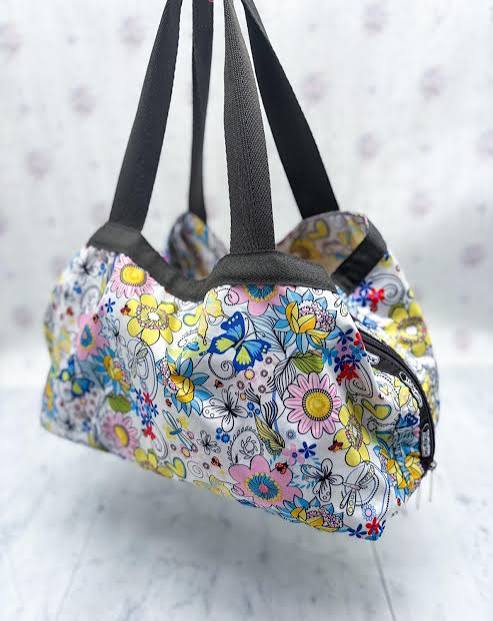
A vintage LeSportsac floral travel duffel bag recently sold on Poshmark for $75, marked down from its original $100 tag, while a leopard-print fanny pack from the same brand went for $28 and a Tokidoki-print crossbody cleared $135. Prices across active vintage LeSportsac listings on the platform range from roughly $15 for a small cosmetic pouch to $165 for a rarer print, spread across pages of inventory that keeps refreshing as sellers dig old bags out of closets. For a brand built on lightweight nylon rather than leather or hardware, that’s a striking amount of resale activity for pieces most original owners assumed were disposable.
A Brand Built for the Jet Age, Not the Runway
LeSportsac wasn’t founded with resale value in mind. According to the brand’s own account of its history, husband-and-wife founders Melvin and Sandy Schifter started the company in 1974 to “create a brand that would transcend gender norms and cater to the needs of individuals who sought functional yet stylish bags,” at a moment when air travel was becoming a mainstream experience rather than an occasion. Instead of the heavy luggage-grade materials competitors like Samsonite were using, the Schifters built their bags from rip-stop nylon, a fabric durable enough for airline baggage handlers to abuse and light enough that it didn’t add much weight to a suitcase. That practical starting point, not a fashion pedigree, is what put a LeSportsac bag on so many shoulders in the first place.
How a Travel Brand Became a Print Machine
The bags that show up most often in today’s resale searches trace back to a specific reinvention. Founders’ son Tim Schifter took over management toward the end of the 1990s and, according to WorthPoint’s history of the brand, introduced brighter colors, more elaborate hardware, and a run of designer collaborations with names like Diane von Furstenberg and Stella McCartney. Gwen Stefani’s 2003 L.A.M.B. collaboration pushed the brand further still, turning it from a niche accessory line into what WorthPoint describes as “a worldwide phenomenon.” Schifter also deliberately limited how long each print stayed available, training a generation of shoppers to buy a bag the moment they liked it rather than wait, a habit that maps almost perfectly onto how resellers now hunt for discontinued prints decades later.
What Resellers Are Actually Chasing
Today’s vintage LeSportsac market skews heavily toward the prints and collaborations that had the shortest original shelf life. Active Poshmark listings show Y2K-era graphic prints and licensed collaborations, including a Tokidoki crossbody, commanding some of the strongest prices in the category, while simpler solid-nylon totes and cosmetic pouches from the same era tend to sell for less. Etsy’s own marketplace for the brand shows a similarly steady churn of listings under its dedicated vintage LeSportsac category, evidence that demand has held up long enough for sellers to treat it as a standing search term rather than a one-off flip. The bags themselves haven’t changed; what’s changed is that a nylon tote nobody thought twice about donating in 2010 is now something a reseller will dig through a bin specifically to find.
Licensed Prints Are Their Own Category
Collaborations weren’t limited to designer names. WorthPoint’s rundown of the brand’s most coveted designs also lists a run of licensed-character prints, including Hello Kitty, Pokemon, Disney, and Harry Potter tie-ins, alongside the DVF and L.A.M.B. lines. Those licensed pieces occupy an odd middle ground in the resale market: too niche for a general vintage-clothing dealer to always recognize, but instantly identifiable to the specific collector who grew up wanting that exact backpack. That mismatch between broad obscurity and narrow, intense demand is exactly the kind of gap resellers have learned to search for.
Ownership Since 2011
The brand itself has changed hands in the meantime. LeSportsac has been owned by the Japanese trading company Itochu Corp since March 2011, which now controls the worldwide rights to the name and its archive of prints. That ownership shift happened well after most of the bags now driving resale interest were originally manufactured, which is part of why so many of the most-wanted prints exist only in secondhand form; the current company isn’t necessarily reissuing the exact patterns a Poshmark search keeps turning up.
A bag engineered for disposability, cheap enough to replace and light enough to forget about, has ended up outlasting plenty of the leather goods it was never trying to compete with, mostly because nobody thought to keep the receipts on something so unserious at the time.

Leave a Reply