

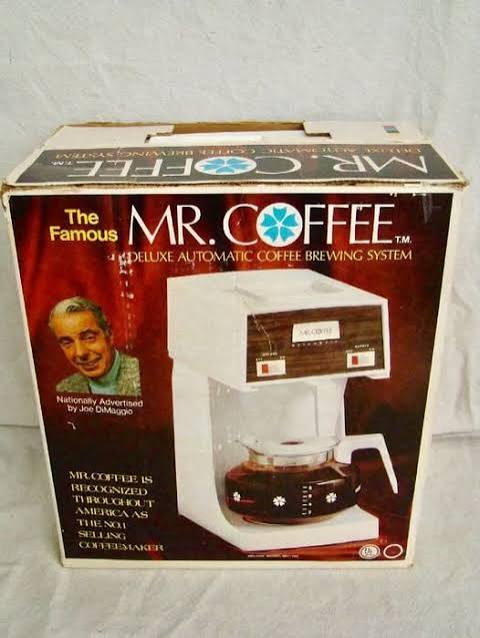
In 1972, a company called North American Systems put a $39.99 coffee maker on shelves that dripped hot water through a paper filter instead of boiling it over and over the way a percolator did. Seven years later, that machine, sold under the name Mr. Coffee, controlled half of the entire American coffee maker market and had generated $150 million in sales, according to a 1979 Forbes account of the company’s rise. The percolator, a fixture on American stovetops for generations, never really recovered.
An Engineer’s Fix for a Bad Cup of Coffee
Mr. Coffee’s inventor, Vincent Marotta, wasn’t a coffee professional. He and childhood friend Samuel Glazer had been real estate developers before a 1968 credit crunch stalled their business, and Marotta pivoted after his wife, Ann, complained about how bad most home-brewed coffee tasted. According to Wikipedia’s account of Marotta’s career, he spent roughly three years chasing what he described to Forbes as “a mechanical means of controlling the time and temperature of the water,” eventually hiring two former Westinghouse engineers, Edmund Abel and Erwin Schulze, to design a machine that dripped 200-degree water through paper-filtered grounds into a glass carafe rather than recirculating boiling water the way a percolator does. That single change solved the biggest complaint about percolated coffee: the burnt, bitter flavor that came from cooking the same grounds over and over.
Why a Retired Baseball Player Sold Coffee Makers
Getting American kitchens to trust an unfamiliar appliance took more than better engineering. Marotta discovered that Joe DiMaggio had already won a Mr. Coffee machine as a golf tournament prize, and after DiMaggio turned him down over the phone, NPR’s account of the partnership describes Marotta flying to California with his wife to make his case over lunch at San Francisco’s Fairmont Hotel. DiMaggio agreed on the spot and stayed on as Mr. Coffee’s spokesman for roughly 15 years, becoming one of the most recognizable pitchmen of the decade despite, by his own admission, rarely drinking the product himself, he preferred decaffeinated Sanka because of a stomach ulcer. The campaign worked anyway: Mr. Coffee sold more than one million units by April 1974, according to the company’s own history, and total annual sales had climbed to $174 million by 1995.
The Percolator’s Quiet Exit
The shift away from percolators happened faster than most kitchen-appliance transitions typically do. Wikipedia’s history of the percolator notes that the devices, once standard equipment in nearly every American kitchen, were “supplanted in the early 1970s by automatic drip-brew coffeemakers” as instant coffee also improved and gave percolators a second source of competition. The retreat showed up in ordinary grocery-store inventory as much as in appliance sales: General Foods discontinued its Max-Pax percolator filter packs in 1976, and by the end of that decade, generic percolator filter rings had largely vanished from store shelves too. A pot that had defined the sound and smell of American mornings for the better part of a century was, within roughly a decade, hard to even find replacement parts for. That is a strikingly narrow window for an appliance to go from ubiquitous to obsolete, especially one that had no real design flaw beyond the flavor of what it produced, it simply lost to a machine that solved the one problem percolators were never built to fix.
What Happened to the Company Itself
Marotta stayed at the helm through the entire transition he’d set off. Wikipedia’s account of his career notes he served as North American Systems’ chairman and CEO from the company’s founding until it was sold in 1987, by which point the drip coffee maker he’d spent three years developing in a garage had become the default way most American households made coffee, not the novelty it was when DiMaggio first appeared on television holding one. The percolator never fully vanished, plenty of camping-gear aisles and stovetop-coffee loyalists kept it alive, but it stopped being the default appliance sitting on a kitchen counter, which is a much quieter kind of extinction than a product simply disappearing from shelves altogether.
DiMaggio had already retired from baseball two decades earlier when the Mr. Coffee campaign made him famous to an entirely new audience, one that knew him from grocery-store television commercials before they ever knew his batting average, a strange kind of second stardom for a man who, according to the people who worked with him, never much cared for the coffee he was selling.

Leave a Reply