

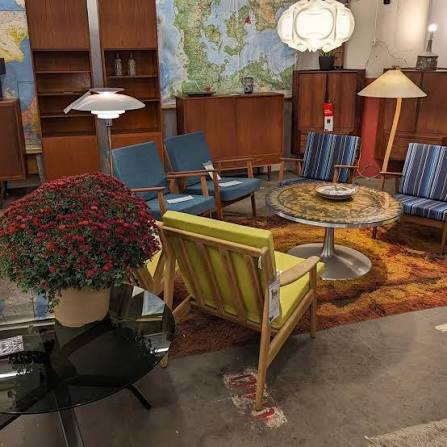
In 1950, a small Copenhagen workshop run by cabinetmaker Johannes Hansen exported exactly zero pieces of furniture to the United States. By 1955, two-thirds of everything that workshop made was headed overseas, most of it to American buyers who a few years earlier would have walked past a spare teak chair in favor of a carved mahogany reproduction. That reversal didn’t happen by accident, and it took decades more before the same furniture became the auction-house darling it is today, with original 1950s and 1960s pieces now pulling prices that new production furniture, even well-made new production furniture, simply cannot touch.
A Style Most American Retailers Doubted
According to design historian Kjetil Fallan’s research on the period, published as “Networks, Narratives, and New Markets: The Rise and Decline of Danish Modern Furniture Design, 1930-1970”, most American furniture manufacturers and retailers in the late 1940s and early 1950s assumed mainstream shoppers wanted traditional styles that imitated upper-class European antiques, not spare modernist pieces with exposed joinery and thin, tapered legs. Manufacturers argued that working- and middle-class families would reject anything that looked unfinished next to the heavily upholstered, ornately carved suites already dominating American showrooms. Danish teak, with its bare wood and visible construction, was exactly the kind of furniture that argument was built to exclude.
How the Tastemakers Changed the Math
The turning point came through institutions rather than mass demand. The Nation’s history of the style notes that Edgar Kaufmann Jr. of the Museum of Modern Art began purchasing Danish pieces for public display, and House Beautiful editor Marion Gough later wrote that “people were ‘discovering’ this beauty even before the experts stamped it with their approval.” A 1950 magazine feature on Danish chairs, cited in Fallan’s research, generated enough reader interest that it helped launch Hansen’s export business from nothing. By 1960 the style’s cultural stock had risen so far that Hans Wegner’s Round Chair appeared beneath both John F. Kennedy and Richard Nixon during their first televised debate, earning it the nickname “The Chair.”
The Export Numbers Tell Their Own Story
The scale of that shift shows up plainly in Danish trade figures. Records cited in the history of the Danish modern movement show Danish furniture exports climbing from roughly 9.8 million kroner in 1953 to 257.8 million kroner by 1964, a jump of more than twenty-five times in about a decade, with sales peaking around 1963 before cheaper substitutes and shifting tastes cut into demand. Those figures describe a style that went from a hard sell to a genuine boom within roughly a decade, once the right names started vouching for it publicly.
Why It Nearly Disappeared, and Why It’s Back
Success eventually undercut the style’s exclusivity. As The Magazine Antiques has documented, American manufacturers began copying the look domestically by the mid-1950s and commissioning cheaper knockoffs from Yugoslavia and Taiwan, flooding the market until genuine Danish pieces got, in the article’s words, “damned by its own success” and associated with commercial cheapness rather than craftsmanship. Interest cooled further through the late 1960s as Mediterranean styles and plastic-and-Formica furniture took over, and by the 1990s, as 1stDibs has noted, teak furniture was firmly out of fashion. The revival didn’t arrive until roughly 2005, when collectors and designers rediscovered what the originals were actually made of.
What Original Pieces Have That New Ones Don’t
That distinction matters more than it might sound. Jenny Cashin, owner of Mid-Century Modern Home, told 1stDibs that contemporary teak simply isn’t comparable: “You can still get teak, but it’s just not the same quality… it wouldn’t have the tight grain because it’s younger.” Old-growth teak, harvested from trees that had a century or more to mature before Danish workshops ever touched them, produced a density and grain pattern that younger plantation-grown teak can’t replicate at any price. Auctioneer Peter Loughrey put the current appeal even more plainly in the same Magazine Antiques piece, saying that “sophisticated collectors are now realizing how beautiful and well-made Danish furniture from the fifties and early sixties is.” Combine finite supply with rediscovered craftsmanship and the arithmetic tips decisively toward the vintage sideboard over the flat-pack replica sitting next to it in a showroom.
The same spare, joint-forward construction that once struck American buyers as unfinished is now precisely what a four-figure sideboard listing is selling, proof that “too plain” was never really about the wood, but about what a room was expected to look like at the time.

Leave a Reply