

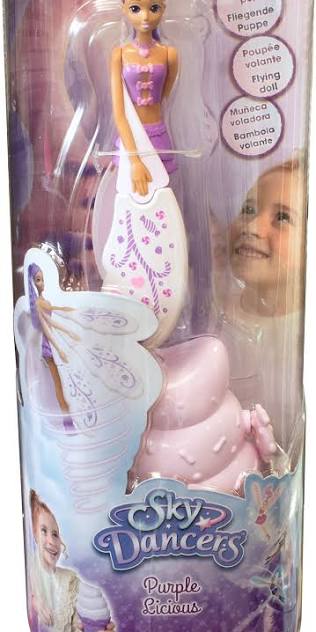
Sky Dancers launched from a plastic base with a yank of a pull-cord, spun into the air on stiff foam-covered wings, and landed — with real frequency — in a child’s face.
Between 1994 and 2000, the flying dolls became one of the decade’s hottest girls’-toy lines for Galoob before racking up 170 separate reports of the toys striking bystanders, an outcome serious enough to trigger a recall of nearly 9 million units and a federal fine against the company that made them.
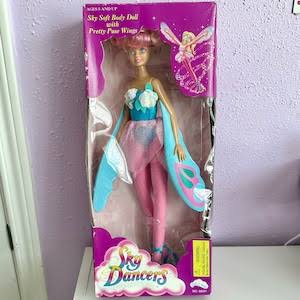
A Simple Launch Mechanism, an Unpredictable Flight Path
The premise was straightforward by 1990s toy standards. A doll — dressed as a fairy, a ballerina, or one of several other themed characters — slotted feet-first into a molded plastic launcher shaped like a dolphin, a flower, a moon, a pony or a rainbow, depending on the line. A pull-cord spun the doll’s wing-covered arms and launched it skyward, where it would flutter and twirl before coming back down. Galoob released it in 1994 at a retail price between $8 and $25, and it became one of the more recognizable toy lines of the mid-’90s, spinning off variants including Pretty Lights Sky Dancers, Mini-Sky Dancers and Fairy Flyers, according to the U.S. Consumer Product Safety Commission’s own recall notice.
The problem was the part that made it fun in the first place: once launched, the hard plastic dolls didn’t follow a predictable arc. They could “fly rapidly in unpredictable directions,” the CPSC’s notice states, striking whoever happened to be standing nearby — sibling, parent, or the child who launched it in the first place. Packaging carried an “Ages 5 and Up” label and a warning that it wasn’t intended for children under 3, but the hazard wasn’t really about age; it was about physics. A spinning piece of hard plastic launched at speed doesn’t check who’s in its path.
The Injuries Behind the Recall
By the time the CPSC and Galoob jointly announced a nationwide recall on June 27, 2000, the agency had logged 170 incident reports describing Sky Dancers striking people, resulting in 150 documented injuries. The list, laid out in the CPSC’s recall announcement, reads more like an emergency-room log than a toy-safety notice: eye injuries including scratched corneas and cases of temporary blindness, a mild concussion, a broken rib, broken teeth, and facial lacerations serious enough to require stitches. The recall covered roughly 8.9 million dolls sold nationwide over the toy’s six years on shelves, and Galoob offered free replacement toys to anyone who called the company’s toll-free line and agreed to stop using the originals immediately.
The fallout didn’t end with the recall itself. In 2001, the CPSC announced that Galoob had agreed to pay a $400,000 civil penalty specifically over how it handled the injury reports — not the toy’s design, but the delay in reporting the defect to federal regulators once the company had reason to know about it, according to the CPSC’s announcement of the fine. Consumer product safety law requires manufacturers to notify the agency promptly once they learn a product creates a substantial risk of injury, and the penalty reflected a finding that Galoob sat on incident reports longer than the law allowed. Galoob settled the matter without admitting it had violated the Consumer Product Safety Act, a standard arrangement in civil penalty cases of this kind, but the dollar figure and the CPSC’s public framing of the case made clear regulators viewed the delay as the real offense.
What Made Sky Dancers Different From an Ordinary Recall
Toy recalls were hardly rare in the 1990s, but Sky Dancers stood out for the sheer scale of the injury count relative to a toy that, on its face, looked like nothing more dangerous than a plastic top with wings. The volume of incidents — 170 reports generating 150 injuries — meant the CPSC wasn’t responding to a handful of freak accidents but to a pattern serious enough to justify pulling nearly 9 million units back from homes across the country. It’s also a reminder that toy-safety failures in that era rarely came from exotic materials or hidden chemical hazards; they came from ordinary mechanical energy, applied to hard plastic, aimed at a child’s face by design.
Sky Dancers never fully returned to shelves in its original form after the recall, and the line’s mid-’90s ubiquity gave way to a reputation defined almost entirely by the CPSC paperwork that followed it. The pattern behind the episode has repeated across decades of children’s products since: a toy engineered for maximum motion and spectacle, tested against fun long before anyone tested it against a kid’s face.

Leave a Reply