

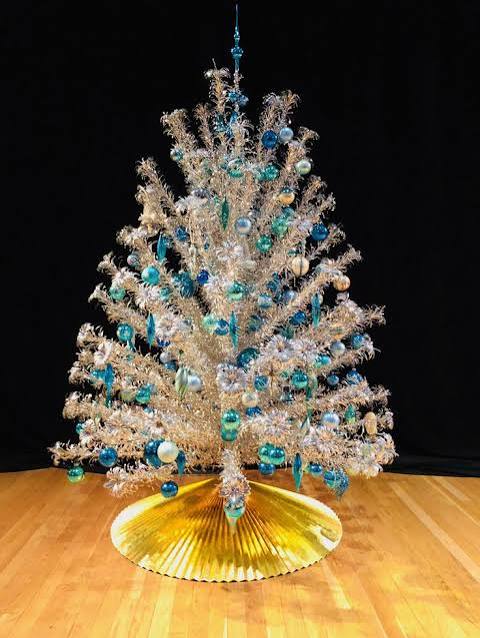
A dented, seven-foot Evergleam sold on eBay in December 2024 for $10,750. It was a genuinely rare pink model, sure, but not a prototype or a one-off — a production-line tree that a small Wisconsin company once cranked out by the hundreds of thousands. According to Money Digest, that price reflects just how far these once-disposable holiday decorations have traveled, from department store bestseller to punchline to five-figure collector’s item.
The Evergleam started, appropriately enough, with an accident of retail curiosity. An employee of the Aluminum Specialty Company in Manitowoc, Wisconsin spotted a metal Christmas tree in a Chicago store window in 1958 and brought the idea home. The company debuted its prototype at the American Toy Fair in New York that following March, then rushed hundreds of thousands of units into stores in time for the 1959 holiday season, according to the Wisconsin Historical Museum, which has documented the tree’s history in its own regional exhibit. By 1960 the line carried the Evergleam name, and by the mid-1960s it was, by the museum’s own account, “the most popular tree available” in American living rooms — several million of them sold, silver branches catching the light of a rotating color wheel instead of a single string of bulbs.
Then came 1965, and Lucy Van Pelt ruined everything. In “A Charlie Brown Christmas,” she orders Charlie Brown to “get the biggest aluminum tree you can find — maybe paint it pink,” a line that became shorthand for everything the special was rejecting: gaudiness, groupthink, the commercial Christmas machine. Charlie Brown instead comes home with a scrawny, real, slightly-too-honest little fir, and America apparently agreed with him. Aluminum trees, so recently the height of modern taste, started to look cheap.
Whether the cartoon actually killed the trend is more complicated than the legend suggests. Researchers at CBR’s “TV Legends Revealed” column dug into the sales data and found that 1965 — the year the special aired — was actually the aluminum tree industry’s peak, with roughly 100,000 units sold that season. The category had nowhere to go but down regardless, the site concluded, as tastes were already drifting toward earthier, more natural-looking décor. Correlation, not causation. But the special’s mockery stuck to the trees anyway, and cultural reputations rarely survive a well-aimed joke intact. Production slowed through the rest of the decade, and the Aluminum Specialty Company discontinued the Evergleam entirely by 1971 or 1972, per the Wisconsin Historical Museum’s timeline, roughly a decade after it had been the hottest tree in the country.
Part of what made the Evergleam so easy to mock in the first place was how it was actually lit. Real Christmas bulbs could scorch the metallic branches, so families instead aimed a motorized, rotating color wheel — a spinning disc of red, blue, green, and gold gels — at the tree from across the room, bathing the whole thing in shifting color from a single bulb. It was a genuinely clever mid-century workaround for a genuinely odd product, and it made the tree look, depending on who you asked, either like the future or like a novelty store display. By the time “A Charlie Brown Christmas” aired, plenty of Americans had already made up their minds which one it was.
For close to fifty years, the trees mostly sat in attics, thrift stores, and estate sales, valued at little more than the price of the box they came in. Mid-century modern nostalgia changed that. Collectors now chase Evergleams specifically for the qualities that once got them ridiculed — the artificial shine, the era-specific palette of gold, blue, and, rarest of all, pink. Pink Evergleams were never part of the standard silver run; they were a limited color option, and the surviving originals are scarce enough that, per Money Digest, some sellers have taken to spray-painting ordinary silver trees pink and passing them off as vintage originals to cash in on the demand. A verified, unaltered pink tree in good condition is a genuinely different asset than a repainted one, which helps explain why one just cleared the price of a decent used car.
Manitowoc still claims the Evergleam as regional history rather than kitsch — the Wisconsin Historical Museum’s “Ever Gleaming” exhibit treats the tree as a legitimate piece of American manufacturing and design, born in a small Midwestern factory town and shipped into millions of homes before a cartoon beagle and his sad-eyed owner talked the country out of it. Sixty-some years later, the tree that couldn’t survive a four-minute joke on network television is now worth more than most of the presents that used to sit underneath it.

Leave a Reply