

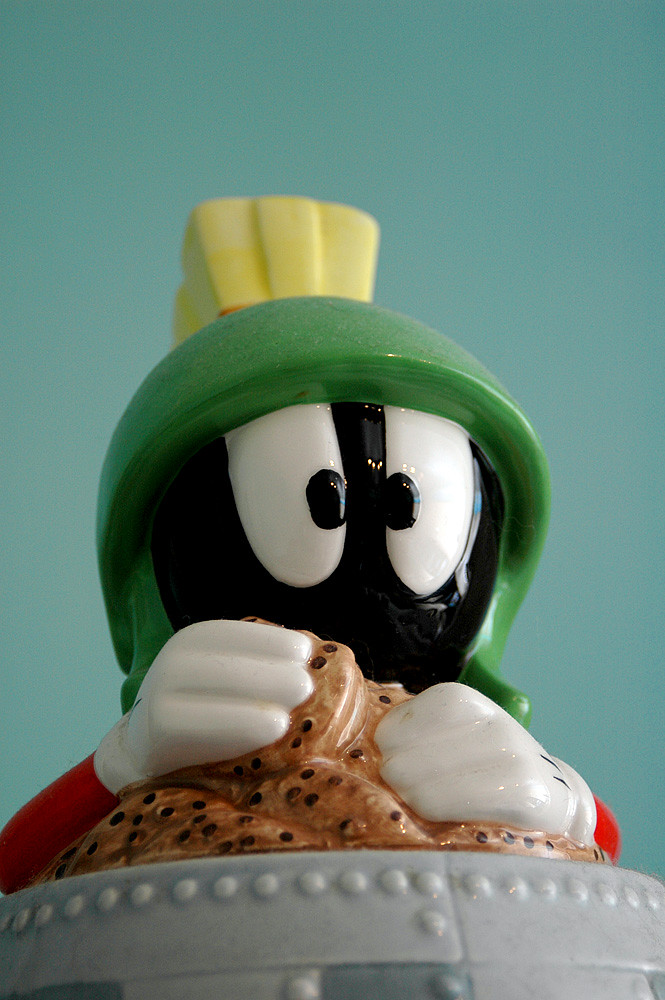
A ceramic cookie jar with a yellow face, a faint smirk, and dabs of cold-painted red at its stem and upper lip sold for $4,999 in May 2026 — a price that would buy roughly seventy of the plain McCoy jars still turning up at estate sales for $30 to $75 apiece.
Collectors nicknamed this particular jar “Freddie the Gleep,” and the gap between what a Gleep commands and what an ordinary McCoy jar fetches is exactly why serious cookie jar collectors bother learning individual pattern names instead of just checking the maker’s mark on the bottom.
McCoy is not a rare company. The pottery traces back to 1910, when Nelson McCoy Sr. and his father founded the Nelson McCoy Sanitary and Stoneware Company in Roseville, Ohio, originally to make utilitarian stoneware crocks and jugs. The company didn’t pivot toward the decorative pottery it’s now known for until around 1933, when it rebranded as Nelson McCoy Pottery.
Cookie jars became one of its signature lines in the decades that followed, and the McCoy family ran the operation until selling it in 1967 — meaning the 1974 “Freddie the Gleep” jar was produced under new ownership, well after the family that built the brand had cashed out, though the pottery kept using the McCoy name on everything it made until it finally shut down for good in 1990.
By the time Freddie the Gleep came off the line in 1974, McCoy had already made an enormous number of cookie jars in nearly every conceivable shape: covered wagons, clowns, hobby horses, fruit baskets, dozens of anthropomorphized animals sized to sit on a countertop next to the flour canister. Most of those jars are common enough now to hold decorative value more than investment value, the kind of thing that sells for the price of a nice dinner out and no more. What makes a jar like Freddie different is a mix of low production numbers and a design strange enough that it likely never sold in the volumes the more conventional shapes did. A grinning, faintly alien face with a painted red mouth was never going to move units the way a smiling pig or a friendly rooster would in a 1970s kitchen. Fewer made means fewer survived a half-century of daily kitchen use, breakage, and yard sales, and the jars that did survive in clean condition are the ones bringing four figures now.
According to Tasting Table’s rundown of the McCoy secondary market, the Gleep isn’t even the pottery’s most extreme outlier. A 1940s “Hillbilly Bear” jar sold for $25,000 in 2018, and a run of other harder-to-find McCoy patterns fetched between $699 and $1,200 in 2025 alone — evidence that the runaway prices aren’t a one-time fluke tied to a single auction, but a market that’s been steadily rewarding specific, identifiable patterns for years. Collectors also chase the elusive “Betsy Baker” jar, distinguished by rare mold variations in its lid, the same way record collectors chase specific pressings instead of just an album title.
The market has a genuine authentication problem attached to it, which is part of why pattern knowledge matters as much as it does. Reproductions and outright fakes have circulated for years, close enough in glaze and mold that even seasoned sellers now list authenticity as a selling point rather than an assumption — the kind of jar that turns up online marked, pointedly, as an “authentic” original and not a reproduction. A collector who can’t distinguish a real Gleep from a knockoff, or a genuine 1970s glaze from a modern one meant to fool eBay shoppers, is the collector most likely to overpay for the wrong jar entirely, which is exactly why the people chasing these prices tend to be specialists rather than casual pickers at an estate sale.
What separates the five-figure McCoy jars from the ones gathering dust in a thrift-store bin is almost never condition alone. It’s specificity — the exact pattern, the exact production run, sometimes the exact mold variation, cross-referenced against how many of that particular jar are known to have survived. A cookie jar collection built on “it’s old and it’s McCoy” will mostly hold decorative value. A collection built on knowing which jars are actually scarce, and which ones a factory in Roseville, Ohio quietly stopped making decades ago, is the one that occasionally throws off a $4,999 surprise from a shelf that looked, at a glance, like everything else on it.

Leave a Reply