

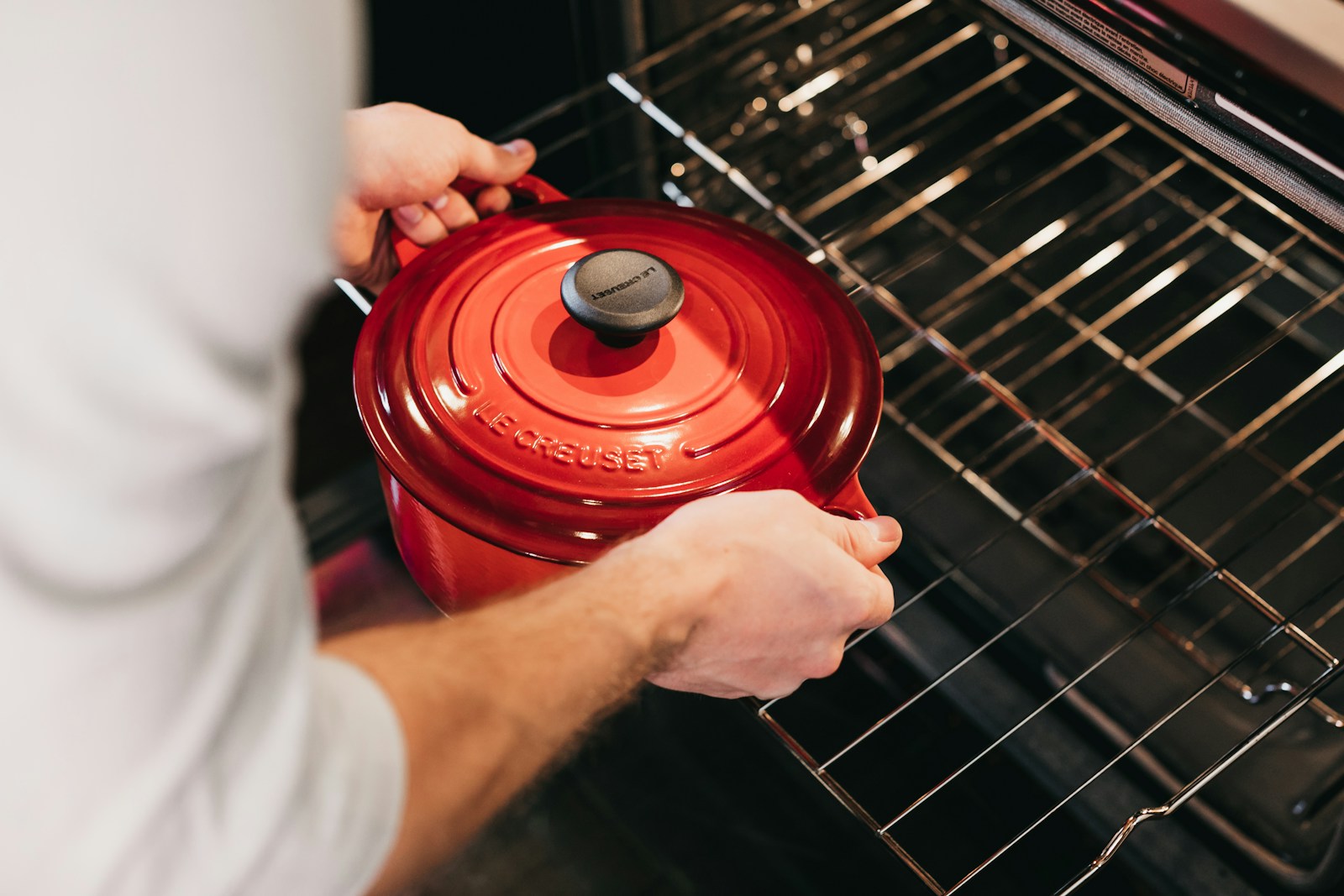
Walk the cookware aisle of a well-stocked estate sale and you can watch it happen in real time: the orange Dutch ovens get picked up, flipped over to check the stamp on the bottom, and either bought on the spot or set back down with something close to disappointment. Serious resellers aren’t looking for the name everyone already knows. They’re looking for one word stamped in cursive on the underside of a pot: Descoware.
For years, Descoware was the brand vintage kitchenware hunters mentioned almost apologetically, a “for when you can’t find the real thing” alternative to Le Creuset. That reputation is flipping. Kitchenware writers have started pointing directly at Descoware as the piece worth digging for at a thrift store, and the reasons have as much to do with the brand’s oddball history as with what the enamel actually does on a stovetop.
A Belgian Import That Predates Its Rival’s American Fame
Descoware’s story starts in Oudenaarde, Belgium, where the cookware was originally sold as “Bruxelles Ware.” According to the brand’s own company history, it was imported into the United States beginning in the mid-1940s, and by the early 1950s the D.E. Sanford Company had set up branches in Los Angeles, San Francisco, and Seattle, giving the cookware its lasting American name. By the mid-1960s, the company had become a subsidiary of the Los Angeles-based General Housewares Corporation.
The brand’s real break came from television. Tasting Table reports that Julia Child regularly featured Descoware Dutch ovens on her 1960s program, cementing the brand’s reputation with home cooks who trusted her judgment on cast iron more than they trusted a marketing budget.
What makes the brand’s current comeback almost funny is who ended up owning it. As competition mounted from French rivals in the 1970s, General Housewares restructured and, per Descoware’s own account, sold off the rights and formulas for its patented enamels directly to Le Creuset. The company that thrifters are now told to skip actually holds the recipe for the enamel on the pots they’re hunting instead.
What Collectors Are Actually Chasing
The pieces people fight over are the ones in Descoware’s signature “Flame” pattern, a red-to-orange gradient enamel that was distinctive enough to survive briefly in Le Creuset’s own catalog after the acquisition. Hunker notes that authentic pieces carry a “Descoware Made in Belgium” stamp on the base, and that the cast iron itself runs noticeably lighter in the hand than a comparable Le Creuset piece, which is one of the easiest ways to spot the real thing at a flea market table.
Prices back up the demand. Hunker’s roundup found a sky-blue Dutch oven listed around $65, a flame-colored bean pot near $140, and a wood-handled skillet closer to $100 — real money for cookware that used to sit unbought at church sales. Tasting Table found individual pieces commonly selling in the $30 to $50 range, with larger Dutch ovens pushing past $100 and full multipiece sets running into the several hundreds.
The Danish Cookware Riding the Same Wave
Descoware isn’t the only enameled cookware line getting a second look. Dansk’s Kobenstyle collection, designed by Jens Quistgaard for Ted Nierenberg’s Dansk International Designs starting in 1954, is turning up in the same searches. The Kitchn’s rundown of the line explains that Kobenstyle pieces are enameled steel rather than cast iron, which trades some heat retention for a lighter pot and a distinctive silhouette with pronged handles that still reads as pure midcentury design. Early Danish-made pieces, produced by the supplier Glud & Marstrand before manufacturing shifted to a French maker in 1966, carry Dansk’s “four ducks” mark and tend to command the highest prices among collectors who know to check for it.
Between the two brands, the appeal is the same. Neither one has the instant name recognition of Le Creuset, which means both are still findable at prices that reward a little patience — for now. The color range helps, too: Descoware’s Flame sits alongside softer yellows and blues, while Kobenstyle came in almond, turquoise, chocolate brown, and an orange that reads more retro than its French rival’s ever did.
There’s also a practical reason both brands are having a moment now rather than five years ago. A new Le Creuset Dutch oven has climbed well into three figures at retail, which sends budget-minded cooks looking for the vintage version of the same idea, and Descoware and Dansk happen to be the two enameled lines still cheap enough at estate sales to make that search worth the gas money. Neither name jumps out at a stranger scanning a shelf full of unmarked cookware, which is precisely why the deals are still out there for anyone willing to flip a pot over and read the bottom.
The pots aren’t rare because they were poorly made. They’re getting rarer because more people finally know what they’re looking at, and the ones who figured it out early are the ones getting the good shelf.

Leave a Reply