

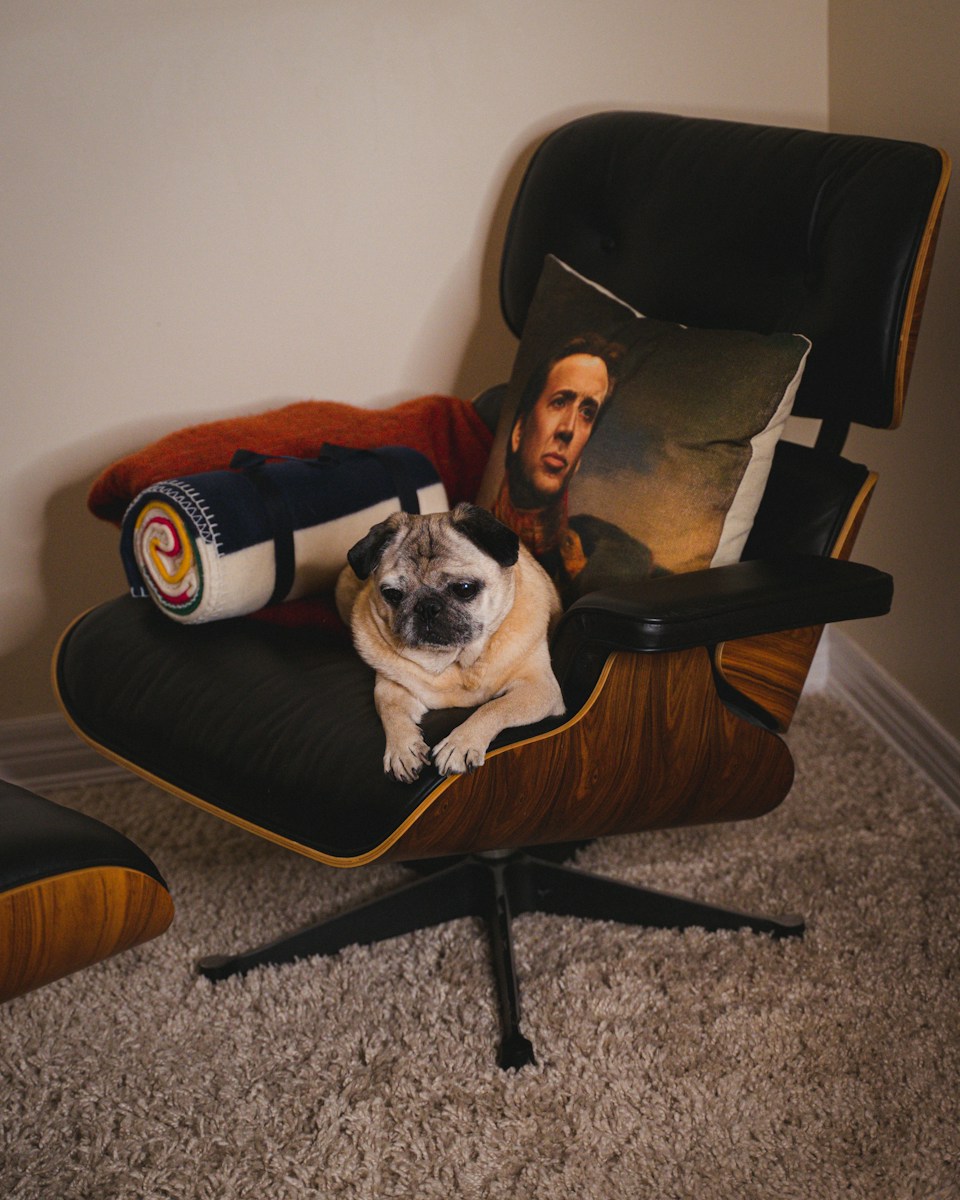
Order a new Eames Lounge Chair and Ottoman today and Design Within Reach will bill you around $8,700, built to the same molded-plywood-and-leather spec Charles and Ray Eames finalized in 1956 and Herman Miller has kept in continuous production ever since. Track down an actual first-year original at auction, in documented condition, and you can end up paying several times that — for a chair that is, on paper, the identical design.
The gap isn’t sentiment or snobbery. It’s a function of exactly how the Eameses built the thing in the first place. When the chair debuted on NBC’s Home television show in 1956, the earliest production run carried a cluster of small manufacturing details that Herman Miller changed within a few years: three-screw armrest mounts rather than a single center screw, bronze bushings, “boot glide” feet on the ottoman rather than the later disc glides, and cushions filled with down rather than the foam that came afterward. None of those details show up in the modern reissue, and none of them were ever repeated once the factory revised its tooling. A chair carrying that specific combination of features is, by definition, a survivor from a production window that lasted only a few years six decades ago.
That rarity shows up directly in what dealers and specialty furniture appraisers report as real-world value ranges. Chairs in good, honestly aged vintage condition with verified first-year features have traded in the $8,500 to $14,000 range, according to furniture-industry valuation guides that track the vintage market, already brushing against or exceeding the reissue’s list price. Museum-quality examples, meaning original Brazilian rosewood veneer, untouched leather, and unrestored early hardware, have been valued as high as $15,000 to $35,000, several times what Herman Miller charges for a brand-new chair built to the same drawings today. Even a genuinely first-year chair in rough, unrestored shape, in need of full reupholstery, still holds value in the low thousands, according to the same guides, simply because the underlying frame and hardware can’t be reproduced by ordering a new one.
Part of what drives that gap is how the design itself changed underneath its own name. Herman Miller has quietly revised the Eames Lounge Chair’s construction more than once since 1956, swapping wood veneers, adjusting foam density, and updating the base, while continuing to sell it as the same chair. Collectors chasing an original aren’t really chasing comfort or aesthetics, since the reissue is engineered to look nearly identical from across a room. They’re chasing a specific, dateable manufacturing snapshot that Herman Miller itself stopped making decades ago, which is a very different thing to shop for than simply picking a finish online.
The auction record tells a more complicated version of the same story, and it’s worth being honest about the complication. Not every chair labeled “1956” at a design auction is a matched, first-year set. Design auction houses regularly sell what collectors call “married” examples — a genuine 1956 chair shell paired with a replacement ottoman or cushions from a decade or more later, after parts wore out and got swapped over the years the chair spent in someone’s actual living room. A recent lot at Rago Arts, for instance, combining a 1956 chair with a circa-1965 ottoman, realized $5,502 against a $4,000 to $6,000 estimate: a real number, but one that sits below what a brand-new reissue costs today, precisely because the set wasn’t a pure, single-year original.
The premium collectors actually chase belongs to the rarer case: a chair and ottoman that left the Zeeland, Michigan factory together in the same short window, with the hardware and materials to prove it, and that never got quietly repaired back into a hybrid over seventy years of use. Those are the examples appraisers place in the five-figure range, and they’re the reason a design that Herman Miller will happily sell you today, brand new, in a matter of weeks, still commands a premium that has nothing to do with comfort and everything to do with proof.
It’s a strange kind of value to put a price on — not better design, since the reissue and the original share the same mold. Just an earlier one, made in smaller numbers, by people who didn’t yet know they were making something that would still be in production seventy years later.

Leave a Reply