

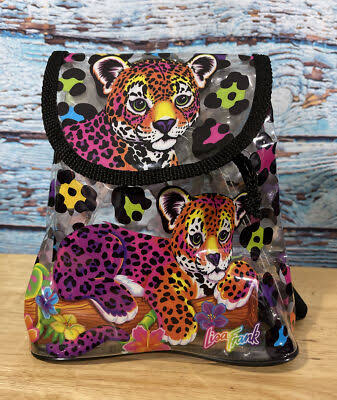
At its peak, a company built around rainbow dolphins and neon-eyed tigers was pulling in an estimated $66 million a year — real revenue, tied to real Trapper Keepers stacked in real Walmart and Target aisles across the country. The founder behind that empire started with jewelry, not stickers, and the actual paper trail of how her company grew is far stranger than anything that ever got airbrushed onto a folder.
photo credit: unsplash
Lisa Frank grew up outside Los Angeles, studied art after graduating from Michigan’s Cranbrook Kingswood School in 1972, and later attended the University of Arizona. Her first venture wasn’t the sticker empire people remember — it was a children’s jewelry line called Sticky Fingers, run out of a guest house. By around 1980, that business had become Lisa Frank Incorporated, based in Tucson, Arizona, and riding the sticker-collecting craze that swept American classrooms through the early 1980s. The early artwork itself was genuinely hand-produced: original illustrations were painted and layered by hand using an airbrush technique, a labor-intensive production method the company relied on for most of the decade before switching over to computer-aided design in 1989, a shift that let the company scale its catalog dramatically without scaling its art department at the same rate.
The turning point came when the company landed a million-dollar order from Spencer Gifts, a deal large enough to push Lisa Frank Inc. out of novelty-sticker territory and into full-scale school-supply manufacturing. Folders, Trapper Keepers, pencils, erasers, lunchboxes — all rendered in the company’s signature palette of hot pink, electric purple, and neon rainbow gradients, populated by cartoon pandas, unicorns, and dolphins that became genuinely inescapable in American elementary schools by the late 1980s and through the 1990s. Unlike most of the licensed characters crowding the same school-supply aisles at the time, Lisa Frank’s animals had never appeared in a cartoon, a movie, or a Saturday-morning lineup first. The company built an entire back-to-school category out of original illustrated characters with no outside media franchise behind them at all — no studio deal, no toy-line tie-in, just Frank’s own illustrations carrying the brand on their own.
James Green joined the company as its first full-time artist in 1982 and married Frank soon after. In 1992, she promoted him to president and CEO and, according to his own later account, gifted him 49 percent ownership of the business. Under that arrangement, the company scaled dramatically — distribution deals landed the brand on shelves at Walmart and Target by the 1990s, and at its height the company’s staff reportedly swelled to roughly 500 employees inside a 320,000-square-foot Tucson facility. By his own later estimate, reported by Time, the business at its peak was worth somewhere north of $200 million.
That growth didn’t hold. Frank and Green divorced in 2005, and Frank terminated his employment and forced a buyback of his ownership stake, regaining sole control of the company that carried her name. The business contracted sharply over the following years: by 2013, Lisa Frank Inc. had closed its manufacturing operation entirely and shifted to a licensing model, working with outside partners rather than running its own factory floor. A company that had employed roughly 500 people at its peak had, by 2015, shrunk to a reported six employees still working out of that same 320,000-square-foot Tucson building: nearly all the floor space, almost none of the staff.
The brand didn’t disappear so much as go dormant and wait. Urban Outfitters began stocking vintage-style Lisa Frank merchandise around 2012, an early signal that the brand’s original customers, by then adults, still wanted the product. By the 2020s the company had leaned into that second life deliberately, striking modern licensing partnerships with brands including Crocs and Morphe and building an active presence on the same social platforms where millennials were busy reminiscing about their old Trapper Keepers, a resurgence effort the company dates to around 2021.
What survives in the documented record isn’t really a story about a designer who got famous for drawing tigers. It’s a business that scaled from a guest-house jewelry line to nine figures in estimated value inside roughly a decade, shed almost all of that structure in the 2000s, and then found a second act by selling the exact same nostalgia it had originally manufactured firsthand. The company outlasted its own factory.

Leave a Reply