

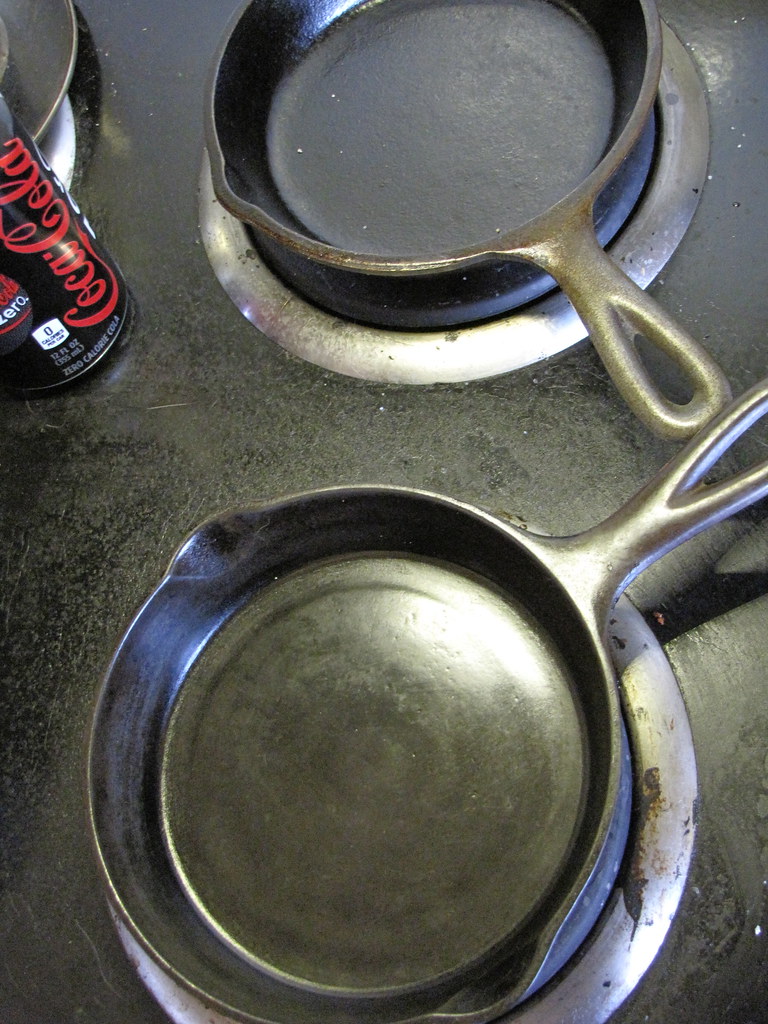
A cast iron skillet from the 1940s sold for a record-breaking $20,000 at auction, according to AOL’s roundup of the vintage cookware market — and the detail that made it worth more than a used car wasn’t the pan’s condition or its finish. It was a single stamped number on the bottom: 13.
Griswold, the Erie, Pennsylvania foundry that dominated American cast iron cookware for most of the twentieth century, made skillets in more than a dozen standard sizes. Most of them are common enough that a decent example sells for well under $200 today. The No. 13, though, was cursed by nothing more than superstition. Foundry lore, laid out by House Digest, holds that plenty of buyers and retailers in the early 1900s wanted nothing to do with a pan bearing an unlucky number, so Griswold simply made fewer of them than almost anything else in its catalog.
Per the same AOL report, an early-1900s No. 13 with the original “ERIE” spider-logo marking and heat ring — a raised ridge on the bottom rim, a feature phased out on later production runs — now sells for close to $2,000 in good condition, with the rarest surviving examples run up considerably further at specialist auction.
That’s the detail worth checking before anything goes in the donation pile: flip the pan over. A modern reproduction or a no-name skillet will usually have a smooth, mostly blank bottom, maybe a size number and not much else. A genuine vintage Griswold carries a cluster of markings together — the Griswold name or its cross-and-slant logo, the phrase “Erie, P.A. U.S.A.,” a pattern number, and the size stamped either on the bottom or cast into the handle. Any one of those alone doesn’t prove much. All of them together, especially paired with a heat ring on an older piece, is what separates a genuinely collectible foundry pan from a look-alike picked up at a big-box store decades later.
The market for the rest of the Griswold lineup backs up just how much that one number matters. A February 2025 Air Works consignment auction tracked by Griswold Cookware’s own price archive saw several No. 13 skillets change hands in the $2,100 to $3,300 range depending on logo era and condition — solid money, but nowhere near the $20,000 outlier, which underlines how much a single exceptional sale can skew what people assume the whole category is worth. The same sale’s actual top lot wasn’t a No. 13 at all; it was a No. 1 skillet, one of Griswold’s smallest and scarcest sizes, which brought $9,750. Rarity, in other words, cuts in more than one direction across the catalog, and the No. 13’s reputation as the “unlucky” grail size is really just the most famous version of a pattern that shows up across several odd, low-production numbers.
Griswold isn’t the only foundry name worth a second look on a bottom shelf, either. Wagner, Griswold’s biggest rival and eventual corporate stablemate — both companies ended up under the same ownership by 1959, first through Randall Corporation and later Textron and General Housewares — made its own No. 13 in a “pie logo” pattern that trades for roughly $800 to $1,000 today, according to the same cast iron valuation data. Erie-marked “spider” logo pieces — Griswold’s earliest, pre-1900s branding, named for the eight-legged look of the “ERIE” wordmark radiating from a central point — can bring around $10,000 in top condition, per recent auction tracking. None of it looks any different at a glance from the plain black pan sitting under a burner right now, which is exactly why so much of it ends up in yard sales priced at five dollars.
Condition still does most of the heavy lifting, even on a rare pattern. A No. 13 with pitting, a hairline crack, or a warped cooking surface loses the bulk of its premium no matter how clean the foundry markings underneath still read — collectors are paying for something they can put back into daily rotation on a stovetop, not a display piece nobody trusts near heat. That’s part of why cast iron behaves differently than most vintage collectibles: the same object that’s worth thousands in mint shape is also, unusually, still fully functional if it’s worth two dollars instead.
None of this means every rusty skillet in a grandmother’s kitchen is secretly worth a house payment. Most vintage cast iron, Griswold included, sells for double or triple digits, not five figures — the $20,000 sale is the exception being talked about specifically because it’s exceptional. But the gap between “worthless old pan” and “four-figure collectible” really can come down to a two-digit number stamped into iron eighty or ninety years ago, which is a good enough reason to check the bottom of the skillet before it leaves the house for good.

Leave a Reply