

Michael Harris searched at least 50 abandoned mines across the American West over five years before he found a pair of jeans worth anything close to what he was hoping for.
When he finally did — an intact pair of Levi’s from the 1880s, pulled out of an old goldmine shaft — they sold at auction in October 2022 for more than $87,000, according to NPR. Harris calls himself a denim archaeologist. After that sale, it’s hard to argue with the title.
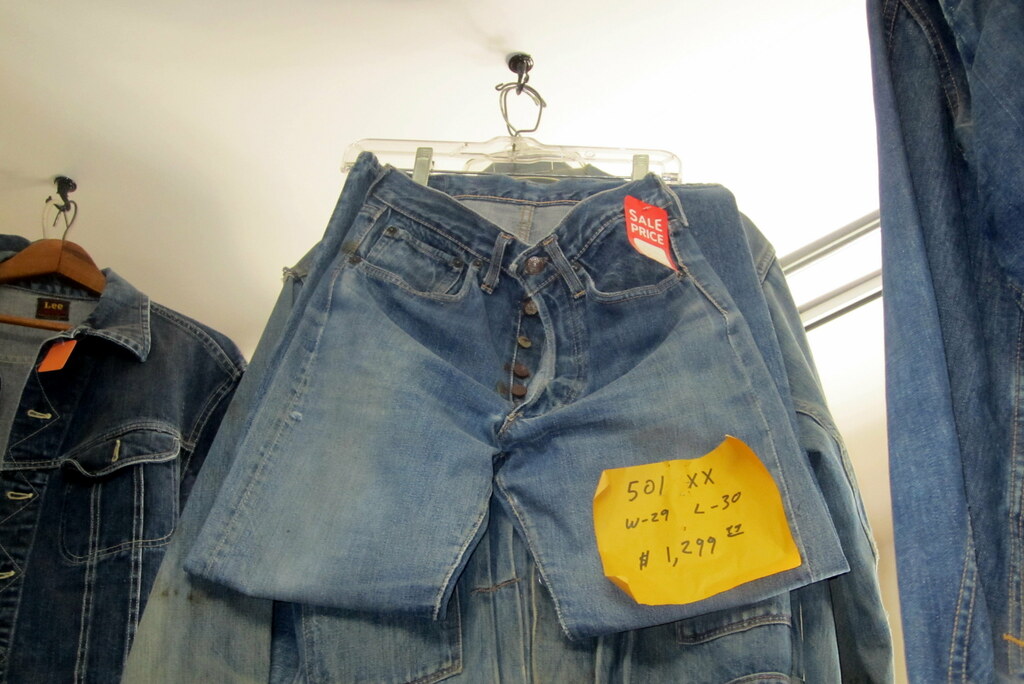
The jeans went up for bid on October 1, 2022, at Durango Vintage Festivus, a first-time vintage-clothing event held in Aztec, New Mexico and organized by longtime denim hunter Brit Eaton, per reporting from Sourcing Journal.
The final number, once the buyer’s premium was added in, landed just north of $87,000. Two California vintage dealers split the purchase: Kyle Hautner of Golden State Vintage took the largest share, and Zip Stevenson of Denim Doctors put in the rest.
What makes a 140-year-old pair of work pants worth six figures isn’t just age. It’s survival. Nineteenth-century denim was work gear, not fashion — bought to be destroyed by manual labor and then thrown out, not preserved. Almost none of it made it to the present in wearable shape.
Mine shafts, abandoned and dry for a century, turn out to be one of the only environments cool and stable enough to keep denim from disintegrating, which is exactly why serious collectors like Harris spend years crawling through them instead of shopping estate sales. Miners in the 1880s often bought work pants a size or two large, wore them until they wore out, and then abandoned them underground when a shaft closed — accidentally creating a time capsule nobody was trying to build.
Rough Enough to Wear, Rare Enough to Frame
According to CNN’s coverage of the sale, the jeans have some soft spots that would need reinforcing, but are otherwise durable enough that someone could, in theory, put them on — a rarity, since most surviving 19th-century denim exists only as museum-conserved fragments too fragile to handle, let alone wear. Buyer Zip Stevenson has kept the pair in a safety deposit box near his Los Angeles denim shop, available for viewing by appointment, treating a pair of work pants with the same handling protocol as a piece of fine art.
The jeans carry their own uncomfortable footnote, too. Stitched into an inside pocket is the phrase “the only kind made by White Labor” — marketing copy Levi Strauss & Co. adopted in the years following the 1882 Chinese Exclusion Act, when anti-Chinese sentiment was being actively courted by American manufacturers competing for white consumer loyalty. The company dropped the slogan by the 1890s. It’s the kind of detail that turns a denim curiosity into a genuine historical artifact — proof the jeans aren’t just old, but a physical record of exactly what was happening in the country the year they were sewn.
A Market That’s Grown Up
This isn’t the first time a mining town has coughed up a six-figure pair of jeans, and it isn’t even the first time Levi Strauss & Co. itself has paid up for one. In 2001, the company bought a pair of 1880s jeans discovered in a Nevada mining town for $46,532 through an eBay auction, planning to use them as a template for a vintage reissue line, a purchase the Deseret News reported at the time as the highest price ever paid for a piece of denim up to that point. A few years later, in 2018, a 125-year-old pair once owned by an Arizona Territory storekeeper sold in a private sale brokered by Daniel Buck Auctions for nearly $100,000, part of a broader run of six-figure sales that has included Japanese collectors paying roughly $60,000 for other 1880s-era 501s, according to Tech Times.
Vintage denim collecting used to be a fringe hobby built around back issues of trade magazines and word-of-mouth tips about which ghost towns still had standing mine structures. Two decades of escalating six-figure sales, organized by an increasingly professional network of dealers and hunters rather than random estate-sale luck, say the fringe hobby now has real institutional weight behind it. Somebody spent five years and fifty mine shafts chasing a pair of pants, and the market didn’t just validate the effort — measured against what Levi’s itself paid for a comparable find two decades earlier, it more than doubled the going rate.

Leave a Reply