

Four Days, 350 Pieces of Street Culture
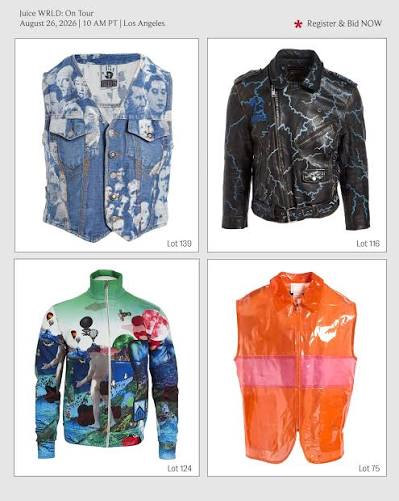
Julien’s Auctions ran Street Culture Week, a four-day online and live sale spanning August 24 through 27, 2026, built around roughly 350 lots pulled from skate, sneaker, and hip-hop history. Tony Hawk’s own memorabilia, including a ridden and signed 2001 deck, a set of original review discs for the 2006 video game “Project 8,” and his 1989 skatepark membership card, anchored the opening days on August 24. The centerpiece, though, was a dedicated live sale called Juice WRLD: On Tour, held August 26 at 10 a.m. Pacific, offering more than 160 items the late rapper personally owned and wore, before the week closed out with a broader “Street Culture” sale on August 27.
A Wardrobe That Reads Like a Tour Itinerary
What set this sale apart from a standard celebrity-memorabilia catalog was its documentation. Julien’s built the collection as, in the house’s own description, essentially “a calendar,” nearly 100 stage-worn garments, sneakers, and artifacts tied to specific dates and venues across the final eighteen months of Jarad Higgins’ life, each backed by single-source provenance and photographs of him actually wearing the piece. A Louis Vuitton monogram trench coat and “Heart of the Abyss” shirt trace to Rolling Loud Oakland in September 2019. A Moncler puffer vest and SoleFly Jordans go back to Splash Festival in Germany that July. A BAPE plaid jacket and gold Air Jordan 14s were the last things he wore onstage, at Festival Hall in Melbourne on November 29, 2019, his final headline show, nine days before his death.
Not Just the Big-Ticket Wardrobe Pieces
Not every lot in the sale was a headline-grabbing tour piece, and that variety was part of the appeal. A pair of stage-worn OAMC overalls from a Jimmy Fallon Show appearance carried a modest $400 to $600 estimate, sitting in the same catalog as five-figure jackets and six-figure jewelry. Julien’s paired the Juice WRLD material with other Street Culture Week lots built for a similar collector base, including an original Shepard Fairey artwork and skate memorabilia tied to Tony Hawk, positioning the whole week as a single continuous marketplace for hip-hop, skate, and street-art provenance rather than treating any one artist’s estate as a standalone event.
The Awards That Made It Official
Alongside the clothing, Julien’s put up his actual RIAA certifications, the Platinum award for “All Girls Are the Same” and a multi-track Gold and Platinum record award tied to “Lucid Dreams,” the single that turned him from SoundCloud regular into a genuine chart force. A GLD-brand “999” skull pendant set with pavé diamonds, worn onstage and on magazine covers, sat in the same catalog as his PlayStation Portable and a full set of instruments, piano, drums, guitar, pulling the sale away from pure fashion memorabilia and into something closer to a documented estate archive.
What the Bidders Actually Paid
By the time the gavel closed on August 26, the numbers made clear this wasn’t a passive nostalgia purchase for most bidders. The GLD 999 skull pendant sold for $102,400, more than triple its high estimate. A stage- and music-video-worn Louis Vuitton “Bandit” cashmere jacket brought $41,600. The RIAA Platinum “All Girls Are the Same” award, originally estimated at $300 to $500, closed at $35,200, roughly seventy times its low estimate. A custom-painted “Live Free Die Free” jean jacket and a “Hear Me Calling” leather jacket from the “Mercy” music video each landed at $32,000. Across the full 160-plus lot sale, that pattern repeated: modest pre-sale estimates set for a broad range of bidders, then final prices that climbed well past them once the room, and the phone lines, actually got going.
Where the Money Actually Goes
A portion of proceeds benefits the Live Free 999 Foundation, the mental health and substance-dependency support organization his mother, Carmela Wallace, established after his death. That detail reframes what happened at Julien’s that week. This wasn’t just a marketplace pricing nostalgia for a young artist gone six years. It was a documented, dated archive of his last eighteen months on stage, sold piece by piece to people willing to pay real money to own one exact night of it. For a catalog built from clothes and hardware rather than lyrics or unreleased tracks, that’s an unusually literal way to keep an artist’s timeline intact once he’s no longer the one telling it.

Leave a Reply