

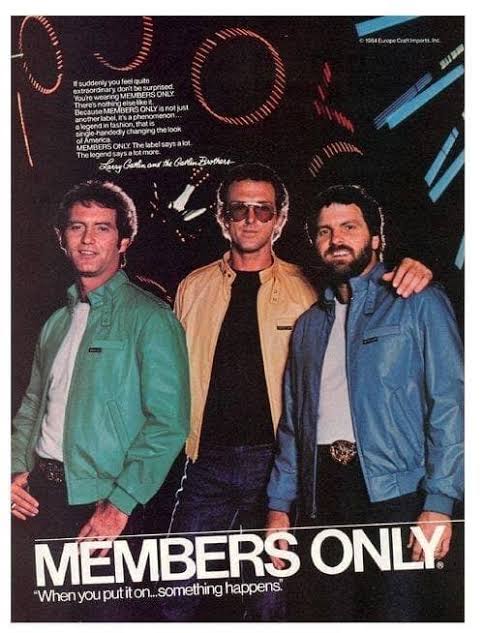
A Country Club Gate Sign Became a Jacket Empire
Herb Goldsmith spotted the racing jacket that would define an entire decade while traveling through Europe in 1977, and he liked it enough to bring the idea home and reproduce it through his company, Europe Craft. The name came from somewhere almost embarrassingly mundane: a sign at the gate of Westbury Country Club that read, simply, “Members Only.” Goldsmith and his co-founder Ed Wachtel built the jacket around a stand-up collar, snapped epaulettes, and a knit waistband, and by the early 1980s it had become one of the defining silhouettes of American mall culture, according to a retrospective from menswear trade publication MR Magazine.
When “Something Happens” Was the Entire Pitch
The jacket’s ad campaign leaned on a tagline rather than a slogan about status: “When you put it on, something happens,” delivered by General Hospital star Anthony Geary in commercials that ran heavily through the early 1980s. It worked. According to an oral history published by MEL Magazine, the jacket retailed for around $55 at the height of its popularity, sales reached roughly $150 million by 1990, and the company had moved an estimated 5.5 million jackets by the time that history was written. President Jimmy Carter wore one. So did Frank Sinatra and Johnny Carson, which is the kind of unlikely three-generation overlap that only a genuinely ubiquitous product manages to pull off.
The Pivot Nobody Expected From a Jacket Brand
Goldsmith didn’t just sell jackets, he built an advertising machine around them, and when celebrity endorsements started feeling stale in the mid-1980s he redirected the entire budget toward public service messaging instead: anti-drug spots and voter registration ads featuring NBA forward Buck Williams, backed by a $6 million campaign in 1986 that grew to $12 million the following year, per InsideHook’s account of Goldsmith’s career following his death in 2020 at age 92. It was an odd instinct for a fashion label to spend that kind of money warning teenagers about drugs, but it built a $100 million clothing operation and cemented the brand’s reputation as something bigger than a jacket kiosk at the mall.
Not Just a Jacket, a Whole Wardrobe
By the mid-1980s, Europe Craft had stretched the Members Only name across sweaters, dress shirts, blazers, swim trunks, and even a 1985 fragrance backed by its own $2 million marketing push, according to the same MEL Magazine account. The jacket alone was never really the whole business plan; it was the entry point into a much broader lifestyle brand, the same way a single hit song can end up funding an artist’s entire back catalog. That expansion is part of why the name stuck so hard in the cultural memory, even after the specific silhouette stopped selling.
From Every Closet to the Discount Rack
The fall was faster than the rise. By the early 1990s, Members Only had slipped out of cultural relevance almost entirely, and the same MEL Magazine oral history describes the brand’s inventory ending up at Value City, a chain willing to buy excess stock in cash, about as unglamorous an ending as a fashion label can get after a decade of Sinatra wearing your product on stage. For most of the following twenty years, the jacket existed mainly as a Halloween costume shorthand for “generic 1980s guy,” which made its current resale prices genuinely surprising to anyone who last saw one folded in a bargain bin.
What a Thirty-Dollar Jacket Sells for Now
A plain vintage Members Only jacket in good condition currently lists for $40 to $89 through vintage retailer Rusty Zipper, already ahead of that original $55 sticker once you account for inflation. That’s the floor. Leather versions with their original fur collar have sold for closer to $150, and according to a collector pricing breakdown from LoveToKnow, leather examples broadly range from $100 to $300, while pieces with real provenance go well beyond that — a jacket screen-worn by actor Richard Chamberlain sold for $768, and a customized version tied to fashion figure Dapper Dan reportedly commanded $1,500. None of those numbers were possible for a brand that spent the 1990s parked at a discount chain, which says less about the jacket itself than about how thoroughly nostalgia can rewrite a garment’s value once enough time has passed.
The Jacket Outlived the Slogan
Something did happen when you put one on, just not the thing the commercials promised — it took forty years, but the payoff finally arrived.

Leave a Reply