

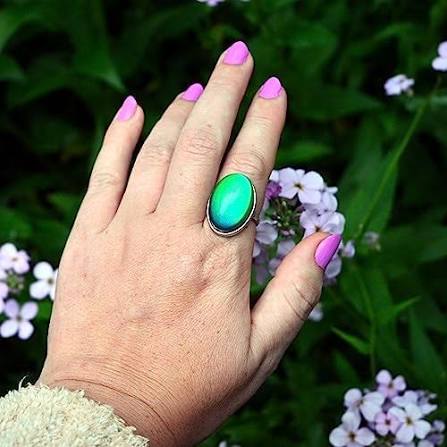
A ring that came out of a weapons lab, not a jewelry bench
The technology inside a mood ring didn’t start with anyone thinking about jewelry. In the late 1960s, physicist Robert Parker was working at Lawrence Livermore National Laboratory, studying how liquid crystal films reacted to rapid heating. Parker found that cholesteric liquid crystals shifted color as their temperature changed, but the material he was using cracked and faded almost as soon as it hit open air. He left the lab in 1972 and started a company, Robert Parker Research, to sell the color-shifting material commercially.
Two guys with no chemistry background and a Wall Street burnout story
That’s where Joshua Reynolds enters. Reynolds hadn’t trained as a scientist or an engineer; he arrived at the idea after burning out on Wall Street and drifting into biofeedback. Working with business partner Maris Ambats, Reynolds proposed housing Parker’s temperature-sensitive crystals inside a ring. The pair launched it at Bonwit Teller in New York in 1975 for $45 a piece, and by year’s end had sold roughly $20 million worth, with other tallies putting total unit sales closer to 40 million rings within the first three months.
What the crystals are actually doing
None of that required Reynolds or Ambats to understand what was actually happening on a wearer’s finger. The rings work because cholesterol-based liquid crystals shift between a warmer nematic phase and a cooler smectic phase as temperature changes, and that shift alters how the crystal structure bends light. What the ring is actually measuring is peripheral blood flow, not brain activity or emotional state. There has never been a peer-reviewed study validating any link between a specific liquid crystal color and a specific human emotion.
Forty million rings, zero patents, and a two-year crash
The fad’s collapse traces back to the same gap in expertise that let it get made in the first place: nobody involved ever secured a patent on the ring itself. Jewelry designer Marvin Wernick, who separately claims to have arrived at a similar design, also never patented his version. With no legal protection on the concept, department stores and mall kiosks flooded the market with cheap knockoffs within a year, prices collapsed, and by 1976 a fad most buyers had assumed was backed by real science had quietly run its course.
What’s left of the mood ring today is mostly nostalgia and a persistent myth, that a ring somewhere out there can read what you’re feeling. It never could. It could only ever read your hands.

Leave a Reply