

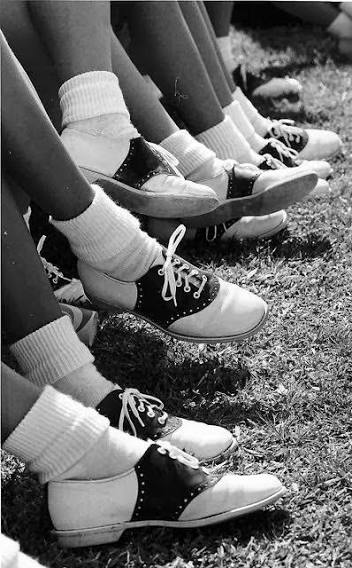
A.G. Spalding introduced the saddle shoe in 1906 as a gym oxford, and the leather panel across the middle wasn’t a style choice at all — it existed purely to reinforce the instep and keep an athlete’s foot locked in place during quick lateral movement, according to The Metropolitan Museum of Art’s own collection record of an early pair. The design flopped with serious athletes almost immediately. Everything the shoe is actually remembered for — bobby socks, poodle skirts, the entire soda-fountain aesthetic — happened decades after the people it was built for had already rejected it.
Built for the Gym, Not the Dance Floor
Spalding envisioned the two-tone shoe specifically as indoor athletic footwear, engineered so the contrasting saddle panel functioned almost like a girdle, holding the foot tight against the shoe during sprints and sharp direction changes, according to a documented chronology of the saddle shoe’s development. It was aimed at sports requiring exactly that kind of quick lateral footwork — tennis and squash among them — rather than any specific sport played on hardwood. Competitive athletes never really adopted it the way Spalding hoped, and the shoe spent its earliest years as a fairly niche piece of gear rather than a mainstream athletic staple.
A Country Club Curiosity for Nearly Twenty Years
For its first decade or so, the saddle shoe stayed almost entirely within a narrow, well-off slice of the population — affluent young men at country clubs were among the first to wear it regularly. It had climbed just far enough into the mainstream by 1915 that Sears’ mail-order catalog listed it as a general adult “tennis shoe,” and children didn’t start showing up in the historical record wearing them until sometime in the 1920s, per the same chronology. That’s nearly two full decades between Spalding’s original gym-oxford concept and any sign of the shoe becoming a genuine youth fashion object — a much slower, quieter climb than its later teen-culture reputation would suggest.
The Jitterbug Made It a Uniform
The real turning point arrived in the late 1930s, when the saddle shoe effectively became a virtual school uniform for girls right as the jitterbug craze swept the country. That timing wasn’t a coincidence — the same reinforced instep and stable base originally engineered for athletic footwork turned out to be genuinely useful for a dance built around fast kicks and spins, worn with pleated skirts and bobby socks, according to documented saddle shoe history. In other words, the shoe finally found its intended purpose — athletic stability during rapid footwork — just not in the sport Spalding had originally pictured.
Elvis, Poodle Skirts, and the Shoe That Refused to Leave
By the 1940s and into the 1950s, the saddle shoe had fully detached from its athletic identity and become inseparable from the era’s teen aesthetic — paired constantly with the flared, crinoline-lined poodle skirt and worn by boys for formal occasions like First Communion, showing up regularly in mail-order catalogs as a default piece of school wardrobe. Its cultural staying power got another jolt when Elvis Presley wore the style in Jailhouse Rock, cementing an association with youth rebellion that had nothing to do with tennis courts or gymnasiums. What started as reinforced athletic gear designed to survive hard lateral movement ended up defining an entire decade’s teenage silhouette instead, and the shoe never fully vanished after that — variations of the two-tone saddle design have cycled back into fashion repeatedly in the decades since, usually with nobody involved remembering it was ever meant for sprinting drills in the first place.
That’s the part of the saddle shoe’s story that tends to get flattened into a simple “50s nostalgia” label: the shoe spent its first three decades failing at the exact job it was designed for, then spent the following three defining a generation’s look almost by accident. It’s a strange kind of longevity — a piece of athletic equipment that became a cultural icon specifically because the athletes gave up on it.
There’s also something fitting about a reinforced instep panel, designed to survive hard cuts and quick pivots, ending up as the shoe of choice for a dance craze built on exactly that kind of footwork. Spalding just guessed wrong about which room it would end up in — not a gymnasium full of athletes, but a dance floor full of teenagers who needed their shoes to hold up just as badly.

Leave a Reply