

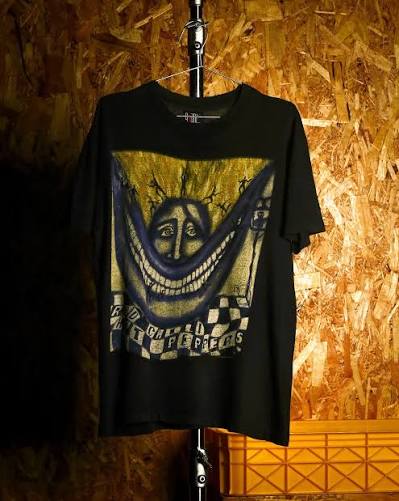
A single 1994 Red Hot Chili Peppers “Smile” tour shirt sold for $2,700. A 1990s-era Björk shirt went for $3,659.94. A worn 1992 2Pacalypse Now Interscope Records promo tee topped $3,499.99. These aren’t estimates or asking prices; they’re completed sales, tracked in Defunkd’s running log of eBay’s highest-selling vintage t-shirts in 2025, on a platform where the same category of shirt sold for a couple of bucks at a thrift store not that long ago.
The Data Behind the Shift
This isn’t a handful of lucky eBay auctions skewing the picture. Merchandise company Spreadshirt analyzed more than 84,000 completed listings of band and music-artist t-shirts sold on resale marketplaces between December 2023 and September 2024, a study covered by Loudwire, and found individual pieces reaching well into four figures: a Grateful Dead “Panther” tee up to $2,750, a Nirvana “In Utero” long-sleeve up to $2,000, a 1989 Soundgarden “Louder Than Love” shirt at $1,349.99. Averaged across the market rather than cherry-picked at the top, Nirvana shirts alone were pulling an average resale price of $278.51, with Red Hot Chili Peppers close behind at $240.54. Rock-genre tees as a category averaged $179.54, well ahead of pop, hip-hop, and R&B merch from the same eras.
Why a Piece of Cotton Can Cost More Than Rent
The economics come down to basic scarcity colliding with rising demand. Most original tour shirts from the 1970s through the 1990s were bought to be worn, not preserved, and got washed, stretched, and eventually tossed the way any t-shirt does, according to merchandise retailer Rockabilia’s breakdown of the collector market. The ones that survived decades in wearable, still-legible condition are the genuine rarity, and as more buyers chase a shrinking supply, prices climb accordingly. Bands with especially devoted, still-active fan bases, Iron Maiden, Metallica, KISS, and the Misfits among them, tend to command the steepest premiums, since demand from committed collectors never really slows down the way it does for a band that broke up and faded from cultural memory.
Construction details have become their own small forensic science. Per Rockabilia’s authentication guide, shirts printed in the 1970s and ’80s were almost universally single-stitched, with simple screen printing; the early 1990s saw a shift toward double-stitched seams and larger back prints, while late-1990s shirts settled into double-stitch construction alongside newer digital transfer techniques. Collectors now cross-reference stitch type, tag style, and fabric weight against a shirt’s claimed age before paying real money for it, because an official reprint of classic tour art, however accurate the graphic, isn’t the same object as the shirt that was actually screen-printed and sold at that specific show.
From Rack of a Hundred to One Priceless Survivor
What makes the shift sting a little, if you’re the kind of person who donated a drawer of old concert shirts to Goodwill sometime in the 2000s, is how recently this was all still disposable. Thrift stores and garage sales spent decades treating faded band tees as filler stock, priced the same as any other cotton castoff on the rack. The Defunkd sales data suggests that era is fully over for anything with real provenance attached: rap and hip-hop tees drove a particularly strong wave of late-2025 sales, with vintage Eminem merchandise alone pulling in over $2,800 and $2,000 on separate listings within the same tracking period.
None of this means every faded band shirt in a bargain bin is secretly worth a car payment. Condition, rarity, and a real fan base still have to line up before a shirt crosses from “old t-shirt” into “four-figure artifact.” But the ceiling on what that alignment can produce has moved dramatically, and it’s rewritten the math on every box of old shirts still sitting untouched in a closet somewhere, waiting for someone to check the stitching before they toss it.
A Market That Rewards Patience
What’s changed most isn’t just the top-line numbers, it’s who’s paying attention to them. A category that used to be the exclusive territory of hardcore music collectors and vintage-store buyers now has an entire secondary economy of resellers actively hunting thrift racks specifically for pre-2000s band merchandise, checking tags and stitch patterns before they’ll even consider a shirt worth folding into their cart. That shift in buyer behavior is itself part of why prices keep climbing: every reseller who correctly spots a genuine original before a thrift store re-prices it is effectively pulling one more scarce survivor out of circulation and into a collection, tightening a supply that was never going to grow back in the first place. A shirt that got worn to one specific tour stop in 1994 only exists in whatever quantity actually survived; nobody is printing more of them, no matter how high the resale numbers climb.

Leave a Reply