

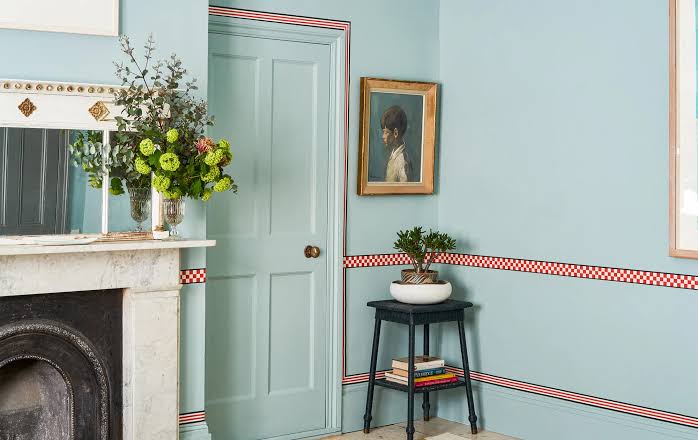
Wallpapering bookings jumped 70 percent year-over-year between January and May of 2024, according to TaskRabbit data cited by Axios. That’s the kind of number that would have sounded absurd a decade ago, when the strip of printed trim running along the top of a kitchen wall was treated as a punchline, the design equivalent of a bad perm everyone wanted to forget they’d ever had.
A Victorian Idea, Recycled a Century Later
The 1980s didn’t invent the concept, even if it gets blamed for the worst examples of it. According to the Victoria and Albert Museum’s history of wallpaper, a three-part decorating scheme built around a lower “dado,” a mid-wall “filling,” and a decorative upper “frieze” was first recommended in 1868 specifically to break up the monotony of a single repeating pattern, and had become a standard feature of fashionable British interiors by 1880. The frieze was meant to be lighter and livelier than the pattern below it, functioning almost exactly like the border strips that would reappear a century later above millions of American kitchen cabinets. The idea disappeared for most of the 20th century before resurfacing, largely stripped of its original Victorian context, as a mass-market decorating staple.
The Trim That Finished Every Room
Wallpaper borders hit their commercial peak in the 1980s and rolled straight through the 1990s as a default finishing touch in American homes. According to House Digest’s retrospective on the trend, the strips were typically run along the top of a wall just below the ceiling or crown molding, treated as the final layer that made a room feel complete rather than an optional flourish. Kitchens got fruit-and-ivy borders. Bathrooms got seashells or geese in bonnets. Kids’ rooms got whatever cartoon was airing that year. It was bold, it was everywhere, and it fit an era of decorating that valued big, unmistakable statements over restraint.
Why the Whole Category Collapsed
Wallpaper broadly, borders included, didn’t fade so much as get outrun by its own visibility. Wallpaper patterns tend to announce their decade almost instantly, and once trend cycles started moving faster than most people were willing to redecorate, that became a liability rather than a charm, according to the Boston Globe’s retrospective on wallpaper’s broader decline. A more mobile homeowning population added to the problem: buyers moving more frequently were reluctant to install something as commitment-heavy as glued paper trim, worried it would date a house they might be selling within a few years. By the early 2000s, paint and the blank, neutral wall had won, and border rolls that once sold by the millions started gathering dust in home-improvement clearance bins.
The Quiet Return, With the Volume Turned Down
The version creeping back into circulation now barely resembles the loud fruit-basket strips of 1994. Per House Digest’s coverage of the trend’s revival, designers are increasingly using thin, restrained strips of pattern to mimic a decorative trim rather than dominate a wall, positioning them along baseboards, around door and window frames, or vertically at door joints instead of exclusively running them at ceiling height. The goal isn’t to recreate a specific look from three decades ago; it’s borrowing the underlying idea, a strip of pattern doing a small, deliberate job, while dropping the maximalism that eventually wore the format out.
The renter-friendly materials driving a lot of this comeback matter too. Peel-and-stick wallpaper, which barely existed in a usable form during the format’s original heyday, has made borders a low-risk experiment rather than a permanent commitment, letting apartment dwellers try a pattern along a hallway or bookshelf edge without the wallpaper-steamer removal project that scared an entire generation of homeowners away from the format in the first place.
Small Spaces, Big Comeback
Designers pushing the current revival tend to steer it toward low-stakes real estate: closets, powder room accents, laundry nooks, the backs of open bookshelves, spaces where a bold pattern reads as a delightful surprise rather than a wall-to-wall commitment. That restraint is really the whole story of the comeback. The 1990s version tried to say everything, on every wall, all the time. The 2020s version says less, on purpose, and that’s precisely why designers are willing to let it back into the room at all.

Leave a Reply