

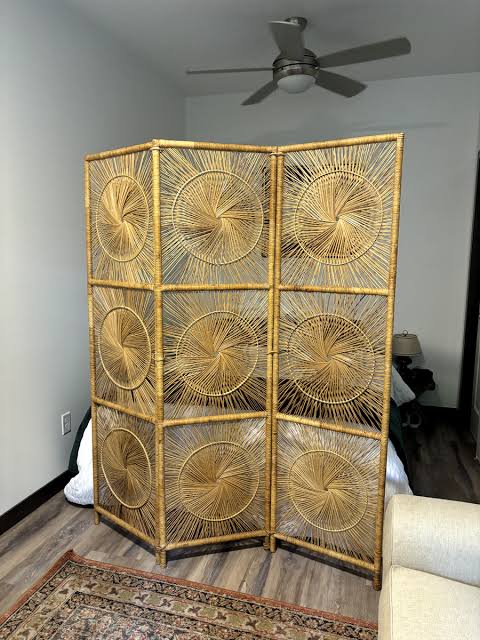
Search demand for folding screens and room dividers has climbed 177 percent in recent tracking, with Wayfair separately reporting a 25 percent jump in room divider searches over a single year. The open floor plan that defined a generation of home renovations is quietly getting subdivided again, and the tool doing it looks a lot like something your grandmother owned.
A Material With a Long Runway to the 1970s
Rattan itself wasn’t a 1970s invention — its use in furniture stretches back to basket weaving in ancient Egypt, and it became genuinely fashionable among Europe’s elite during the Victorian era, when design history records describe it filling the parlors and conservatories of wealthy households. But the material went through what amounts to a second act in the 1960s and 1970s, driven by a wave of renewed appreciation for its texture, warmth, and association with tropical and bohemian aesthetics. Designers like Gabriella Crespi and Marella Agnelli helped push rattan from a practical, budget-conscious material into something genuinely fashionable again during that period, and that revival is exactly what set the stage for rattan and lattice screens to show up as a serious home furnishing rather than a novelty item.
Solving a Problem Open-Plan Living Created
The 1970s open floor plan created a genuine design problem: households wanted the airy, connected feel of knocked-through living and dining spaces, but they still needed a way to carve out privacy, hide clutter, or visually separate a dining area from a living room without putting up permanent walls. A folding rattan or lattice screen was the flexible fix. It could fold flat when it wasn’t needed, get moved wherever a household wanted a temporary boundary that day, and it added texture and warmth to rooms that could otherwise feel like one large, undifferentiated box. Mid-century designers of the era leaned into geometric patterns and clean lines for room dividers generally, and design history coverage of the period notes many pieces doubled as storage, with shelving or cabinet space built into the base of the screen so it did more than one job at once.
From Thrift Store Castoff to Restoration Project
Like a lot of 1970s decor, rattan and lattice screens spent the 1990s and 2000s as the kind of thing that got left at the curb during a renovation rather than kept. That’s changed noticeably in the past several years. Recent coverage of the trend points to a wave of restoration content online, with people specifically hunting down and refinishing vintage mid-century room dividers rather than buying new ones, and mainstream design publications increasingly featuring genuine vintage pieces rather than only reproductions.
The Data Behind the Comeback
Homes & Gardens’ reporting on the folding screen trend puts real numbers behind the anecdotal revival: beyond the 177 percent rise in overall demand and Wayfair’s reported 25 percent increase in search volume, designers interviewed for the piece pointed to a specific, very contemporary driver — homes that shifted permanently toward remote and hybrid work needed a way to zone off a desk or hide a video-call background inside an otherwise open living space, without sacrificing the open-plan layout entirely. That’s a distinctly 2020s problem being solved with a distinctly 1970s tool.
The Same Fix, for a New Kind of Open Room
What’s genuinely interesting about the rattan screen’s return is that it’s solving almost the identical problem it solved fifty years ago, just with a different cause. In 1975, the problem was an open-plan living and dining room that felt too exposed. In 2026, it’s an open-plan living room doubling as a home office. Either way, the fix is the same: a lightweight, foldable, texturally warm object that lets a room change shape without anyone picking up a hammer. Rattan and lattice screens never stopped being a smart answer to that problem — they just waited a few decades for homes to need the answer again.

Leave a Reply