

The paperwork proving Birkenstock is 250 years old isn’t a sandal patent — it’s a German church record. In 1774, a cobbler named Johannes Birkenstock was formally documented as a “subject and cobbler” in the village of Langen-Bergheim, and that single line is the earliest confirmed evidence of the shoemaking family that would eventually put cork-soled sandals on runways two centuries later, according to the company’s own 250-year history record and Forbes’ retrospective on the brand’s anniversary.
A Cobbler in a Village, Not a Startup Founder
There’s no dramatic founding myth here — no eureka moment, no patent filing, just a name in a registry. Johannes Birkenstock worked as an ordinary village shoemaker in the late 1700s, generations before anyone in the family had a reason to think about arch support as a business. The company itself treats that 1774 guild-era record as the true starting line of its history rather than picking a more flattering later date, which is unusual for a brand this size — most footwear companies date themselves to a product launch, not a name in a parish ledger.
The Insole Came a Century Before the Sandal
The real technical leap didn’t arrive until Konrad Birkenstock, a descendant of the original cobbler, started rethinking how shoes were built from the ground up. In 1897 he engineered the first fully three-dimensional shoe last that actually distinguished between a left foot and a right foot — a basic distinction modern shoppers take for granted that simply didn’t exist as standard practice before then, per the company’s history. He followed that in 1902 with a flexible, anatomically contoured insole designed to mold to the shape of the foot rather than force the foot to conform to a flat sole, an idea Forbes’ account frames as revolutionary “at a time when most soles were flat.” Konrad spent the following decade refining the exact material composition of that insole, not landing on a satisfactory formula until around 1912.
“Fussbett” Becomes a Trademark, Not Just a Product
By 1925, the family formalized what Konrad had spent decades building: the company officially registered the “Fussbett,” or footbed, trademark under Konrad Birkenstock GmbH in Friedberg, according to the Birkenstock Group’s own documentation. That’s worth sitting with for a second — the word “footbed,” which now shows up on shoebox labels from dozens of unrelated brands, started life as a specific, legally protected Birkenstock trademark describing Konrad’s contoured insole technology. The company had built and patented the core biomechanical idea nearly forty years before it ever made a sandal that regular consumers could buy off a shelf.
The Sandal Almost Wasn’t Called Birkenstock at All
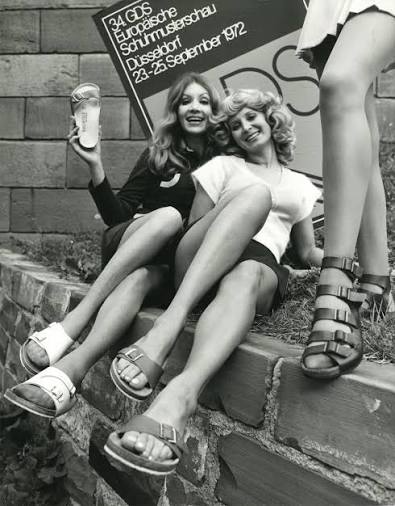
It took another Birkenstock, Karl, to finally turn all that orthopedic engineering into the open-toed sandal people actually associate with the name. Karl introduced the original footbed sandal in 1963, built around the deep, flexible cork insole his grandfather’s work had made possible, and it reached the American market by 1966. For years the shoe didn’t even carry a distinct product name — it wasn’t formally christened “Madrid” until 1979, more than fifteen years after its debut, per Forbes’ account of the sandal’s naming history. From there it moved through counterculture wardrobes in the 1970s and eventually onto the feet of Heidi Klum, Gwyneth Paltrow, and Kendall Jenner, part of a climb that reportedly pushed annual sales to roughly $800 million by 2018.
Why the Long Version Matters
It’s easy to assume a brand this associated with 1970s hippie culture and 2020s celebrity styling was invented to chase a trend. The actual paper trail says the opposite: a 250-year run of ordinary shoemaking, a specific and patient piece of orthopedic engineering developed decades before it had a commercial application, and a sandal that spent its first sixteen years without even a proper name. Six generations of the same family worked on the same basic problem — how a shoe should actually fit a human foot — before the sandal most people know the brand for ever left a factory floor.
The next time a pair of two-strap cork sandals shows up in a thrift bin or on a fashion week runway, that lineage — church registry to guild trademark to global fashion object — is the part most people walking past never think to ask about. It’s a rare case where the marketing story and the actual archival record line up almost perfectly, which might be the strangest thing about a shoe most people bought for comfort long before anyone called it fashion.

Leave a Reply