

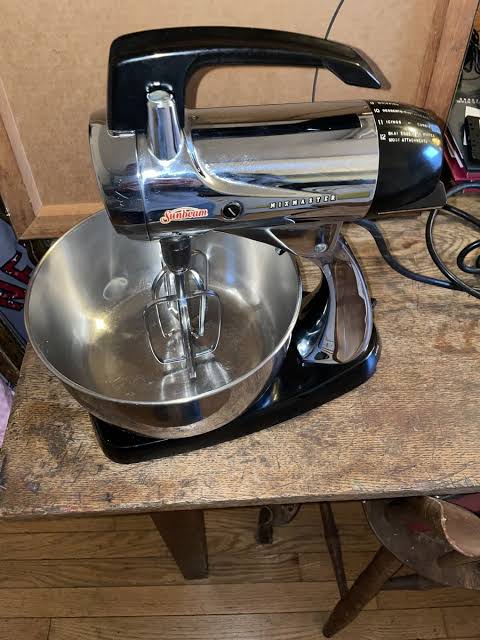
A well-preserved vintage Sunbeam Mixmaster in a desirable color can sell for close to $300, while a brand-new, current-production Sunbeam stand mixer sits comfortably in budget-appliance territory at retailers like Walmart and Target. For a machine built on 90-year-old engineering, that’s a strange position to be in — outselling its own modern descendant.
A Design Patented in 1929, Barely Changed Until 1967
The Mixmaster’s staying power starts with engineering that was genuinely ahead of its moment. According to the International Housewares Association’s own historical archive, Sunbeam patented the core Mixmaster design in 1929 and brought it to national market in the 1930s, in an original ivory finish paired with green glass mixing bowls. Its defining innovation was mechanical: a bowl that rotated on its own combined with off-center beaters that continuously scraped the inside walls, a self-basting motion that eliminated most of the manual scraping earlier mixers required. The housewares association’s own account notes the design remained largely unchanged from 1930 all the way to 1967 — nearly four decades of essentially the same reliable mechanism, engineered under longtime Sunbeam chief engineer Ivars Jepson.
Popular Enough to Get Its Own Postage Stamp
By the 1940s and into the 1960s, the Mixmaster had become close to a default wedding-registry appliance, and retrospective coverage of the appliance’s design history notes it came in a genuinely wide range of finishes over the decades — chrome, pink, yellow, turquoise, white, blue, and the now-iconic avocado green of the 1970s — with attachments that could grind meat, chop vegetables, peel potatoes, and knead bread dough. Its cultural footprint got a formal stamp of approval, literally: in 1998, the U.S. Postal Service honored the Mixmaster with its own commemorative postage stamp, recognizing it as an icon of 20th-century household convenience nearly seventy years after its debut.
What a Working Vintage Model Actually Sells For
Current resale data shows genuinely wide-ranging but frequently substantial prices for working vintage units. A recent appraisal of a functioning Sunbeam Mixmaster model 12 from the late 1950s, cited in a professional appraisal consultation, put auction resale value between $80 and $150, with vintage retail shop pricing running as high as $220. Separate coverage of the eBay resale market found completed listings ranging from roughly $35 up to $295, depending heavily on condition, completeness of original attachments, and how desirable the specific color happens to be. The rarer or more sought-after finishes — certain pastel colors and the 1970s avocado green in particular — tend to command the top end of that range.
Why Buyers Are Choosing 90-Year-Old Engineering
Part of what’s driving demand is that these machines simply keep working. Units from the 1950s, 1960s, and 1970s routinely still run today, decades past when most modern small appliances would have failed — a durability record most current-production mixers, built to a much lower price point with plastic gearing, can’t match. That reliability, combined with genuine design appeal that modern appliances have largely abandoned in favor of minimalist, disposable-feeling plastic housings, gives vintage Mixmasters real functional value beyond nostalgia. Buyers aren’t just decorating a kitchen with a retro accent piece; in many cases they’re choosing a machine they expect to actually use for another decade or more.
A Rare Case Where Old Genuinely Outperforms New
Most vintage collecting runs purely on sentiment — nobody expects a 1950s toy or a midcentury lamp to outperform its modern equivalent functionally. The Sunbeam Mixmaster market is unusual because the collector premium tracks real, defensible advantages: proven longevity, genuinely capable mixing mechanics, and design that still looks good on a counter decades later. When a well-kept vintage model can fetch two to five times what a new entry-level mixer costs, that’s not pure nostalgia pricing. It’s the market recognizing that the old engineering was simply built better, and buyers are willing to pay for it.

Leave a Reply