

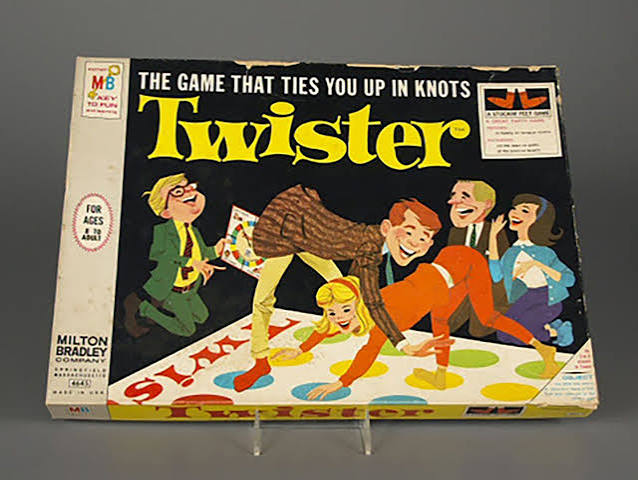
Sears refused to carry it. Milton Bradley’s own executives argued over it internally before agreeing to ship it at all. And the packaging showed fully clothed cartoon adults standing at a polite, board-game distance from one another, which was the exact opposite of what happened the moment real players actually opened the box. Twister launched in the spring of 1966 as one of the most contested toy releases in Milton Bradley’s history, according to Smithsonian magazine’s account of the game’s rocky debut, and it took one specific late-night television appearance to turn that reputation around.
A Shoe Polish Promotion That Became a Game
Twister didn’t start as a board game at all. According to designer Reyn Guyer’s own account of the game’s origin, published on his own site, he first dreamed it up in 1965 while working at his family’s design agency, imagining it as a mail-away promotion for Johnson’s Wax shoe polish: customers would mail in a dollar and a box top, and get back a game they could play on their own living room floor. That first version was a cardboard mat with 24 one-foot squares, and when Guyer tested it on colleagues in the office, he noticed something that would define the entire product: people having fun specifically because the game forced them physically close together on the floor.
The shoe-polish tie-in fell through, but Guyer kept refining the idea with collaborators Chuck Foley and Neil Rabens. Foley arranged the squares into neat rows of colored circles, and Rabens suggested working in hands as well as feet, turning a simple stepping-stone game into a full-body tangle. The team’s working title for the finished concept, before Milton Bradley ever touched it, was “Pretzel: the game that ties you up in knots.”
The Internal Fight at Milton Bradley
Milton Bradley executive Mel Taft saw the game’s potential right away when Guyer and Foley pitched it. Not everyone in the room agreed. Per Smithsonian’s reporting, other Milton Bradley executives worried openly that a game built around players wrapping their limbs around each other, sometimes literal strangers at a party, would read to parents as inappropriate rather than playful, with internal skeptics framing the whole concept as uncomfortably suggestive for a family product. That internal argument nearly killed the release before it started.
Retailers weren’t much more welcoming. Buyers previewing the game at the 1966 American International Toy Fair reacted with open skepticism, and Sears, the single most powerful retail buyer in the country at the time, declined to stock it at all, judging it too risqué for its shelves. For a mainstream board game in 1966, a Sears rejection was close to a death sentence.
One Night on The Tonight Show
The rescue came from television, and specifically from a Milton Bradley salesperson’s pitch to book the game on the country’s biggest late-night stage. About a month after its shaky launch, Johnny Carson and actress Eva Gabor played Twister together on The Tonight Show in May 1966, tangled up on national television in front of millions of viewers, according to Smithsonian’s account of the broadcast. What retailers had worried would look inappropriate instead played as genuinely funny and charming once America watched two adults laughing their way through it on live TV. The game’s reputation flipped almost overnight.
From Rejected to Record-Setting
By 1967, Milton Bradley had sold more than three million copies of the game, a staggering reversal for a product Sears had refused to touch just a year earlier. Sears itself eventually reversed course and began carrying it once the demand became impossible to ignore. What had briefly looked like a career-ending misstep for the designers who dreamed it up on an office floor became one of the best-selling games in the company’s history, and the game’s basic pitch, contort your body into a knot without falling down, has barely changed across the nearly six decades since.
The lesson Milton Bradley took away wasn’t really about game design. It was about who gets to decide what looks scandalous versus silly, and how fast that verdict can flip once the right audience sees it for themselves.
Guyer, Foley, and Rabens went on to found their own toy company, and the mat game they’d once called Pretzel eventually earned Twister a spot in the National Toy Hall of Fame in 2015, credited for a design so simple it fit on a folded plastic sheet and still managed to talk generations of otherwise cautious American living rooms into a pile on the floor.

Leave a Reply