

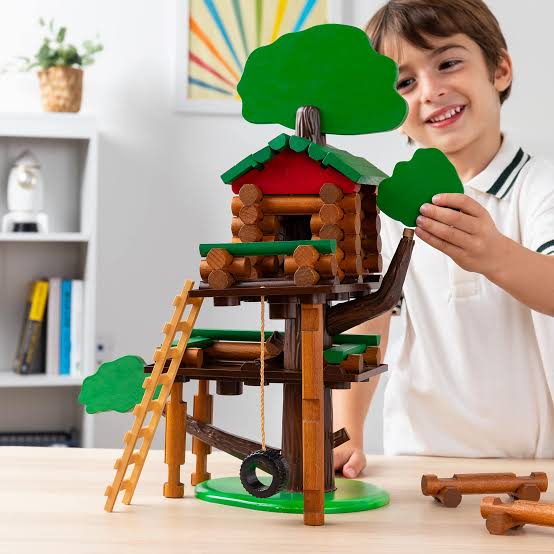
John Lloyd Wright filed for a toy patent in 1920 built around a real structural principle: interlocking, notched timbers that could flex and hold together under stress no glue-and-peg cabin set could match. He didn’t invent that principle. His father did, on a hotel in Tokyo built to survive earthquakes.
A Toy Born on a Tokyo Job Site
Between 1917 and 1918, John Lloyd Wright worked in Japan as chief assistant to his father, Frank Lloyd Wright, on the design and construction of Tokyo’s Imperial Hotel. The hotel’s foundation and structure relied on interlocking log-beam construction engineered specifically to flex rather than shatter during seismic activity — a design choice that would prove itself in dramatic fashion when the building survived the 1923 Great Kanto earthquake largely intact while much of Tokyo collapsed around it. According to the Smithsonian’s Lemelson Center for the Study of Invention and Innovation, it was this direct exposure to his father’s earthquake-resistant engineering that planted the idea for a children’s building toy based on the same interlocking-log principle.
From Red Square Toy Company to a Patented Cabin Kit
Back in Chicago, the younger Wright started developing the idea into an actual product. According to Chicago manufacturing history records, Wright created the toy in 1916 at age 24, machining flat notches into the ends of small redwood logs so they could stack and interlock without sliding apart — the same structural logic that held up the Imperial Hotel, scaled down to a child’s hands. He initially manufactured the toy under the name Red Square Toy Company during World War I, then renamed the operation John Lloyd Wright, Inc. a few years later, reportedly to distance the brand from any association with Communist symbolism carried by the word “red.” Wright formally patented the invention as U.S. Patent 1,351,086, titled “Toy-Cabin Construction,” granted on August 31, 1920. In his own patent filing, Wright described the goal as producing an educational toy calculated to develop a child’s constructive inclinations.
Named for Lincoln, Sold Through Marshall Field’s
Wright branded the toy Lincoln Logs, leaning into log-cabin imagery associated with Abraham Lincoln’s frontier childhood rather than any connection to Lincoln himself. Early packaging paired Lincoln’s portrait with an illustrated cabin, and 1925 advertisements carried the tagline “Interesting playthings typifying the spirit of America.” Chicago’s Marshall Field’s department store became an early and important retail partner, stocking the toy for local shoppers well before it reached national distribution. By 1934, marketing materials were explicitly pitching the toy to “boys and girls” alike — a notably gender-inclusive pitch for a construction toy in that era, according to the same Chicago manufacturing archive.
From a Humboldt Park Factory to Playskool
Production scaled up through the 1940s and into the 1960s at a factory at 1750 N. Lawndale Avenue in Chicago’s Humboldt Park neighborhood, a building that had previously housed the Harmony Instrument Company. Wright sold the Lincoln Logs patent and business to Playskool in the early 1940s, and ownership continued changing hands over the following decades: K’NEX Industries acquired the brand in 2014, and licensing shifted to Basic Fun, Inc. in late 2017, with sets now manufactured by Pride Manufacturing in Burnham, Maine. Lincoln Logs earned formal recognition as a design landmark in 1999, when the National Toy Hall of Fame inducted the toy alongside a small handful of playthings considered genuinely foundational to American childhood.
A Toy That Actually Teaches Structural Engineering
What separates Lincoln Logs from most nostalgia-shelf toys is that the underlying mechanism isn’t decorative — it’s functional engineering shrunk to tabletop scale. The notch-and-stack system Wright patented is a genuinely simplified version of timber-frame construction techniques that architects still study, and the fact that it traces directly back to a building that survived a major earthquake gives the toy a credibility most construction sets never earned. Generations of kids who spent afternoons stacking those little red-brown logs into cabins were, whether they knew it or not, replicating a structural idea good enough to keep a Tokyo hotel standing.

Leave a Reply