

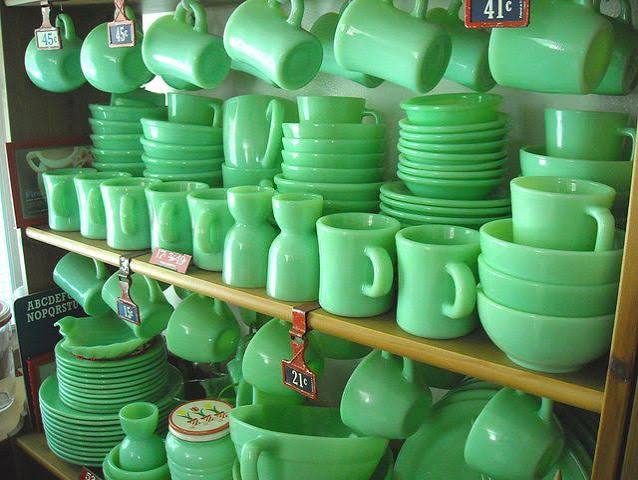
A milk-green mixing bowl that cost a dollar at a church rummage sale sold for close to eleven hundred dollars once a collector recognized the maker’s mark on the bottom. That’s not an outlier fantasy — it’s the kind of number real Fire-King Jade-ite sets have actually fetched, and the reason thrift shoppers have started flipping over every opaque green dish they find before dropping it back on the shelf.
It Isn’t the Same Green as Grandma’s Depression Glass
Jade-ite as a color predates Fire-King by more than a decade — McKee Glass Company and Jeannette Glass were both selling their own opaque green lines in the early 1930s, mixing recycled green glass scraps into a milk-glass base to get that cloudy jade tone. Anchor Hocking didn’t launch its version, marketed under the Fire-King name, until 1945, arriving “over a decade after competitors McKee and Jeannette” according to the glassware’s documented production history. Late to the party or not, Fire-King ended up dominating it.
A Wartime Color With No Radioactive Secret
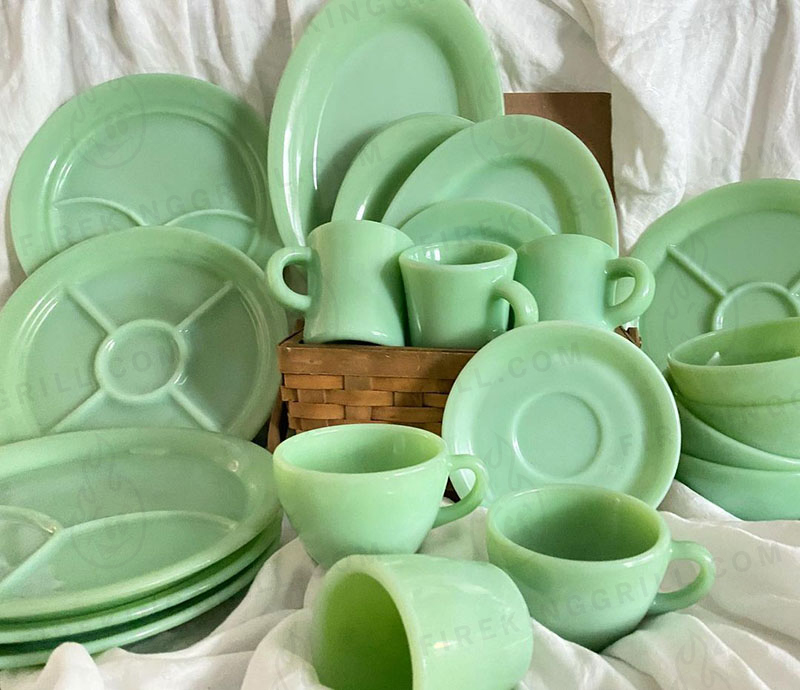
One persistent thrift-store myth is that vintage green glassware glows under a blacklight because it’s radioactive. Some Depression-era glass genuinely does contain uranium oxide, but Fire-King Jade-ite specifically does not — because civilian uranium use was tightly restricted in the United States between 1942 and 1958 for military purposes, Anchor Hocking’s formula skipped it entirely, getting its color instead from ordinary green cullet stirred into milk glass. That means true Fire-King Jade-ite will not fluoresce under UV light, which is actually one of the more reliable ways collectors separate it from earlier McKee and Jeannette pieces that do, as the brand’s production record lays out. The line first appeared on shelves through patterns like Alice, which Anchor Hocking distributed as an oatmeal-box premium, before expanding into Jane Ray and the heavier commercial Restaurant Ware sold to diners and cafeterias starting around 1948.
Twenty-Five Million Pieces and Counting
The scale of Fire-King’s original run is part of why it’s still turning up in thrift bins eight decades later. Anchor Hocking sold more than twenty-five million pieces of Jade-ite within the line’s first six years alone, and it became the company’s single best-selling product, according to the Jadeite kitchenware history. That kind of volume means most everyday pieces — cups, saucers, plain mixing bowls — are genuinely common and correspondingly cheap, often just a few dollars each. It’s the rarer molds and shorter production runs, like the round “ball” pitcher or the two-year-only Sheaves of Wheat pattern, that pull real money, because so much less of it ever left the factory floor.
What Actually Sells, and For How Much
Pricing data pulled from recent completed sales gives a clearer picture than the folklore does. A documented Fire-King Jade-ite collection spanning the brand’s 1945-to-1975 production window sold for around $1,100, while individual mid-tier pieces — a 1950s Restaurant Ware splash-proof mixing bowl, a 1940s butter dish, a ruffled swirl bulb bowl — have sold in the $50-to-$100 range on their own, per recent price-guide figures. Rarer restaurant-grade forms and the ball jug in particular can still command several hundred dollars or more when they’re in clean condition with an intact mold seam and legible maker’s mark, a pattern the Jade-ite production record also confirms. A full boxed set, unsurprisingly, is worth dramatically more than the sum of its plates.
How to Tell It’s the Real Thing
Most genuine Fire-King pieces carry a maker’s mark stamped into the glass base — an anchor over an “H” for Anchor Hocking — though promotional and special-order runs sometimes shipped unmarked, according to collector reference material on the line’s history. Weight and opacity matter too: original Jade-ite has a dense, almost chalky opacity rather than the slightly translucent look of some modern reproductions, and it should feel notably heavier in the hand than typical clear glassware of the same size. Anchor Hocking itself muddied the identification waters somewhat by reissuing Jade-ite in 1992 for a 50th-anniversary run and again in 2000 with new molds clearly marked “Fire-King 2000” — both legitimate, both collectible in their own right, but neither worth what an original 1940s or ’50s piece commands.
None of this requires an appraiser’s eye to start noticing. Flip the piece over, look for the anchor mark, check whether it’s the dense chalky opacity rather than a glassy translucent green, and hold it up to the light instead of a blacklight — Jade-ite doesn’t need to glow to be worth something. The next milk-green mixing bowl in the thrift bin might just be exactly what it looks like: leftover midcentury tableware that happened to survive in remarkably good company.

Leave a Reply