

Six words, first released to the public in 1954, are still doing more work for a candy brand than almost any slogan in advertising history: “Melts in Your Mouth, Not in Your Hands.” According to Journal of Antiques, that line became M&M’s official tagline in 1954, more than a decade after the candy itself first hit shelves. The man behind it wasn’t a candy executive. He was one of the most influential — and most ruthless — advertising minds of the 20th century, and M&M’s was just one stop on a career that eventually reshaped how American political campaigns talk to voters.
A Candy Born From a Battlefield Observation
M&M’s itself started with Forrest Mars, son of Mars founder Frank C. Mars, watching British soldiers eat hard-shelled candies called Smarties that didn’t melt in their hands during wartime conditions, according to Journal of Antiques. He brought that candy-coating approach back to the United States and partnered with Bruce Murrie, whose father William ran Hershey’s — a partnership that gave the new venture reliable access to chocolate at a moment when that access mattered enormously. The company launched in 1941, and its name is simply the two founders’ initials stacked together: Mars and Murrie.
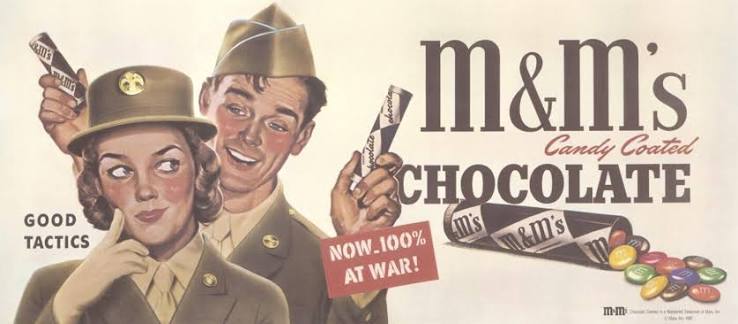
That timing is worth sitting with. A candy built specifically to withstand heat and rough handling launched right as the country entered a war that would ship millions of young men into hot, dusty, physically demanding conditions overseas. The product wasn’t retrofitted for military use after the fact — durability was the entire founding premise, which is exactly why it slotted so naturally into ration kits rather than needing a separate pitch to the armed forces at all.
Soldiers Made the Candy Famous Before Any Ad Did
M&M’s earliest distribution wasn’t really a consumer product story at all — the candies went first to U.S. military rations, prized specifically because they could survive heat and handling without melting into a mess in a soldier’s pocket. Per Journal of Antiques, public demand grew organically as those same soldiers came home and kept buying the candy that had traveled with them. Forrest Mars eventually bought out Murrie’s stake entirely, taking full ownership of the company and continuing to adjust the recipe even while keeping the original military supply contracts running.
The Ad Man Behind the Line
The slogan that outlived every other marketing decision the company made came from Rosser Reeves, an advertising executive already known for building sharp, memorable campaigns for brands like Anacin and Colgate before M&M’s ever hired him, according to PBS’s own history of advertising consultants. PBS’s account credits him plainly for “catchy slogans like ‘Melts in your mouth, not in your hands.’” Reeves wasn’t a jingle writer chasing a clever pun — he was a strategist who built his entire approach around distilling a product down to one single, ownable claim and repeating it relentlessly until it became inseparable from the brand itself.

From Candy Bags to Campaign Ads
Reeves took that same discipline directly into politics. PBS documents how he was later recruited by a group of Texas businessmen to build a Republican campaign strategy, and rather than simply crafting a counter-slogan to the Democratic message of the moment, he proposed something structurally new: a series of short, direct television spots featuring presidential candidate Dwight Eisenhower answering ordinary voters’ concerns face-on, camera-ready. That effort, titled “Eisenhower Answers America,” is now regarded as one of the earliest and most influential uses of short-form television advertising in a national political campaign — built by the same mind that had just spent years compressing a candy bar’s entire pitch into six words.
Why the Line Never Needed Replacing
Most advertising slogans get quietly retired within a decade, replaced by whatever a new marketing team decides sounds fresher. M&M’s never had to make that call. Reeves’s line has now outlasted the man who wrote it by decades, survived dozens of packaging redesigns, and remained the brand’s defining claim through the introduction of animated spokescandies, new flavors, and entirely new product lines. That’s the real signature of a Reeves campaign: not cleverness for its own sake, but a claim specific and true enough that the company built everything else around it, rather than the other way around.

Leave a Reply