

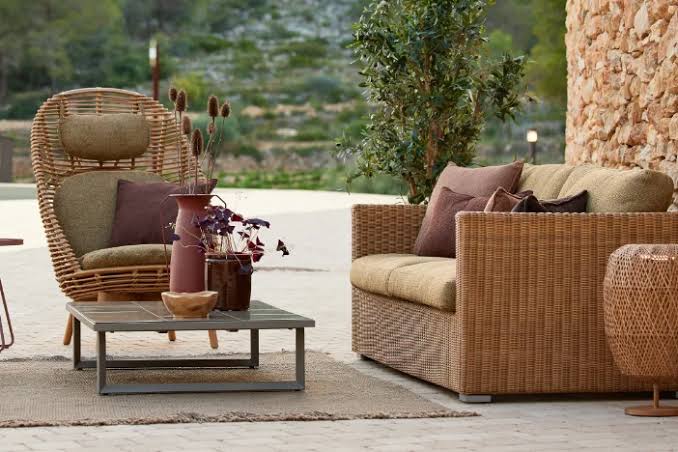
Twenty-seven percent. That’s the share of interior designers citing wicker and rattan furniture as a rising client request for 2026, according to the 1stDibs 2026 Interior Design Trends survey, based on responses from 468 professional decorators polled by Surveys & Forecasts LLC last summer. It’s a material most people associate with a specific decade — the sunroom their grandparents furnished sometime around 1975 — but wicker’s actual history stretches back roughly 5,000 years, and its current comeback has less to do with nostalgia for the ’70s specifically than with a much longer pattern of falling out of favor and getting rediscovered.

Older Than Almost Any Other Furniture Material
Woven furniture is one of the oldest categories that still exists in roughly recognizable form. Wicker pieces made from rattan and swamp grasses have been traced to Ancient Egypt around 3000 B.C., with examples surviving in Tutankhamun’s tomb, according to Patio Productions’ documented history of the material. The word itself comes from Scandinavian roots meaning “to bend,” a fitting origin for a category defined entirely by how the material is manipulated rather than what it’s made of.
An American Boom Built on a Chinese Shortage
Wicker’s first major American moment came courtesy of Cyrus Wakefield, who founded the Wakefield Rattan Company in 1851 and turned woven furniture into a genuine household staple through the Victorian era. A rattan shortage out of China in 1856 forced manufacturers to switch to flexible reed instead, which ironically opened the door to more elaborate curved and spiral designs than rattan alone had allowed. The Heywood-Wakefield Company, formed from a merger in 1897, dominated wicker production for the next three decades, turning increasingly ornate woven furniture into a fixture of American parlors and porches.

The First Time It Died, and the First Time It Came Back
Victorian wicker eventually became too elaborate for design tastes that were shifting toward simpler lines, and production had effectively stopped by 1979. But that decline overlapped with its first real revival: the 1960s and ’70s saw consumers rediscovering antique wicker specifically, embracing its ornate, textural qualities right as clean minimalism was supposedly winning everywhere else. That’s the era most people picture when they think “wicker” — the peacock chair, the hanging egg seat, the sunroom stuffed with ferns — and it happened as a countercurrent to the era’s more dominant aesthetic, not as its natural expression.
Bohemian, But Backed by Data
What’s notable about the 2026 version of this cycle is that it’s showing up in hard survey numbers rather than just editorial spreads. The same 1stDibs research groups rising interest in cane, wicker and rattan alongside materials like glass block and paper lanterns, framing the whole cluster as a signal of returning 1980s aesthetic influence rather than a single-material fad. Today’s woven furniture leans less ornate than its Victorian ancestor and less overtly bohemian than its 1970s revival, favoring cleaner silhouettes in synthetic resin and natural reed that can survive actual weather rather than just an Instagram photo.
Why Designers Are Choosing It on Purpose
There’s also a practical case for wicker and rattan that has nothing to do with looks. Woven furniture is lightweight, easy to move between indoor and outdoor spaces, and — in its modern synthetic-resin form — genuinely weather-resistant in a way the material’s original natural-fiber versions never were. For designers working on the increasingly popular indoor-outdoor rooms that blur the line between a living room and a covered patio, a material that already reads as at-home in both settings solves a real layout problem rather than just a stylistic one. That practicality is part of why 27% of professionals are reporting client demand rather than just personal enthusiasm for the look: it’s a request coming from homeowners, not just something designers are pushing.
A Pattern, Not a One-Off
Wicker has now fallen out of style and come roaring back at least twice in documented history, and both revivals landed at moments when design culture had spent a stretch chasing something rigid and uniform. That’s the real throughline connecting 1970s sunrooms to 2026 client requests: woven furniture keeps getting rediscovered by people who are tired of straight lines, not by people chasing a specific decade. The sunroom association is real, but it’s a footnote to a much older, much more repetitive story.

Leave a Reply