

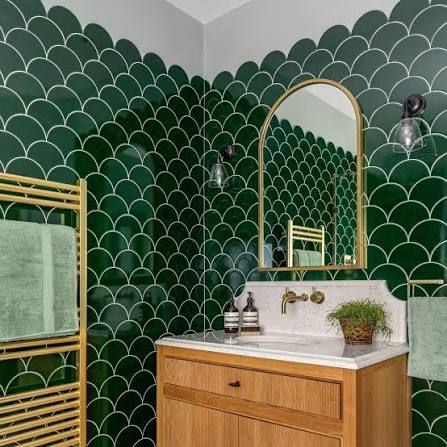
Search interest in scalloped tile has more than tripled over the past year, and arched range hoods are up 177 percent, according to Houzz’s own 2026 trend research. Rounded kitchen islands are up 123 percent. Curved peninsulas and islands are up 61 percent. Curved staircases are up 66 percent. None of these are small, isolated numbers — they’re the same shape showing up in searches for six unrelated parts of a house at once, which is usually the sign that a design language is shifting rather than a single product having a moment.
The Numbers, All Pointing the Same Direction
Houzz’s data, pulled from its own platform search activity and published in its “8 Design Trends Emerging in 2026” report, also found wave-pattern tile up 38 percent and arched pantry doors up 130 percent. Forbes’ coverage of Houzz’s broader 2026 predictions quotes the platform describing the throughline directly: “curves, arches, and scalloped edges soften spaces, while built-ins, paneling, and detailed millwork add depth and character.” That’s a fairly precise description of what a mid-century kitchen or bath actually looked like before the 2010s decided every edge in a house should be a 90-degree angle.
Why Curves Read as Retro in the First Place
The straight-line, right-angle kitchen — flat-panel cabinets, unbroken quartz slabs, boxy islands — is a relatively recent default, one that solidified through the 2010s open-concept boom. Scalloped edges, arched openings, and rounded islands all trace back further, to a mid-century vocabulary where curves were a structural flex as much as a style choice: barrel ceilings, porthole windows, and streamlined “Googie” coffee-shop architecture all used the same soft geometry Houzz’s search data is now showing a spike in. An arched range hood in particular reads as a callback to that era’s love of the rounded appliance silhouette, back when refrigerators and stoves alike had shoulders instead of edges.
Where the Curves Are Landing
Scalloped tile shows up most often as a backsplash or a shower surround, where the repeating half-circle edge catches light differently than a flat rectangle and reads almost like fish-scale shingle siding brought indoors. Arched range hoods and pantry doorways tend to anchor a kitchen’s one big architectural gesture — the piece everything else in the room is quietly built around — while rounded islands and curved peninsulas solve a practical problem retro design solved decades ago: soft corners are easier to walk past in a busy kitchen than sharp ones. Curved staircases sit at the top end of the trend, a full-architecture commitment rather than a finish choice, which is likely why that number (66 percent) trails the smaller, easier-to-swap-in tile and hood numbers.
How to Bring the Look In Without a Renovation
Not every version of this trend requires knocking out cabinetry. A single scalloped-edge tile backsplash behind a stove, a rounded mirror to replace a rectangular one, or a curved-arm chair pulled into an otherwise straight-lined room can carry the same softening effect the Houzz data is describing at a fraction of the cost and commitment of an arched hood or a full curved staircase. For anyone actually renovating, pairing a curved architectural element with warmer, saturated colors — rather than an all-white palette — tends to read as intentionally retro rather than accidentally trendy, since curves on their own can slide into a generic “soft modern” look without a period-appropriate palette backing them up.
What the Data Actually Signals
A single search-term spike is noise. Six related search terms — tile, hoods, islands, peninsulas, pantry doors, and staircases — all moving the same direction in the same year is closer to a genuine shift in what people want their houses to look like. After more than a decade of rooms designed around straight lines and flat surfaces, the appeal of a curve seems to be less about nostalgia for any one decade and more about wanting a house that doesn’t look like it was drawn entirely with a ruler.

Leave a Reply