

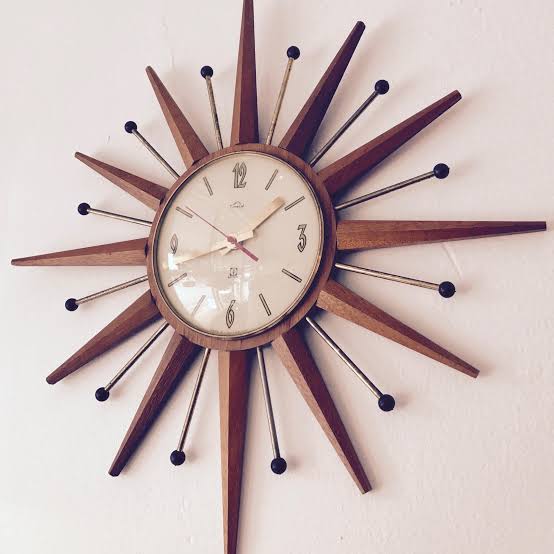
Howard Miller Clock Company commissioned George Nelson in 1947 to design a single clock collection. Nelson’s studio ended up designing more than 100 clock models over the following 35 years, and one of them, the Sunburst Clock, is still sitting in Vitra’s active product catalog nearly 75 years later, according to Vitra’s own product history page. Most mid-century furniture and objects that survive into a modern retailer’s lineup do so as a reissue, pulled back from decades of obscurity. The Sunburst Clock never really left. It has simply kept selling, generation after generation, without needing to be rediscovered first.
A Clock Designed to Have No Numbers
Nelson’s core idea for the 1949 collection was almost contrarian for a clock: leave the numbers off entirely. His reasoning, laid out in Vitra’s own account of the design brief, was that people actually read the time by the relative position of the hands rather than by matching a hand to a printed digit, and that since most people already wore a wristwatch, a wall clock’s real job had shifted from telling time to functioning as a decorative object in a room. That collection launched in 1949 with 14 original timepieces unified by that numberless logic but wildly different in shape, color and material, according to Vitra. The Sunburst Clock, with its wooden dowel rays radiating outward from a central hub like a child’s drawing of the sun, was one of the most visually direct expressions of that idea — you don’t read a Sunburst Clock so much as glance at where its rays point.
The Attribution Nobody Advertised
Like much of the output credited to George Nelson Associates, the actual authorship of individual clock designs within the Howard Miller collection is murkier than the branding suggested. Howard Miller simply assigned each design a model number rather than crediting an individual designer, and many of the studio’s most recognizable clocks, including the famous Ball Clock, are now understood to have been largely the work of Nelson’s in-house designer Irving Harper rather than Nelson personally, according to design history compiled on Wikipedia. That arrangement was standard practice at Nelson’s studio, where work went out under the firm’s name regardless of which individual designer originated a given piece. It doesn’t change what collectors are buying today, but it complicates the tidy story of a single genius sketching a sunburst on a napkin.
Preserved in a Design Archive, Not Just a Catalog
The reason any of this design history is traceable in detail is that it didn’t just live in Howard Miller’s old sales catalogs. The Cooper Hewitt, Smithsonian Design Museum holds original Nelson-era Howard Miller clocks in its permanent collection, including an Asterisk Wall Clock from the same numberless-face program, made of steel and enamel and dated to 1953, according to the Smithsonian’s collection record. Objects like that one entered museum collections specifically because they represented a genuine break from conventional clock design, not simply because they were old. Nelson’s own archive went a step further: after his death in 1986, roughly 7,400 of his design documents spanning 1924 to 1984 were acquired by the Vitra Design Museum, giving a single institution custody of the paper trail behind the entire clock program, according to Vitra.
Back in Production Since 1999
Vitra began reissuing Nelson’s clocks in 1999, and has been steadily expanding that collection since, per the company’s own product history. Rather than treating the Sunburst as a one-off nostalgia item, Vitra manufactures it using the same production standards as its current furniture lines, with quartz movements and wood sourced primarily from Poland, according to Vitra’s own materials description. That’s a meaningfully different path than most mid-century reissues take, where a design typically disappears for decades before a licensing deal resurrects it for a limited run. The Sunburst Clock’s continuous presence in Vitra’s catalog since the turn of the millennium means it has now been in active commercial production, on and off, for longer than most furniture designs ever get made at all.
A Design That Didn’t Need Rediscovering
What makes the Sunburst Clock unusual isn’t that it looks distinctly of its decade, plenty of 1950s objects do, it’s that it never had to wait for a design revival to find buyers again. A collection built around the idea that a clock’s real job is decorative, not functional, turned out to be remarkably durable exactly because that argument never really went out of date.

Leave a Reply