

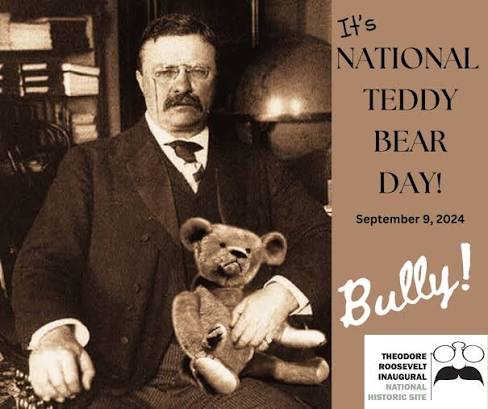
On November 14, 1902, President Theodore Roosevelt was hunting near Onward, Mississippi, as a guest of Governor Andrew H. Longino, and he had not caught a single bear all trip, according to the National Park Service. When his hunting party finally cornered and clubbed an exhausted, roughly 235-pound black bear and tied it to a willow tree so the president could get an easy shot, Roosevelt refused. He said he couldn’t take pride in shooting “an old, tired, worn-out bear that was tied to a tree,” according to the Smithsonian Institution’s own account of the incident, calling the setup unsportsmanlike and declining to fire. Three days later, on Monday, November 17, 1902, a cartoon based on that refusal ran in the Washington Post, according to Smithsonian magazine. A Brooklyn candy shop owner saw it and stayed up that night sewing a bear out of plush velvet. Neither man had any idea he’d just started a toy industry.
A President’s Refusal, Drawn for the Papers
Political cartoonist Clifford Berryman had been covering the trip for the Post and turned Roosevelt’s refusal into “Drawing the Line in Mississippi,” a cartoon that used the spared bear as a visual pun on an unrelated Mississippi-Louisiana boundary dispute the president was also handling that week, according to Smithsonian magazine. The image caught on immediately and Berryman kept redrawing it in the months that followed, and the bear in his pen got smaller and more endearing with each pass, eventually settling into something closer to a cub than the roughly 235-pound animal that had actually been tied to that tree.
A Candy Shop Window in Brooklyn
Morris and Rose Michtom ran a small candy and novelty shop in Brooklyn, and Rose set to work the night the cartoon appeared, shaping plush velvet into a bear and stitching on a pair of eyes, according to Smithsonian magazine. By the next morning the bear was sitting in their storefront window with a hand-lettered sign reading “Teddy’s Bear.” Before selling any more, Morris mailed the original to the White House and asked the president’s permission to keep using his nickname. Roosevelt agreed, though he doubted, according to the same account, that a stuffed animal named after him would amount to much of a business.
From Storefront to Ideal Toy Company
He was wrong. Demand for “Teddy’s Bear” grew fast enough that the Michtoms built a full toy operation around it, and the venture became the Ideal Novelty and Toy Company by around 1903, according to a fact sheet from the Smithsonian’s National Museum of American History. That firm eventually shortened its name to Ideal Toy Company and grew into one of the largest toy manufacturers in the country, still operating under the Michtom family’s stewardship decades after the original bear left the Brooklyn storefront window. Not everyone welcomed the craze, though. In 1907, a Michigan clergyman named Reverend Michael G. Esper warned his congregation that letting girls trade their dolls for “the horrible monstrosity known as the teddy bear” would blunt maternal instinct and eventually shrink birthrates, according to Smithsonian magazine‘s account of the backlash. A Nevada paper mocked the sermon days later under the headline “Teddy Bears Rule Supreme,” and the fad outlasted the criticism easily.
Where the Original Bear Ended Up
Roosevelt’s own copy of the toy stayed with his family for six decades. In January 1964, Kermit Roosevelt’s family donated an original Teddy Bear to the Smithsonian Institution, an acquisition arranged by Benjamin Michtom, Morris and Rose’s son, who by then was running the company his parents had built from a candy-shop side project, according to the Smithsonian’s own object record. Berryman’s original cartoon, meanwhile, had actually been drawn to illustrate something else entirely — a boundary dispute Roosevelt was mediating between Mississippi and Louisiana — and the bear was only a background detail he added because the hunting trip was in the news that week. The animal was supposed to be a throwaway gag, not the point of the drawing.
A Restraint That Outlived the President
A president’s one act of restraint on a Mississippi hunting trip, filtered through a newspaper cartoonist’s pen and a Brooklyn couple’s needle and thread, is the reason a stuffed bear is still the default first toy handed to American infants more than a century later. The company the Michtoms built to meet that first wave of demand would go on, decades after Morris and Rose were gone, to become the American manufacturer of an entirely different craze toy — licensing Rubik’s Cube from its Hungarian patent holder in 1980, long after Ideal Toy had stopped being a candy-shop side project and become one of the country’s biggest toy makers. Two unrelated toy-history footnotes, one company connecting them by accident. The teddy bear itself remains proof that the biggest consumer trends sometimes start with someone simply declining to do something.

Leave a Reply