

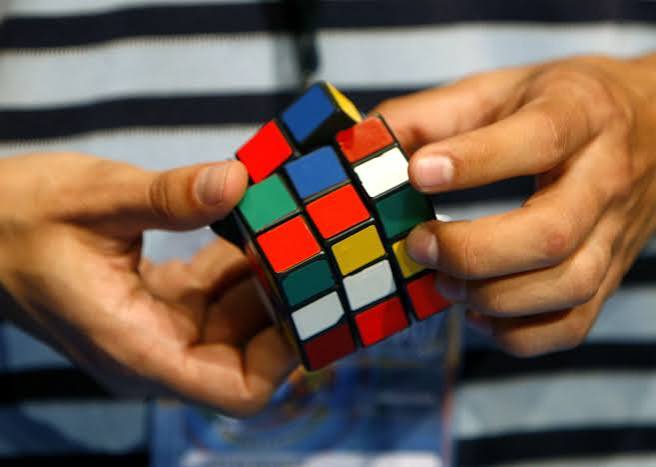
Larry Nichols came up with a cube made of eight smaller cubes, held together by internal magnets and twisting in groups around three axes, on an evening walk in the summer of 1957, according to the federal court record in Moleculon Research Corp. v. CBS, Inc. He didn’t file for a patent until March 3, 1970, and didn’t receive one — U.S. Patent 3,655,201 — until April 11, 1972, two years before Hungarian architecture professor Erno Rubik built his own version of a twisting cube. Nichols’s employer had already tried to interest Ideal Toy Company in the puzzle years before Rubik’s Cube existed. Ideal said no. When Ideal’s Rubik’s Cube became a global sensation in the 1980s, Nichols’s patent was still sitting there, unexpired, and his company sued.
A Patent Nobody Wanted
Nichols assigned his 1972 patent to Moleculon Research Corporation, the firm he worked for, and Moleculon tried the straightforward path first: it sent Ideal a general description of the twisting-cube concept and asked if the company wanted to license it, according to the same district court record. Ideal passed. The puzzle sat unlicensed and unmarketed for most of the 1970s while Rubik, working independently in Budapest with no knowledge of Nichols’s patent, developed his own 3x3x3 version to help his students visualize three-dimensional movement. Ideal licensed Rubik’s design from the Hungarian state trading agency Konsumex and introduced it to American stores in February 1980, and the court record is explicit that Ideal never knew Nichols’s puzzle existed when it did.
Independent Invention Doesn’t Matter to Patent Law
That distinction — that Ideal copied nothing — turned out to be legally irrelevant. Patent infringement doesn’t require copying, only that a competing product falls within a patent’s claims, and in 1984 a U.S. District Court in Delaware ruled that Ideal’s cube puzzles did exactly that. The Federal Circuit Court of Appeals took up the case in 1986 and split the difference: it affirmed that Ideal’s 2x2x2 Pocket Cube infringed Nichols’s method and apparatus claims, but vacated the finding as it applied to the 3x3x3 and 4x4x4 versions and sent that piece back down for another look, according to the appellate opinion published by Digital Law Online. The smaller Pocket Cube — closer in scale to what Nichols had actually sketched out in 1957 — was where his claim held.
A Win, Shrunk Down on Appeal
The district court entered an injunction against the infringing Pocket Cube and referred the question of monetary damages to a special master for calculation, according to the 1987 opinion recorded by Justia. CBS, which by then owned Ideal, kept fighting over the larger cubes, and on a second trip to the Federal Circuit in 1989 the court found that the standard 3x3x3 and the 4x4x4 versions — the puzzles that actually made Rubik’s Cube a household name — did not infringe after all, ruling for CBS on that narrower question and leaving each side to cover its own costs, according to Justia’s record of that decision. Nichols’s victory, in the end, applied to the smaller, less famous puzzle that carried his design most closely — not to the cube everyone actually remembers.
The Chemist Who Never Sold a Toy
Nichols never built a company around his cube the way Rubik or Ideal did. He earned a chemistry degree from DePauw University in 1958, went on to graduate work at Harvard, and spent his career as a research chemist at Moleculon in Cambridge, Massachusetts, according to biographical detail collected by Wikipedia — the same source that later credits him with inventing Poroplastic, a porous polymer used in drug-delivery and environmental cleanup applications, in 1973. He built a working prototype of his twist cube by 1968, two years before he got around to filing the patent that would eventually put him in federal court. The puzzle was a side project for a man whose real professional output was industrial chemistry, not games.
The Idea That Beat the Toy
The lawsuit that followed didn’t rewrite the Rubik’s Cube’s popular history — Ideal’s version stayed on shelves, Rubik’s name stayed on the box, and most buyers in the 1980 toy aisle had never heard of Larry Nichols. But it did settle, on the federal legal record, that the underlying twisting-cube mechanism had an American inventor whose paperwork predated the Hungarian one by years, and that a court had found at least one version of Ideal’s bestselling puzzle infringed it. Some inventions get remembered for what they became. Nichols’s case is one of the rarer ones remembered for what a court decided it had been first — a distinction that outlasted him; he died in Massachusetts in 2022, at 82, having spent six decades as the answer to a trivia question almost nobody thought to ask.

Leave a Reply